In January 2024, aiXplain described a problem familiar to anyone who has watched a promising software project acquire a life of its own. Its machine-learning pipelines kept breaking. Changes to Python dependencies caused trouble. Data scientists wanted to test locally; their infrastructure kept pulling them into Kubernetes. The machinery meant to help them work had become another job.
- Build agents visually in Studio or through the SDK; use Omni to coordinate work and Koder to write code.
- Set permissions, spending limits, and checks around agent actions.
- Choose managed cloud or enterprise deployment on your own infrastructure.
The team moved from Kubeflow to Flyte, gradually: prove the replacement, translate workflows, validate them, then retire the old pipelines. It reported less maintenance and cheaper testing. The lesson was wonderfully ordinary. A system can have the right capabilities and still make its users miserable. That small engineering confession helps explain the company’s much larger wager.
01 The work around the intelligence
aiXplain sells the infrastructure surrounding AI agents: the software that connects models to tools and data, coordinates their work, and governs their behavior. An agent might retrieve a document, query a database, ask another agent for help, or draft a customer response. Somebody must decide which of those actions it may take. Somebody must pay for them.
Founder Hassan Sawaf arrived with experience at Amazon, Meta, eBay, and Leidos, and a background in language technology. The founding proposition was access: useful AI resources existed, but assembling them into working applications required specialist knowledge. Today that proposition includes a second concern. Once software starts choosing its own steps, access needs a chaperone.

In its April 2023 funding announcement, aiXplain described an $8 million seed round led by Transform VC and Calibrate Ventures. Another $6.5 million pre-Series A followed in July 2024, led by Aramco-backed Wa’ed Ventures. The funding story fits the product story: making AI usable across markets, rather than assuming every buyer has a large internal research department.
“The best infrastructure disappears.”
Hassan Sawaf · Founder & CEO
02 Give the agent a job description
There are several doors into the platform. Studio gives business users a visual way to configure agents, their goals, and their tools. It avoids requiring them to draw every execution path. Developers can use the SDK and APIs. Agents saved through one route remain accessible through the other, an appealing arrangement for teams where the person who understands the problem is not the person writing Python.
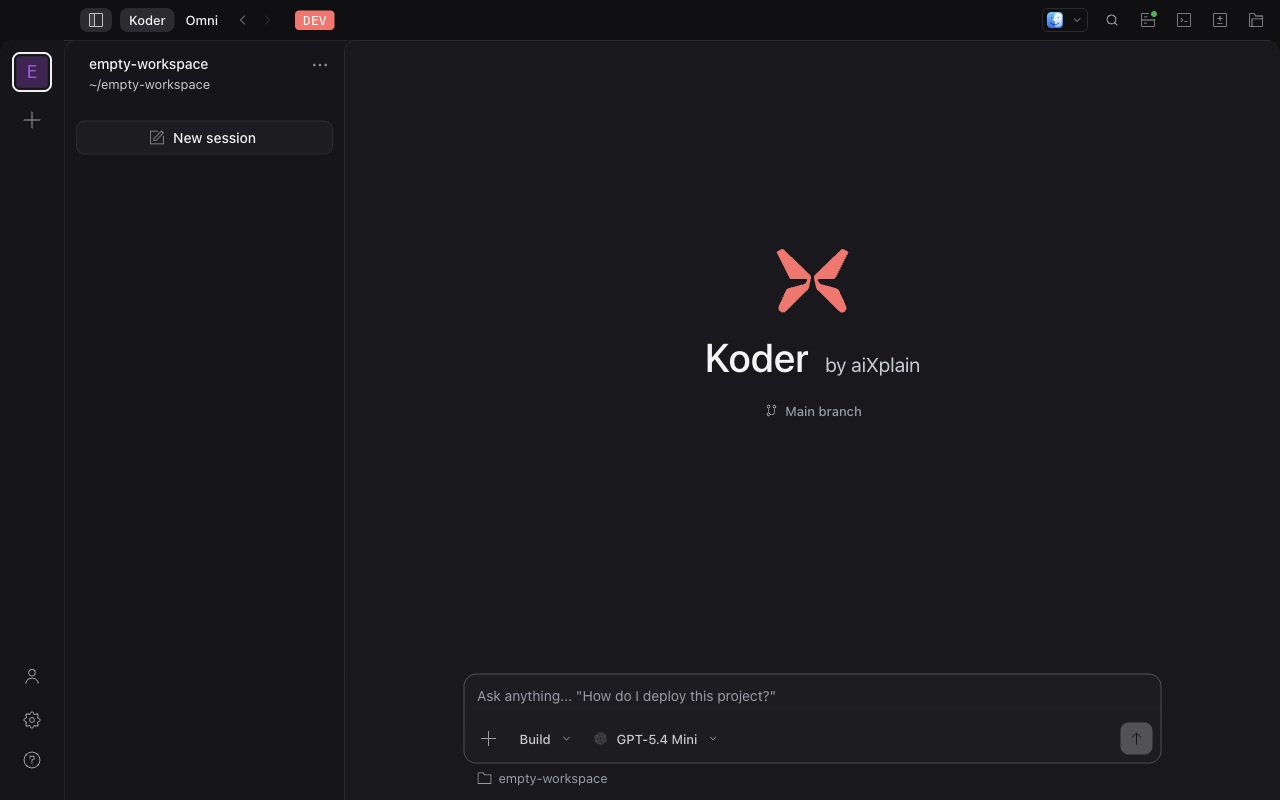
Omni is the work coordinator. Its product examples include checking renewals, reconciling invoices, and preparing recurring reports. Koder handles coding in a desktop or terminal environment, with repository context, tools, model selection, and review. The marketplace supplies models and integrations; retrieval infrastructure connects agents to documents and structured data. Together, these products address the awkward distance between a plausible answer and completed work.
Consider a supplier-invoice assistant. Reading a contract, checking an order, and flagging a mismatch could belong to its assignment. Approving payment might require a person. That distinction is the product’s real subject. aiXplain documents runtime validation, access controls, and human approval checkpoints. Its system agents have unusually candid names: Inspector checks behavior; Bodyguard enforces permissions. The vocabulary is almost a miniature office comedy.
03 Arabic belongs in the architecture
The customer picture is more interesting than a wall of logos. Translated described using aiXplain for data sourcing and machine-learning development in the 2023 announcement. Slide described a prototype to assist claims examiners. Treatment.com AI announced a partnership in April 2024 to make its Global Library of Medicine accessible through the marketplace and explore multilingual applications. These are distinct jobs, united by the difficulty of joining specialized information to usable software.
Language is a particular point of expertise. aiXplain’s documentation addresses Arabic throughout the agent stack, including right-to-left text, diacritics, tool calls, and mixed Arabic and Latin content. A regional headquarters in Riyadh gives that emphasis a commercial home. Language support here includes the plumbing, where seemingly minor text-handling mistakes can spoil an otherwise sensible system.

In September 2026, aiXplain published its Syriatel partnership announcement: Arabic-first AI infrastructure intended for a telecom network with more than 12 million subscribers. That number describes the network the agreement targets, not proven adoption of aiXplain agents. It nevertheless shows where the company wants to compete: systems serving institutions and populations, with local requirements built into their design.
04 The bill follows the work
The business model combines usage charges, team subscriptions, and custom enterprise deployments. The current pricing page offers a seven-day trial, followed by Core pay-as-you-go top-ups starting at $10. Scale costs $75 per seat each month, with credits included. Agents consume paid models and tools and carry a service fee. A seat price therefore gives a starting point; workload determines the rest.
Enterprise customers can arrange VPC, on-premises, or air-gapped installations. That choice matters when documents and operations must stay within a particular environment. It also creates responsibilities: hardware, integration, support, and evaluation still need owners. Koder’s documentation is refreshingly specific about local work: choosing a cloud model sends context to that provider, and network tools may send data outside the machine.
05 Start with one small permission
Alternatives include Amazon Bedrock’s agent offerings, Microsoft Copilot Studio, frameworks such as LangGraph and CrewAI, and an internally assembled stack. aiXplain’s pitch combines model portability, governance, deployment choice, and multilingual capability. Those are purchasing criteria to test, rather than grounds for declaring a winner. The relevant question is whether the combination removes enough integration work for your particular team.
A useful experiment is modest: choose one recurring task, give it a small set of approved tools, define what needs human approval, and inspect execution traces and costs. Test missing records and contradictory instructions. If a fixed script already does the job reliably, adaptive orchestration may add needless complexity. If permissions are vague or the underlying data is poor, a more elaborate agent will inherit the confusion.
The portable lesson from aiXplain is to judge the whole working arrangement: people, models, tools, and authority. Its own pipeline migration began when the team noticed the arrangement was slowing them down. An enterprise buying agents should keep the same standard. The software ought to earn its permissions by making a bounded piece of work easier to trust.