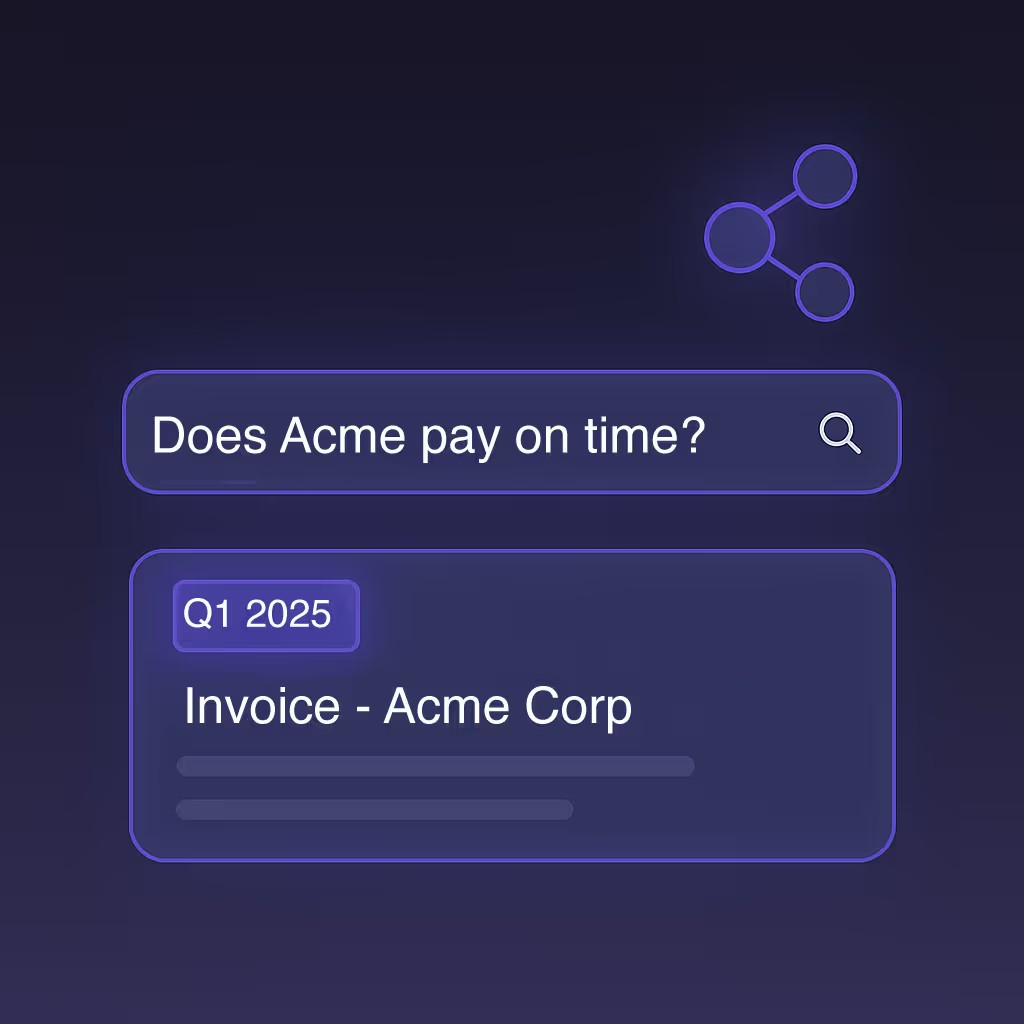
A company can lose its memory without losing a single file. The drawings remain. The emails remain. Somewhere, a presentation explains why an engineer rejected a particular design. But the engineer has retired, the presentation has an unhelpful filename, and the next person starts again. Corporate amnesia is often an access problem masquerading as a storage problem.
- Allganize connects company knowledge to search, document analysis and automated tasks.
- Its Alli products can run in the cloud or inside a company’s own infrastructure.
- The practical test: can an employee find, check and use an answer from real internal material?
The archive has an appointment with retirement
Geospace Technologies, the sensing and instrumentation manufacturer, supplies a useful example. In Allganize’s account, engineering knowledge was scattered across email, presentations and file shares. Retirements threatened to make that knowledge harder to recover. The proposed AI project began with approximately 10GB for a cloud proof of concept, with on-premises production as the destination. The wider archive presented a potential scope of 500TB.
That distinction matters. A pilot dataset and a company archive are different things. The case study describes a phased plan and expected benefits; it does not establish that the entire archive became searchable. What it does reveal is the buying motive: make old expertise available to new people, while protecting intellectual property and export-controlled information.
500TB potential enterprise scope · a plan, not a completed-ingestion claim
People buy cars, not engines
Allganize began in 2017 with Changsu Lee, Kibin Shin and Yasuo Sato. Its early work covered natural-language cognitive search, the Alli taskbot and consulting. Offices followed in Seoul and Tokyo. Headquarters functions subsequently moved to Japan, while Houston became the base for its US business. That geography reflects an enterprise business built across three markets rather than around a single Silicon Valley launch.
Lee had already built a mobile analytics company, 5Rocks, which Tapjoy acquired. In a 2024 interview, he described learning more about deep learning during his time at Tapjoy. His explanation of Allganize’s strategy was pleasingly mechanical: the language model is the engine; the application is the car. Buyers want something they can drive to a destination.
“People are buying cars, people are not buying engines.”
Changsu Lee · January 2024 interview
The distinction helps explain the product direction. Allganize wraps models in applications tied to documents, business systems and ordinary work. An employee looking for a policy needs an answer grounded in the employer’s policy. A procurement team needs requirements extracted from its actual tender. General fluency is useful, but context pays the invoice.
Two doors into the same paperwork
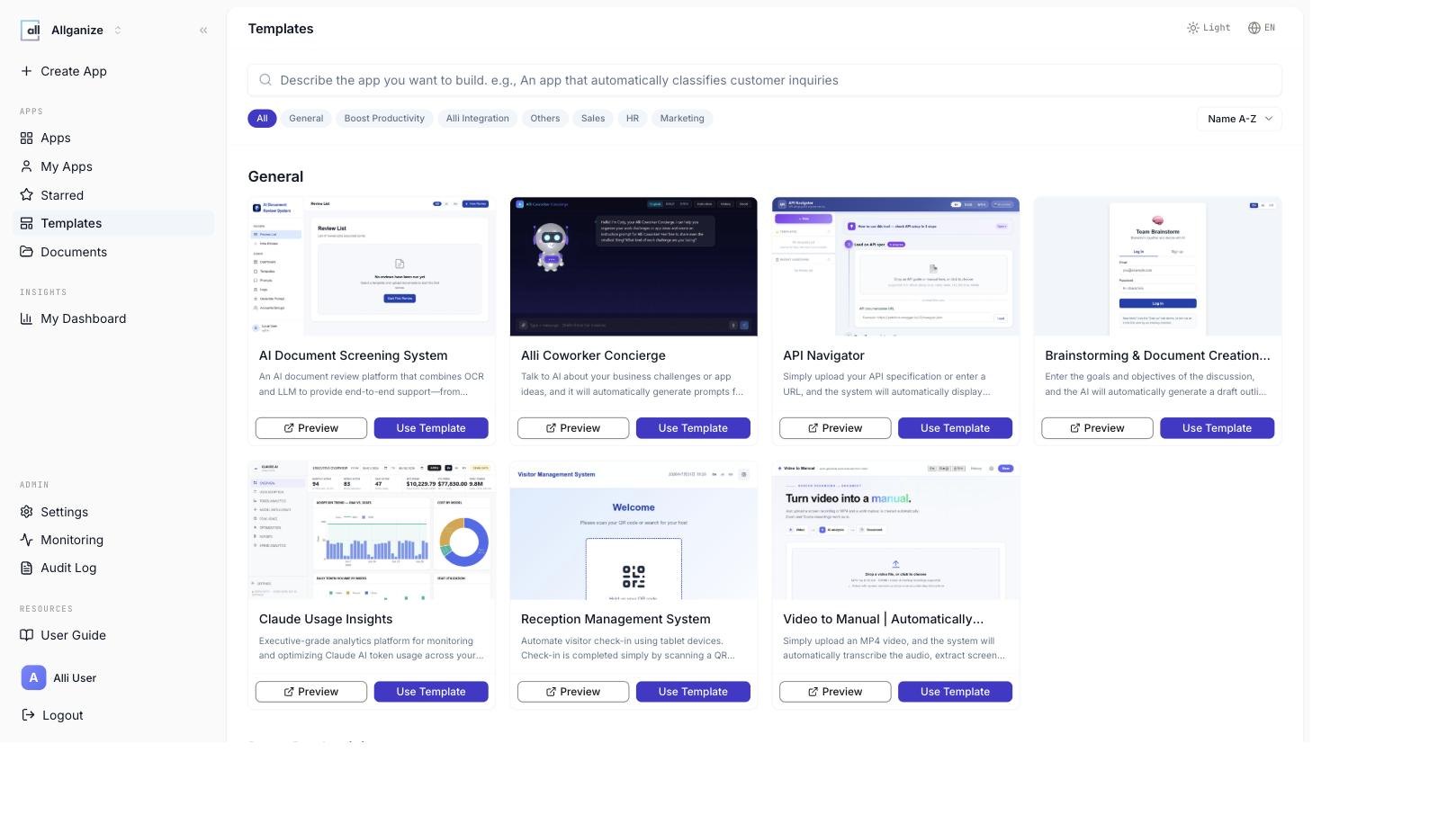
The current product pitch centres on Alli Coworker and Alli Works. Coworker lets users describe apps and agents in natural language, then run them on the web or through Slack and Microsoft Teams. Works handles document and knowledge tasks such as contract review, proposal requests and guideline checks. Both sit within a shared platform that supports cloud, on-premises and air-gapped configurations.
Coworker’s operating controls deserve as much attention as its app builder. Its product page describes separate viewing and editing permissions, deployment history, usage tracking and budgets. The interesting moment comes after somebody makes a useful app: who owns it, who can see it, and who pays when the whole department starts using it?
The Works suite also includes document classification and relationship mapping, an AI usage reporting module, and a desktop client. Enterprise Deep Research, launched in May 2025, combines internal information with external knowledge in structured reports. These capabilities target the handoffs between finding material, interpreting it and producing something colleagues can use.
A lost object is a workflow problem
Tokyo Metro offers a less abstract use case. Its customer service centre receives approximately 250,000 inquiries annually, according to Allganize’s announcement. Its FAQ chatbot struggled with varied questions, while lost-property emails could require repeated follow-ups. The planned system combines broader chatbot answers, conversational collection of lost-item details and draft replies for service staff.
Consider the modest intelligence involved in asking the next useful question. A lost-property inquiry needs enough detail for a search. An email response needs relevant information and a proposed reply. The appeal lies in joining those steps. Allganize’s market includes manufacturers, banks, insurers and public-service organisations with similarly awkward combinations of documents, systems and access rules.
The bill follows the deployment
Allganize sells software and implementation services to businesses. Its English Coworker offer advertises free starting credits, then payment for token usage without seat fees; enterprise and self-hosted terms are custom. The Japanese Coworker page separately lists monthly fees from ¥300,000 and an initial ¥300,000 fee, excluding tax. Geography and contract scope therefore belong in any price comparison.
The company announced a roughly $20 million Series B in 2023, taking its stated cumulative funding to approximately $35 million. Its application-first approach competes with alternatives including Glean’s knowledge and agent tools, Microsoft Copilot Studio’s workflow builder, and in-house development. Permissions and no-code creation alone are not exclusive advantages. Allganize’s particular proposition combines those features with document work and deployment inside restricted environments.
Even private AI needs a mechanic
Keeping AI inside the network brings maintenance work. Allganize’s own anonymised deployment accounts describe a newer GPU configuration that initially ran slower until engineers adjusted serving parameters. Another account describes a parser update that caused chart-containing PDFs to disappear from indexing. The repair involved extending a downstream schema. The first visible failure was missing searchable material, not an eloquent but incorrect answer.
A practical lesson follows: test an upgrade against the files people actually use. Start with a bounded workflow, questions with known answers and permissions that can be checked. Budget for recurring infrastructure work if the deployment stays private. A team unable to maintain that stack may be better served by a managed configuration. Allganize’s wager is that company knowledge becomes more useful when retrieving it, checking it and acting on it belong to the same routine.