A GPU is easy to admire and hard to organize. It can sit idle in one data center while an AI researcher waits for capacity somewhere else. In July 2024, Prime Intellect offered a tidy answer: gather scattered computing power into an exchange. The company had integrated 12 clouds when it announced the public platform. It was a plausible business in its own right. Yet the interesting part of its story begins when the hardware stops being the whole story.
- Prime Intellect started with a marketplace for GPU compute, then built software for training models across unreliable, far-flung machines.
- Its commercial center is now Lab, where teams define tasks, evaluate agents, train them with reinforcement learning and deploy the result.
- Its open research models are demonstrations of that machinery; Ramp and Goodfire show two very different customer uses.
- The company says it had more than 6,000 customers across its stack when it announced a $130 million Series A in July 2026.
The company was founded in 2024 by Vincent Weisser and Johannes Hagemann. Weisser is chief executive; Hagemann is chief technology officer. Their early proposition was that compute had become strangely local for a resource bought and sold worldwide. A developer could rent a machine in minutes, but assembling a dependable cluster across providers was another matter. Prices, availability and network quality varied. Prime Intellect's exchange aimed to make the supply legible and accessible on demand.
A training run with a passport
The obvious objection to a global GPU pool is physics. Model training usually rewards tightly connected machines. Send updates over ordinary long-distance networks and communication can swallow the savings. So Prime Intellect built the thing its marketplace needed to be more than a booking desk: distributed training software that could survive weak links and disappearing nodes.
INTELLECT-1 was the proof. Released in November 2024, the 10-billion-parameter model was trained over 42 days using machines in five countries and three continents, with as many as 112 H100 GPUs at once. Nodes joined and left during the run. The team's technical report described a system that reduced communication bandwidth by about 400 times compared with conventional data-parallel training at that scale. Those figures come from the company's experiment, not a guarantee for every workload. They were enough to make a serious point: a useful cluster need not always occupy one building.
There was a snag inside that achievement. A process failure could still stall an entire collective communication program. Prime Intellect later introduced PCCL, its collective communications library, to address the fragility and throughput cost it had met during INTELLECT-1. That is the less glamorous side of the open compute dream: before machines can cooperate elegantly, engineers must decide what happens when one of them stops answering.
The turn from chips to practice
The second shift came from reinforcement learning. INTELLECT-2, released in May 2025, was a 32-billion-parameter reasoning model trained with globally distributed RL. Instead of forcing every worker to march in lockstep, the system let inference workers generate reasoning attempts at different speeds. Other components verified the work, trained on the results and broadcast new model weights. This suited a mixed fleet better than a training job that expects every node to be equally fast and equally reliable.
That design suggested a larger market. Most companies do not need a general model with a grander name. They need an agent that reliably completes a narrow, expensive piece of work: searching a spreadsheet, using a browser, writing code or spotting a bad answer. To improve such an agent, a team first needs a task that resembles the real job and a way to score the result. Prime Intellect's Environments Hub and verifiers make those tasks reusable. Its prime-rl framework handles training. Its hosted platform, Lab, joins the pieces.
“You bring the task. Lab handles the training stack.”Prime Intellect, announcing Lab's public release
Lab became generally available in May 2026 after the company reported more than 10,000 training jobs during beta. A team can define an environment, run evaluations, train on reward signals, inspect the agent's attempts, deploy an adapter and run inference. Open-source components remain available to people who prefer to build and operate parts of the stack themselves. The commercial offer is the hosted version: pay to avoid assembling a small research lab before you can improve one product feature.
The spreadsheet is the sales pitch
Ramp offers a neat example because the task is so prosaic. Its Sheets agent needed answers from financial workbooks. A general model could search them, but the work was slow and costly at scale. With Prime Intellect Lab, Ramp built a training environment around 14 finance task types and trained FastAsk, a 35-billion-parameter specialist subagent. On Ramp's held-out test, the trained model reached 66.25% exact-match accuracy against 61.88% for Claude Opus 4.6, while finishing faster. Those are results for this particular spreadsheet retrieval task, under Ramp's evaluation setup. They are not a universal model ranking.
The memorable detail is smaller than the benchmark. In one example, FastAsk found a useful summary sheet, read only relevant cells and used Python once for the final calculation. Five tool calls replaced the sort of broad rummaging that makes an agent seem clever until the bill arrives. The lesson available to copy is practical: define the expensive bottleneck, turn it into a trainable environment, and test a smaller model against the real workflow before paying for a larger general model on every request.
Goodfire used another part of the stack for an almost opposite job. The AI interpretability company trained small activation probes to detect reward hacking, when an agent appears to satisfy a score while doing the wrong thing. Prime Intellect's shared environments and verifiers let Goodfire run and grade those experiments across models without rebuilding the evaluation plumbing each time. One customer sought faster answers; the other sought better alarms. Both needed the same underlying commodity: a repeatable test.
Thirty million places to make mistakes
By September 2026, the training loop had acquired another essential room. Agentic RL can require thousands of isolated environments running at once. Prime Sandboxes, which became generally available that month, are Linux microVMs built for that load. The company said roughly 30 million sandboxes had been created during its earlier use by its researchers and selected customers. The product can be used alone through a CLI or SDK, or as part of the RL suite.
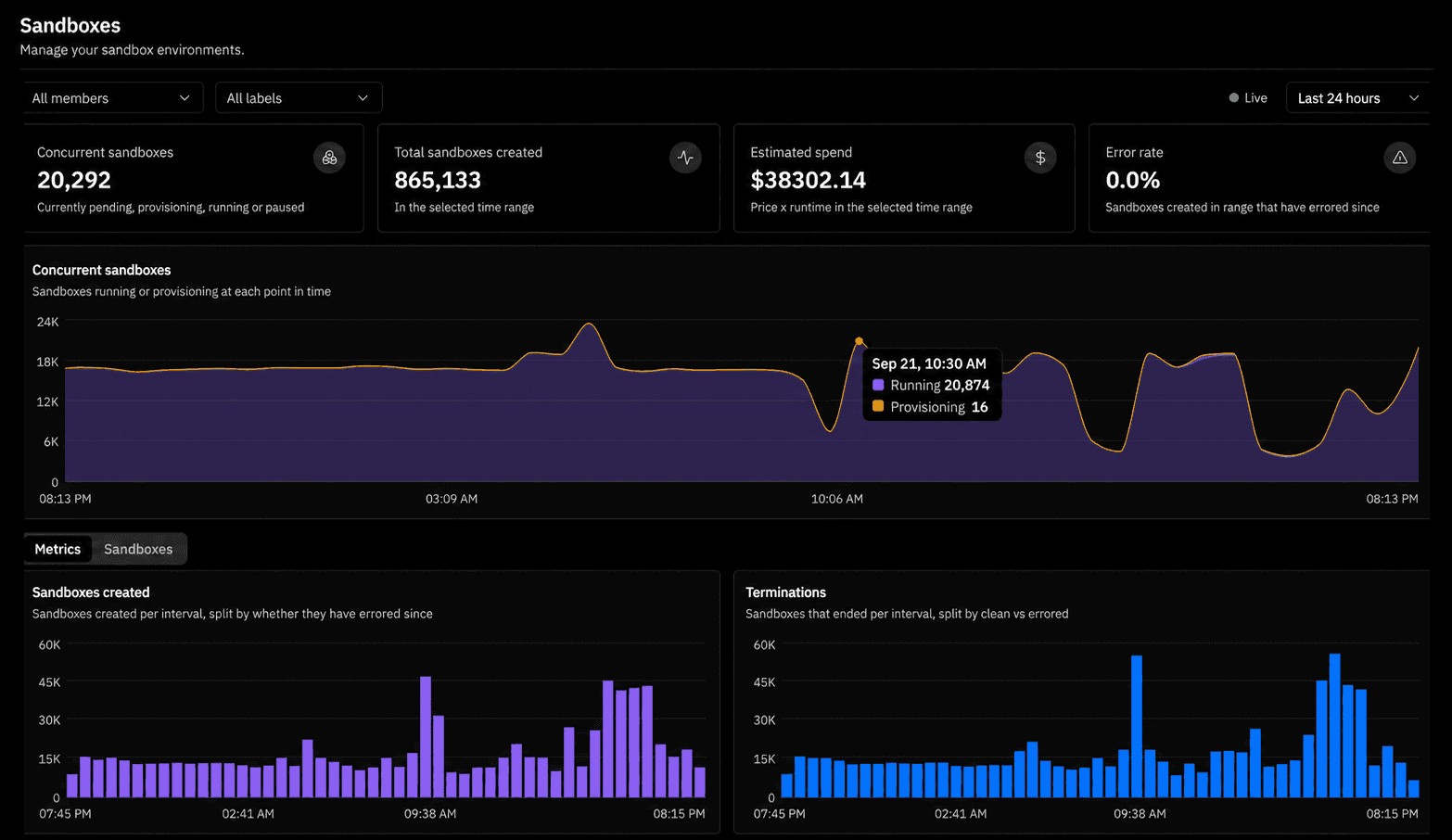
The contrast with the original compute exchange is revealing. GPUs provide the horsepower, but a training run also needs tasks, grading, safe execution, scheduling, model updates and deployment. Hyperscale clouds and GPU marketplaces can sell compute. Model platforms can host training. Prime Intellect's wager is that the same team will want those steps to fit together, especially when agents are revised continuously around a company's own data and tools.
That is also where the limits become clear. Distributed training pays off when work can tolerate slower communication and uneven hardware; tightly synchronized jobs may still prefer a conventional, close-coupled cluster. A specialized agent is useful only if the task and reward signal represent the real work. Give it a poor score to chase and it may become excellent at the score instead. The open-source tools make experimentation possible, but they do not write a company's evaluation for it.
Prime Intellect's July 2026 Series A of $130 million, led by Radical Ventures, brought its announced total funding above $150 million. The round followed a change in what the company was really selling. The exchange made GPU hours easier to find. Lab asks a more consequential question: once you have the machine, what exactly will you teach it to do?