The Work Now
Renting the world its own GPUs
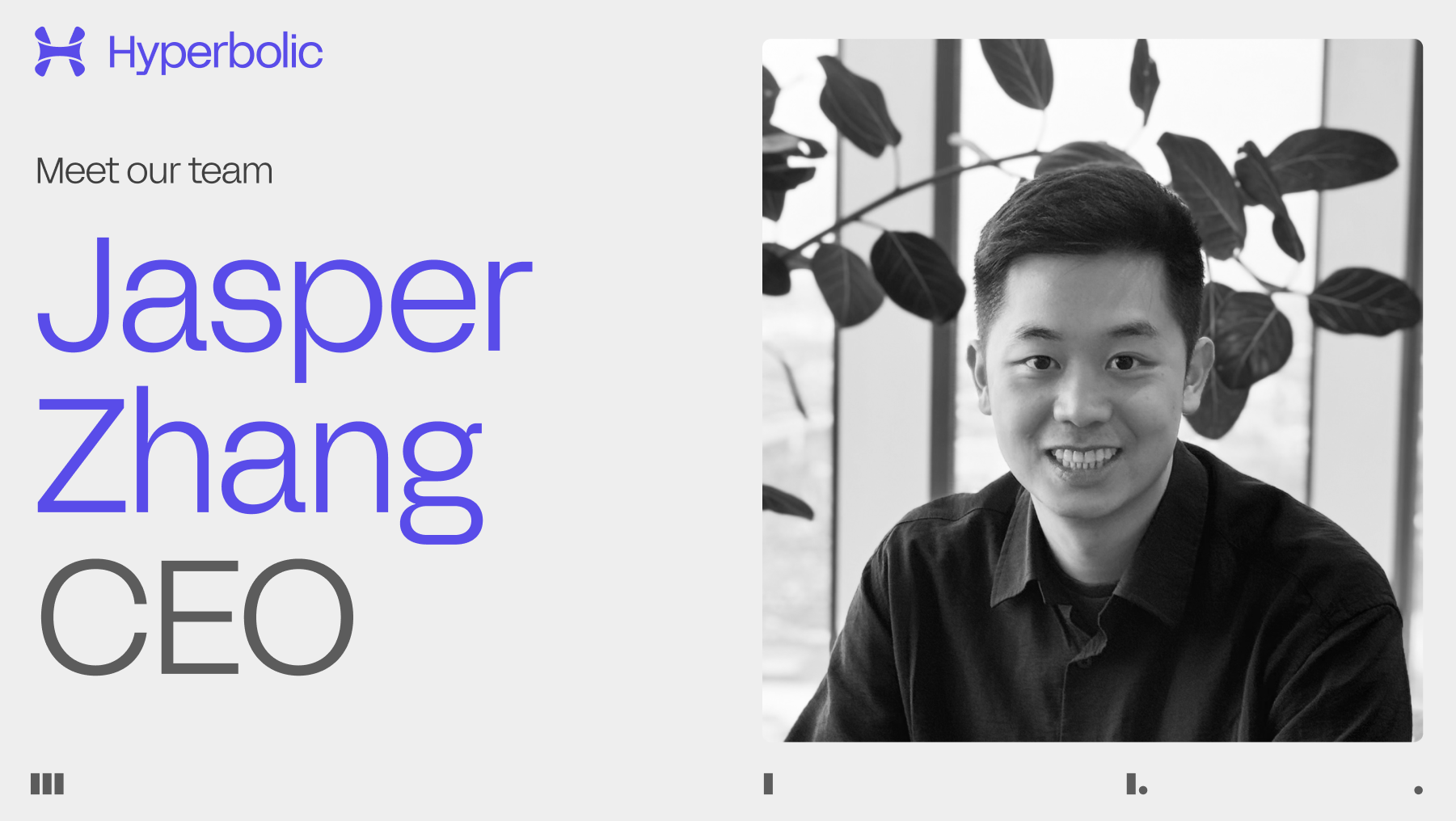
Hyperbolic is an open-access AI cloud and GPU marketplace, and Zhang is its CEO. The pitch is deceptively simple. The world is full of graphics processors sitting idle - in data centers, in labs, in places that overbought during a boom. Meanwhile, the people who most want to build with AI, students, professors, small teams, cannot afford the going rate for compute. Hyperbolic aggregates the first group to serve the second, turning scattered supply into programmable, pay-as-you-go infrastructure for training and inference.
Zhang co-founded the company in 2022 with Yuchen Jin, a computer scientist out of the University of Washington. From their separate vantage points in startups and academia, both had watched good ideas die on the vine for want of hardware. The company has since aggregated global GPU supply, hosts open models from Llama on down, and sells inference by the token. By late 2024 it had raised roughly $20 million in total, closing a Series A.
The distinction Zhang keeps returning to is the one most people gloss over. Open source, he argues, is not the same as open access. You can publish the weights of a frontier model to the entire planet, and it still does nobody any good if running it requires a cluster only a handful of firms can afford. The model is free. The compute is not. Hyperbolic exists in that gap.
Open source does not mean open access.
— Jasper Zhang
The Origin
A childhood spent racing his mother
Before the GPUs, there were the problem sets. Zhang grew up in China competing at mathematics, and the first opponent he remembers is his own mother, the two of them racing through challenges at home. It was less a chore than a sport, and he turned out to be very good at it.
Good enough to collect gold medals at both the Chinese Mathematical Olympiad and the All-Russian Mathematical Olympiad while still in high school. Good enough, later, to place first at the 2017 Chinese Mathematics Competition of College Students, and to take two gold medals at the Alibaba Global Mathematics Competition, in 2018 and 2020. He studied mathematics at Peking University, finishing his bachelor's in 2018, then went to UC Berkeley for a doctorate.
He finished it in two years. His thesis, Guts, Dehn Fillings and Volumes of Hyperbolic Manifolds, is a study in three-dimensional topology, and it is where the company name comes from. Most people spend five years on a Berkeley math PhD. Zhang is described as the fastest to ever complete one there.
2
Years for a Berkeley PhD
The Detour
From Citadel to consensus protocols
A freshly minted math PhD has options, and Zhang took the lucrative one first. He joined Citadel Securities as a quantitative researcher, applying the same rigor he had aimed at hyperbolic manifolds to the movement of markets. It is a common landing spot for olympiad-caliber mathematicians, and by most accounts a comfortable one.
He did not stay. Zhang moved to Ava Labs as a senior blockchain researcher, where his attention turned to the performance, reliability, and security of consensus protocols and distributed systems - the machinery that lets a network of strangers agree on what is true without a referee. That question, how to trust a computation you did not run yourself, would follow him into AI.
It surfaces in Hyperbolic's research on the Proof of Sampling Protocol, a scheme for verifying AI computation cheaply. The mechanism leans on a pure-strategy Nash Equilibrium, the game-theory idea from John Nash of A Beautiful Mind. Zhang frames verification as a field that keeps reinventing itself: first consensus, then optimistic proving, then zero-knowledge proofs, and now a sampling-based approach he argues is faster, more secure, and economically feasible where the others are not.
The future of AI should not be controlled by a small group of people, but shared by everyone.
— Jasper Zhang, on why Hyperbolic exists
The Bet
Everyone wins when everyone contributes
Zhang describes Hyperbolic as a mission-driven company, and the mission is not subtle. He wants the builders and dreamers - his words - who cannot currently afford compute to be able to build anyway. A student with a research idea. A professor without a grant big enough for a cluster. A two-person startup that would rather spend its runway on people than on cloud bills.
The logic is cooperative rather than winner-take-all. Contributors put idle hardware into the network; users draw affordable compute out of it; the whole thing gets more useful as it gets bigger. It is an argument that sounds almost quaint next to the arms race of proprietary data centers, and that is rather the point. Zhang is betting the counter-position: that open beats closed if you make open actually usable.
Whether the bet pays off is an open question, and the incumbents are enormous. But Zhang has a track record of finishing things faster than anyone expects, and of choosing the harder, more principled path when a comfortable one was sitting right there. He left the quant desk. He left the research lab. He named a company after a topology thesis and pointed it at one of the largest infrastructure problems in technology.