The most honest unit of measurement in artificial intelligence may be the megawatt. Models are abstract. Chips fit in a hand. But put tens of thousands of those chips together and the abstraction becomes industrial: substations, concrete shells, cooling loops, fiber, permits and power bills large enough to redraw a town's economy. Applied Digital operates in that translation layer. It takes electricity and real estate and turns them into rooms where AI can happen.
The Dallas company calls those rooms "AI factories." The phrase is useful because it removes the cloud's soft edges. Applied Digital is not primarily selling a clever model or a monthly software seat. It designs, finances, builds and operates high-density data centers for hyperscalers and other large compute buyers. The buildings are the product. Uptime, power density and delivery dates are the features. Long leases are the business model.
A very physical answer to a digital shortage
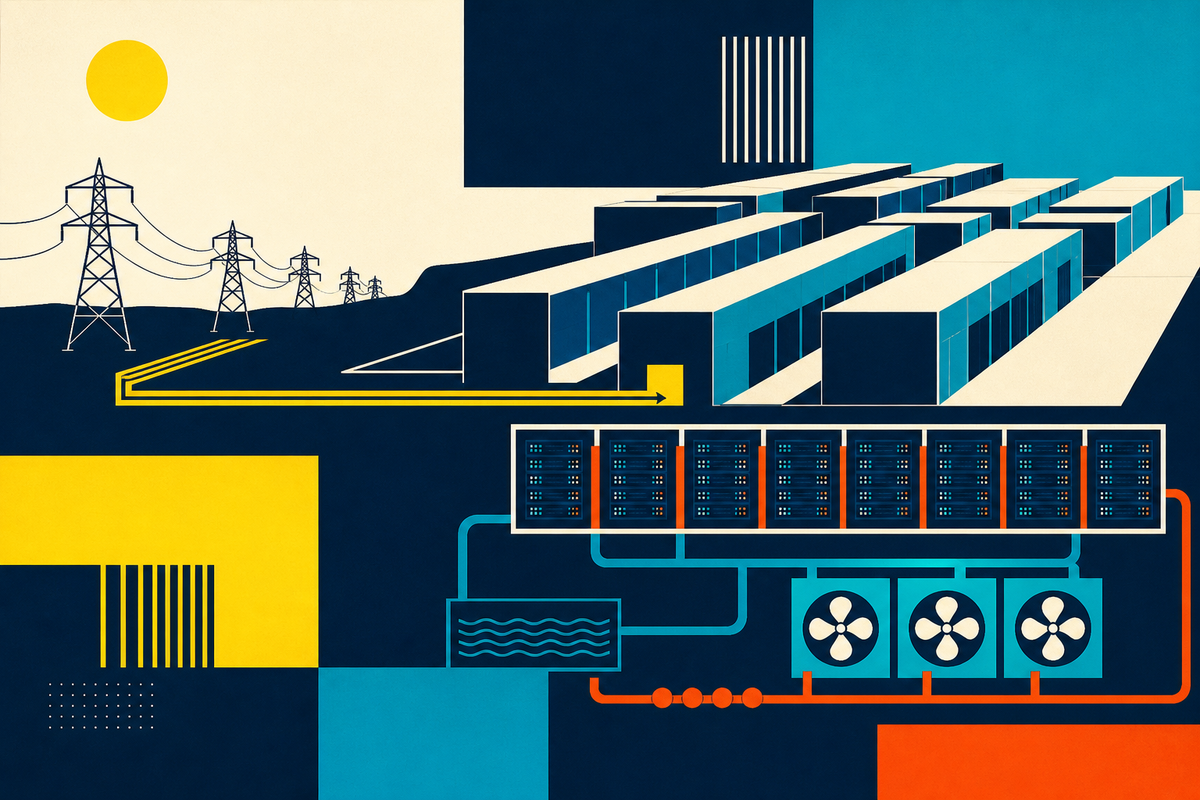
AI developers have learned that ordering GPUs is only the beginning. A dense cluster also needs a large, dependable electrical feed; networking fast enough to make thousands of processors behave like one machine; and cooling that can lift heat directly away from the chips. In established data-center markets, grid connections can take years. Conventional air-cooled halls may not support the newest rack densities without substantial redesign.
Applied Digital tries to solve those constraints as a bundle. It looks for large power positions in markets with room to build, then pairs them with a repeatable campus plan and direct-to-chip liquid cooling. Its flagship, Polaris Forge 1 in Ellendale, North Dakota, is planned around 400 megawatts of critical IT load. The first 100 MW building began operating in late 2025. In July 2026 the company announced delivery of the second building. A third is part of the same campus plan, and financing has been arranged for a fourth.
The anchor tenant and the long clock
CoreWeave is the clearest proof of the model. Across three leases at Polaris Forge 1, the AI cloud operator has contracted for 400 MW. Applied Digital says those agreements represent roughly $11 billion in prospective lease revenue over base terms of about 15 years, before renewal options. That is less like selling cloud minutes and more like owning a specialized industrial property built for a tenant with an unusually large appetite for electricity.
The structure can create predictability once a building is running. Revenue can include base rent, tenant fit-out services, power passed through to the customer and other operating charges. Applied Digital has estimated high site-level net operating income margins for its leased AI campuses, though those projections depend on execution and exclude the very large cost of getting the buildings ready. Management has indicated capital expenditure of roughly $11 million to $13 million per megawatt at Polaris Forge 1. At that scale, even a tidy campus diagram carries a multibillion-dollar price tag.
“For AI to reach its potential, the foundation has to be ready before the demand arrives.”Applied Digital
That sentence captures both the advantage and the hazard. A developer that controls power before customers arrive can offer speed in a capacity-starved market. It also has to spend before rent begins. Applied Digital's answer is project finance: Macquarie Asset Management-managed funds agreed to a preferred-equity facility of up to $5 billion, with the framework intended to support more than two gigawatts of development. The company has also raised secured notes, convertible debt and revolving credit. This is infrastructure finance wearing a technology-sector ticker.
Why North Dakota keeps appearing
Polaris Forge 1 sits near Ellendale, a town far from the traditional data-center corridors of Northern Virginia and Silicon Valley. Polaris Forge 2 is near Harwood, outside Fargo. The geography is part of the design. Land is available. The climate is cool. Most important, the company has been able to assemble large blocks of power. For training a model, physical distance from a coastal office matters less than the ability to keep a huge cluster energized and connected.
Applied Digital also argues that its closed-loop, direct-to-chip cooling design reduces dependence on water-intensive evaporative systems. Liquid carries heat more effectively than air and can support denser racks. The distinction matters as communities scrutinize the water and power demands of new data centers. "Waterless" describes facility heat rejection, not an absence of environmental tradeoffs: electricity still has a generation mix, transmission has a footprint, and construction consumes material. The useful comparison is with alternative ways to cool the same compute load.
The company is now exporting the template. Polaris Forge 2 has a long-term lease with an unnamed investment-grade U.S. hyperscaler. Delta Forge campuses in the southern United States add more leased capacity, and in May 2026 Applied Digital said it had crossed one gigawatt under contract. Its own website now displays 1.4 GW of contracted critical IT load and a roughly 3 GW active pipeline, both accompanied by the appropriate forward-looking cautions.
A pivot with some old machinery attached
Applied Digital did not begin as a pure AI-campus developer. Founded by technology investor Wes Cummins and Jason Zhang in 2021, the operating business first built hosting sites for cryptocurrency mining. The public company was called Applied Blockchain before adopting Applied Digital in 2022. That history supplied a practical education in locating cheap power and running always-on, high-density computing facilities. It also left a legacy hosting operation: sites in Jamestown and Ellendale continue to provide energized space for blockchain customers.
The company also moved higher in the stack with Applied Digital Cloud, buying GPU clusters and offering accelerated compute. In May 2026 that operation was separated into ChronoScale, a Nasdaq-listed company. Applied Digital received about 138 million ChronoScale shares and owned approximately 97 percent at closing. The split makes the parent easier to read. Applied Digital is concentrating on land, power, buildings and leases; ChronoScale is meant to sell the compute platform that runs inside such facilities.
Where the edge ends and the risk begins
Against Equinix or Digital Realty, Applied Digital is smaller and more concentrated, but its campuses are conceived for unusually dense AI loads rather than broad colocation. Against Crusoe, Core Scientific, IREN and other crypto-to-AI converts, it competes for many of the same scarce ingredients: utility commitments, transformers, cooling equipment, construction labor and hyperscale tenants. Against AWS, Azure and Google Cloud, it sits lower in the stack. Those companies sell vast menus of software and compute services; Applied Digital primarily supplies the physical environment.
Its differentiation is therefore operational. Management emphasizes early power procurement, climate-advantaged locations, prefabrication, parallel construction and an integrated team that carries a project from design to operation. A 100 MW liquid-cooled building that is actually energized is more persuasive than a rendering. CEO Wes Cummins put the point plainly after Polaris Forge 1 went live: “We now operate one of the only 100 MW direct-to-chip liquid-cooled data centers online today.”
The opportunity
Power-ready AI capacity is scarce. Long leases can turn a difficult construction project into a durable stream of rent from highly rated customers.
The exposure
Buildings cost billions before they earn rent. Delays, financing terms, power disruptions and a small customer roster can materially change the economics.
Concentration deserves particular attention. CoreWeave occupies all 400 MW planned across the first three Polaris Forge 1 buildings. Other disclosed AI-factory customers are not named, even when described as investment-grade. In the legacy hosting segment, four customers generated all fiscal 2025 revenue. A long contract can make cash flow visible, but it also makes each counterparty consequential.
Construction risk is just as concrete. Campuses require permits, skilled labor, specialized electrical gear and utility infrastructure. Delivery schedules can slip. Financing can become more expensive. Hardware densities can change during a building's useful life. Applied Digital's repeatable design is meant to absorb some of that change, but a data center designed to perform for decades must remain useful across several generations of chips.
The unglamorous middle of the AI stack
Applied Digital occupies an odd and valuable position. It is close enough to AI demand to benefit from the rush for compute, but its daily work resembles power development, construction management and industrial real estate. Customers use its campuses to install enormous GPU clusters without spending years assembling sites, substations and cooling systems themselves. The service is speed, translated into an energized building.
For enterprises and model builders, the practical benefit is indirect but real: more suitable capacity can shorten the path from a GPU order to a functioning cluster. For hyperscalers, a leased campus can move capital and construction complexity to a specialist. For Applied Digital, success means finishing on time, operating reliably and repeating the process before the market loosens.
The AI conversation naturally gravitates toward intelligence. Applied Digital's story is about everything intelligence weighs: the land below it, the grid behind it, the liquid running past it and the financing wrapped around it. If the company executes, its most important achievement will be wonderfully plain. The lights will stay on, the coolant will keep moving, and the rent will arrive.