The most revealing thing Riot Platforms bought in January was not a faster computer. It was the ground under its feet. The company paid $96 million for 200 acres beneath its Rockdale, Texas, campus, ending a long ground lease and securing the land, water and fiber around a 700-megawatt grid connection. Riot funded the purchase by selling roughly 1,080 Bitcoin. In one tidy transaction, a business built on digital scarcity traded coins for dirt.
That dirt is now the hinge of Riot's second act. For most of its modern life, the company has used specialized machines to compete for Bitcoin rewards. The machines run calculations, the network adjusts the difficulty, and Riot earns its share through a mining pool. It is a punishingly simple model: electricity goes in; a volatile asset comes out. Revenue rises with Bitcoin's price and Riot's share of global computing power, then gets squeezed when the network becomes more competitive or the block reward is cut.
AI changes the customer, the equipment and the contract - but not the industrial problem. Training and serving large models require dense racks, dependable electricity, serious cooling, fiber and crews who understand high-voltage systems. Riot already had much of the unglamorous layer. It had spent years finding inexpensive power, commissioning substations, moving enormous electrical loads and keeping heat-producing machines alive through Texas summers.
The product hiding inside the mine
Riot now presents itself as three linked businesses. Bitcoin mining remains the cash-generating original. Data-center development leases upgraded capacity to high-performance-computing tenants. Engineering sits between them: ESS Metron makes switchgear, power-distribution centers, portable substations and custom controls, while E4A Solutions handles consulting, procurement, installation and commissioning. Those subsidiaries also sell to outside customers, but their strategic value is control. Riot can design more of the electrical stack, test it in the factory and deploy it without outsourcing every critical handoff.
The campuses give that stack scale. Corsicana has a one-gigawatt plan and a direct 345-kilovolt transmission interconnection. Rockdale has 700 megawatts of developed capacity across seven buildings. Two Kentucky operations add geographic diversity and access to different power markets. Before an AI tenant needs a finished hall, mining can occupy available capacity. When a long-term lease justifies a conversion, Riot can move the megawatts toward steadier contracted revenue.
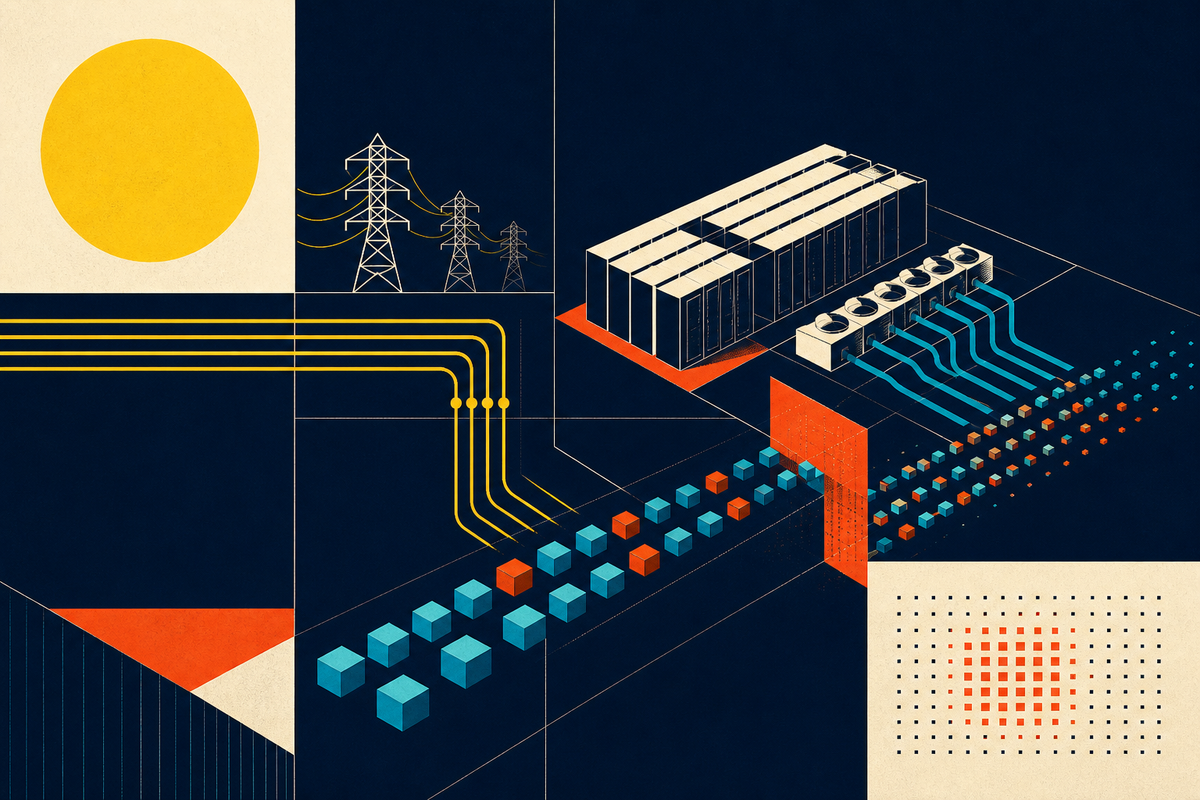
One power position, two ways to monetize it
AMD supplies the proof
The pivot stopped being a presentation slide when AMD signed for an initial 25 megawatts at Rockdale. The ten-year agreement was expected to produce about $311 million in contract revenue, with extension and expansion rights that could make it larger. Riot began delivering capacity in January 2026. By April, AMD had exercised an option for another 25 megawatts, doubling its contracted footprint to 50. The first five megawatts helped Riot report $33.2 million of data-center revenue in the first quarter.
“Advancing high-performance computing and AI requires partners that can match our pace and scale.”Hasmukh Ranjan, AMD chief information officer
The important word is not “AI.” It is “delivering.” Cryptocurrency miners have spent the past two years announcing possible conversions because markets assign richer valuations to predictable data-center cash flows. A functioning tenant is harder evidence. AMD's quick expansion suggests that at least one demanding customer found Riot's retrofit useful enough to take more of it.
Then came a much larger commitment. In August 2026, Riot announced a 20-year lease for a 191-megawatt, build-to-suit Tier 3 facility at Rockdale. The company said the unnamed frontier AI lab contract should generate approximately $9.1 billion over its initial term, with two five-year options that could lift the total to about $16.1 billion. External reporting identified the tenant as Anthropic. The lease changes the scale of the story, but it also raises the execution stakes: long contracts require heavy construction, exacting service levels and confidence that both tenant and landlord will still matter decades from now.
A better business - with a bigger invoice
The appeal of leasing is duration. Bitcoin gives Riot upside when the coin price runs, but the network does not sign a ten-year purchase order. Every miner competes against every new machine worldwide. The 2024 halving reduced the block subsidy, and the average global network hash rate rose 47 percent in 2025. Riot's average cash cost to mine a Bitcoin, excluding depreciation, climbed from $32,216 in 2024 to $49,645 in 2025, even after help from power credits.
A data-center lease can replace some of that volatility with scheduled rent and annual escalators. It can also swallow capital before producing a dollar. AMD's first 25-megawatt retrofit carried expected capital expenditure of $89.8 million, or about $3.6 million per critical IT megawatt. A purpose-built 191-megawatt campus is another order of magnitude. Riot must finance buildings, cooling, backup power and networking while avoiding delays and cost overruns. Its Bitcoin treasury and access to capital are useful, but they are not free money.
The comparison is also less direct than it first appears. Mining halls are designed around rows of single-purpose machines that can tolerate interruption. AI clusters carry expensive GPUs, fast networking and tightly synchronized workloads. They demand more redundancy, more precise cooling and a service organization built around customers rather than a company's own fleet. A ready power line shortens the journey, but it does not turn a mine into a Tier 3 facility by magic. Riot's opportunity comes from starting several expensive steps ahead. Its burden is proving that the remaining steps can be completed on schedule and operated for a tenant whose tolerance for downtime is close to zero.
Time to power
AI customers need energized space faster than new grid connections are often available. Riot offers existing interconnections, land and retrofit-ready structures.
Time to deliver
Enterprise tenants expect precise construction schedules and high availability. Riot has deep electrical experience but a shorter conventional data-center track record.
There is also concentration risk. A few large tenants can make a data-center operator's backlog look magnificent and its negotiating position look thin. Riot is entering a market with experienced operators such as Equinix, Digital Realty and QTS, while miners including IREN, Core Scientific, Hut 8 and TeraWulf chase similar conversions. The former miners share Riot's shortcut - power-first sites - and some have their own marquee customers.
The Texas trick: knowing when to stop
Riot's relationship with electricity is more sophisticated than “buy the cheapest kilowatt.” In ERCOT, the Texas grid market, a mining load can shut down quickly when prices spike or the system needs relief. That flexibility creates power credits and avoided costs. In 2025, Riot said power credits increased 68 percent from the prior year. A machine that can stop consuming is sometimes worth more idle than active.
AI data centers are less forgiving. A model-training cluster cannot casually disappear every hot afternoon. The tenant pays for uptime, redundancy and predictable performance. Riot's challenge is to preserve whatever grid flexibility is possible while graduating to infrastructure with stricter obligations. Its May 2026 memorandum with Terrestrial Energy hints at one long-term answer: explore data centers co-located with advanced nuclear plants, potentially with natural gas as a bridge. The memorandum is exploratory, not a power plant, but it shows where the constraint has moved. Compute demand is abundant. Dependable generation is the puzzle.
That is why Riot fits awkwardly into familiar market boxes. It is still a Bitcoin miner, and 89 percent of 2025 revenue came from mining. It is also an electrical-equipment maker, a construction operator, a landowner, a flexible grid load and, increasingly, a data-center landlord. The combination can create savings - Riot reported $23.2 million in cumulative capital-expenditure savings from ESS Metron by the end of 2025 - but it can also make the company harder to value. Investors must judge a cyclical commodity-like business and a long-duration infrastructure business under one roof.
What the pivot teaches
Riot's story offers a useful idea for any company caught in a volatile market: inventory the capabilities underneath the product. Mining Bitcoin forced Riot to become competent at things that do not sound like crypto - land negotiation, high-voltage distribution, cooling, industrial construction, hardware procurement and real-time energy economics. When AI demand arrived, those capabilities formed a second product.
The company did not abandon the first business. Mining still monetizes installed machines and gives Riot direct exposure to Bitcoin. Instead, it is trying to make the same megawatt choose between two jobs: pursue a probabilistic block reward today or support a contracted computing customer for years. That optionality is Riot's clearest difference from a conventional miner and its clearest test as a data-center operator.
The amusing part is that a company once named AspenBio, then Riot Blockchain, has ended up selling something older than either biotechnology or Bitcoin: reliable power in the right place. The glamorous tenants may train frontier models. The durable advantage may be a substation, a water line and a deed.