There is a clean way to describe Galaxy Digital, and then there is the accurate way. The clean version calls it a crypto financial-services firm: a New York trading desk, lender, investment bank and asset manager built for institutions. The accurate version requires a detour to Dickens County, Texas, where a former bitcoin mine now feeds rows of AI servers and where the local college football stadium has acquired the company's name.
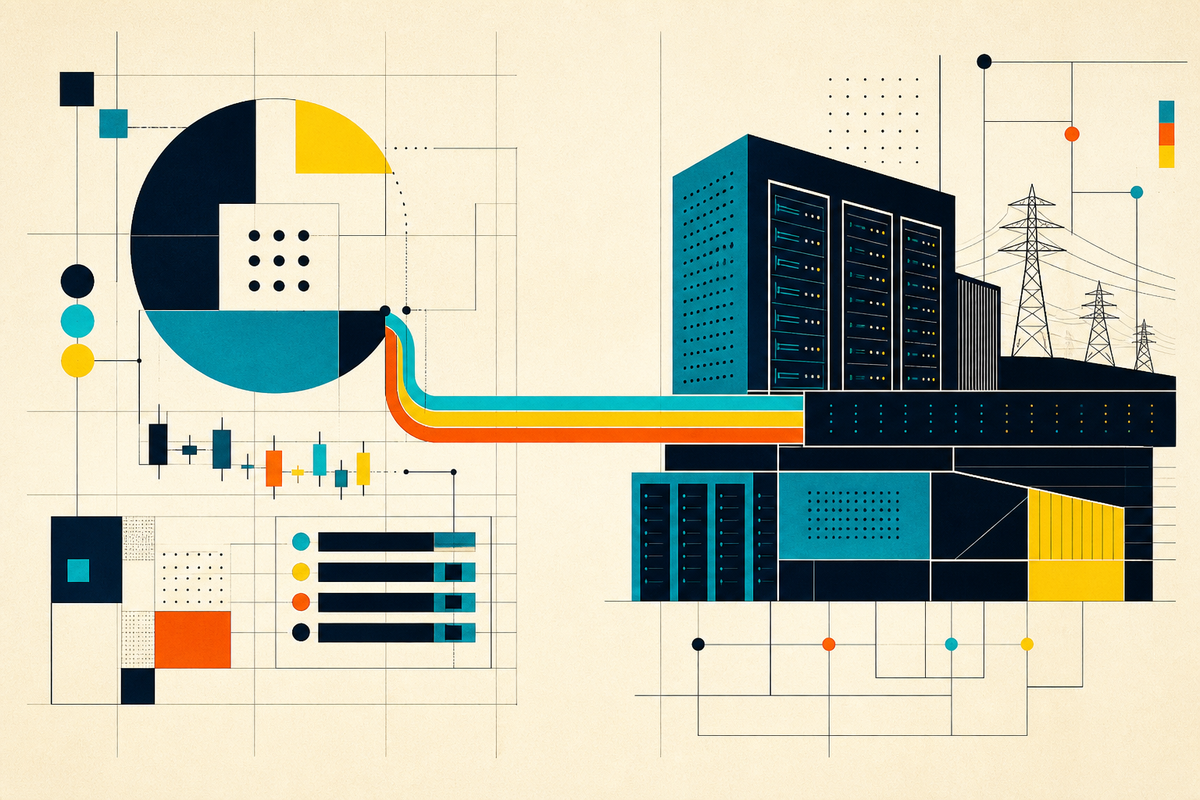
This is not random diversification so much as a thesis about scarcity. Digital finance needs trusted rails - counterparties, custody, liquidity, compliance and risk controls. Artificial intelligence needs physical rails - land, grid connections, cooling and enormous blocks of power. Galaxy has spent eight years collecting the first set. Its second act is an attempt to own the second.
01 / The original machine
A crypto company designed like a financial institution
Michael Novogratz founded Galaxy in 2018 around a blunt idea: bring institutions into the blockchain economy. His Wall Street history mattered. The intended customers were not hobbyists swapping tokens at midnight; they were hedge funds, asset managers, banks, family offices and trading firms that needed someone to answer the telephone when markets broke.
Galaxy filled in the stack. Global Markets provides OTC execution, derivatives, lending, structured finance and investment-banking advice. Asset Management packages digital exposure into ETFs, alternative funds, venture strategies and active or passive portfolios. Its infrastructure arm supplies staking, tokenization and self-custody technology. Galaxy Research explains the market in public, which doubles as education, distribution and a display of expertise.
The breadth is the differentiator. A client can trade, borrow, hedge, stake, hire an adviser or place assets in a managed product without rebuilding its counterparty map each time. Coinbase Institutional, FalconX and other specialists overlap with parts of that offer; BitGo, Anchorage Digital and Fireblocks overlap with other parts. Galaxy's proposition is not that every component is unique. It is that the components live under one roof, share risk infrastructure and can be combined for complicated clients.
We built Galaxy to be a comprehensive platform for the digital asset economy - a one-stop partner for institutions navigating this new frontier.Michael Novogratz, founder and CEO
02 / The distribution trick
Build the machinery once. Put several doors on it.
That institutional machinery is now escaping the institutional wrapper. GalaxyOne, launched in October 2025 from the bones of an app called Fierce, combines cash, eligible yield products, crypto, U.S. stocks and ETFs for individual investors. The interesting part is not the familiar app screen. It is the lending desk and balance sheet behind it. Galaxy turned an internal capability into a retail product without pretending the risk had disappeared: its premium-yield notes are investments, not bank deposits, and are restricted to accredited investors.
A second door opens through other institutions. In August 2026, Israel's Bank Leumi said it would use GalaxyOne Institutional and Galaxy's custody infrastructure to let customers buy, hold and sell selected digital assets inside Leumi's own capital-markets app. BNY is working with Galaxy on digital-asset infrastructure and staking support. BlackRock uses Galaxy infrastructure for a rewards-generating crypto ETP. State Street and Invesco work with the company on investment products.
One company, five layers of infrastructure
The problems are practical and unglamorous. A bank does not want to assemble a trading desk, validators, wallets and transaction controls from scratch. A fund wants liquidity without broadcasting its entire order. An investor wants cash and assets in one view. Galaxy sells the missing coordination layer, then earns spreads, execution revenue, advisory fees, management fees and infrastructure fees depending on the job.
A hard capability becomes more valuable when it can be repackaged for several customer types. Galaxy's lending and trading infrastructure can sit behind a hedge fund relationship, a bank's interface or a consumer app. The interface changes; the expensive machinery underneath does not.
03 / The Texas conversion
When the second rail requires concrete
Galaxy acquired Helios in 2022 as a bitcoin-mining campus. Then AI changed the value of a powered site. Grid access, not clever software, became the bottleneck for high-performance computing. Galaxy signed long-term agreements with CoreWeave, financed the retrofit and began transforming Helios into an AI data-center campus.
The physical milestone arrived in July 2026: Galaxy completed Phase I and delivered 133 megawatts of critical IT load to CoreWeave. Revenue recognition had started as halls came online during the second quarter. Galaxy said Phase I should produce roughly $80 million of leasing revenue in the third quarter, with project-level adjusted EBITDA margins above 90 percent. That figure is guidance, not a guarantee, but the delivery moved Helios from architectural rendering to operating asset.
The ambition has grown around it. Helios has more than 1.6 gigawatts of approved, utility-contracted capacity. Galaxy has also acquired three additional Texas sites, including a 500-acre campus in McGregor. Together they push its potential development pipeline beyond 5.7 gigawatts. The company is no longer simply converting one mine; it is trying to become a large American data-center developer.
We now have a track record of delivering on time and on budget, not a projection.Chris Ferraro, president and chief investment officer
The economics are attractive because a long lease can be steadier than a trading quarter. The risks are equally physical. Data centers consume capital before they earn rent. Transformers and construction crews run late. Power markets and regulation change. CoreWeave is a major tenant, so customer concentration matters. Crypto earnings still move with asset prices: Galaxy posted a $85 million GAAP net loss in the second quarter of 2026, driven largely by unrealized marks, even as its operating businesses improved.
04 / Where Galaxy fits
A barbell for the code economy
Galaxy now occupies a peculiar intersection. Against crypto prime brokers, it can point to asset management, custody technology and advisory. Against traditional asset managers, it can point to native trading and staking infrastructure. Against data-center developers such as Core Scientific, Applied Digital or Crusoe, it arrives with a public balance sheet and a separate financial business - but less history operating conventional AI campuses.
Different buyers enter through different doors. A hedge fund might begin with a block trade, then borrow against the position or add staking. An asset manager can hire Galaxy to subadvise an ETF instead of recruiting a crypto-native investment team. A bank can integrate custody and execution while keeping its own interface and customer relationship. An individual can use GalaxyOne without knowing that the same firm handles institutional loans. An AI-cloud operator cares about none of those screens; it buys powered data halls on a long contract. In each case, Galaxy removes a specialist problem the customer would otherwise have to staff, regulate or finance internally.
The integrated pitch has a cost. A focused vendor may be easier to evaluate, and a global bank may prefer several suppliers so no single counterparty controls too much of its stack. Galaxy must also prove that breadth creates useful cross-selling rather than organizational drag. Trading risk, software security and data-center construction do not fail in the same way, yet they ultimately meet on one balance sheet. For clients, that balance sheet is part of the attraction. For shareholders, it is also where every operating bet is collected.
Its new products show the financial side continuing to move down the stack. GOFR gives institutional borrowers an optimized onchain financing rate while Galaxy remains the counterparty, insulating the client from a patchwork of wallets and protocols. Galaxy Curator packages onchain vaults into risk tiers and distributes them through Fireblocks. Its OTC prediction-markets desk lets professional investors trade event contracts at size. These are not mass-market crypto spectacles. They are attempts to make onchain activity resemble familiar institutional plumbing.
The company makes money wherever that plumbing carries flow: spreads on trades and loans, fees on advice and managed assets, service revenue from staking and infrastructure, and rent from data-center tenants. It is a barbell. One side is exposed to liquid markets and rapid product cycles. The other exchanges market volatility for construction schedules, financing costs and long leases.
Culture has to bridge those worlds. Galaxy's published principles - demystify complexity, combine strengths, innovate responsibly and earn trust - read less like startup wallpaper when a single organization must satisfy securities lawyers, cryptographers, credit officers and electrical engineers. The hard part is not inventing a slogan broad enough for everyone. It is making the risk vocabulary travel between them.
The oddest symbol of the strategy may be Galaxy Stadium, the renamed home of Texas Tech football, about 60 miles from Helios. A New York crypto firm bought naming rights in the region where it is becoming a large employer and power customer. The gesture is corporate marketing, certainly, but it also acknowledges a truth that software companies can ignore: when your product needs substations, your neighbors become stakeholders.
Galaxy's wager is that the next economy needs both code and somewhere for code to run. The financial rails are already busy. The Texas campuses still have years of building ahead. If the pairing works, Galaxy will be difficult to classify and easy to understand: it sells access to scarce infrastructure, whether the scarce thing is institutional trust or a live megawatt.