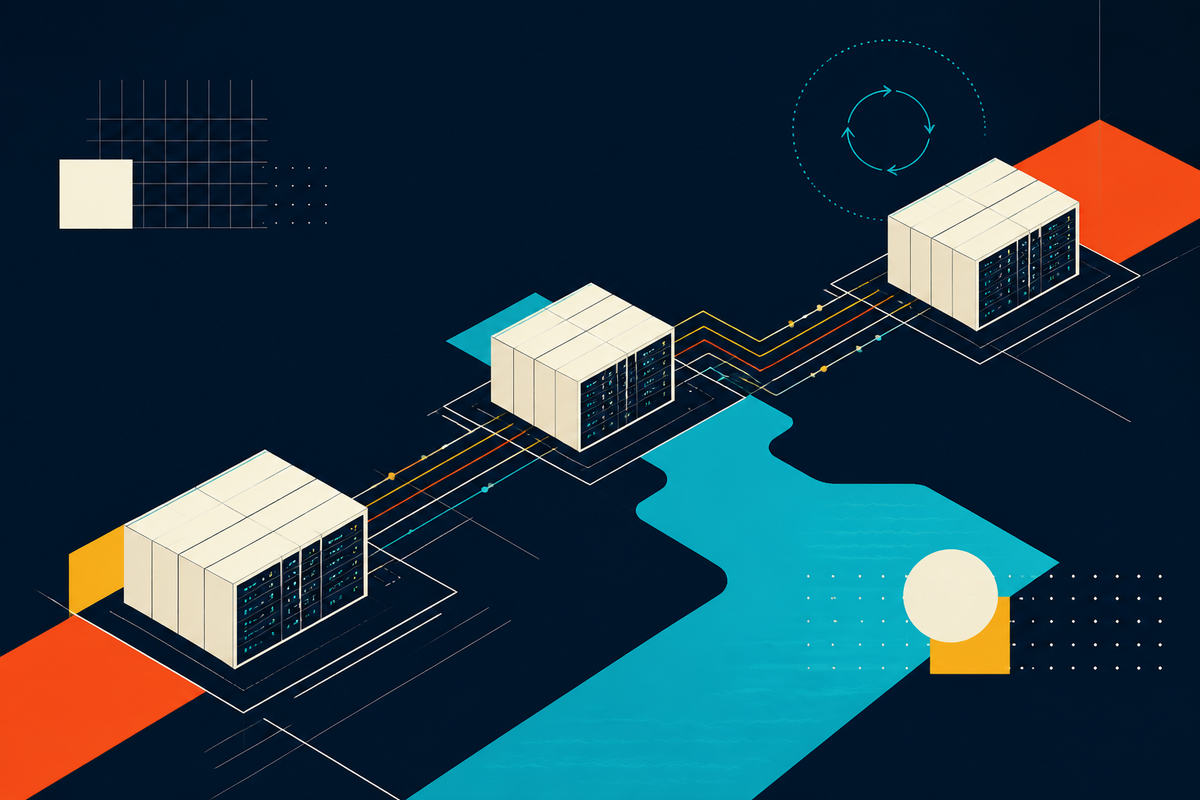
On a map, Singapore, Johor and Batam are separated by borders and a stripe of tropical water. On DayOne's sales map, they are pieces of the same machine. Singapore supplies dense international connectivity and a trusted business hub. Johor, just over the Malaysian border, offers room for campuses and access to large power contracts. Batam, an Indonesian island about 20 kilometers from Singapore, adds lower-cost expansion inside a special economic zone. Fiber makes the distances feel smaller. DayOne calls the combination SIJORI.
This is the central idea behind the Singapore-based data-center operator: a customer should not have to accept the physical limits of one city when nearby markets can be made to work as a regional platform. For hyperscale cloud companies and AI operators, that promise is practical rather than poetic. They need hundreds of megawatts, predictable construction dates, low latency, physical security and cooling systems capable of handling racks that run hotter every year. Few cities can supply all of that on demand.
DayOne does not make semiconductors or sell a public cloud. It prepares the place where the machines live. The company secures land and grid connections, navigates permits, arranges fiber, builds highly engineered facilities and operates them around the clock. Customers install their computing and networking equipment, usually under large, long-duration capacity commitments. The names on those contracts are mostly confidential, as they often are in wholesale data centers. The scale is less shy: DayOne said in June that bookings since its 2022 inception had passed 1.5 gigawatts.
The product is a deadline
A data center can look like industrial real estate, but rent is only the beginning. The usable product is energized capacity delivered when the customer needs it. A late building has no value to a cloud provider that has already bought servers and promised a launch date. DayOne therefore presents speed to market as an engineering discipline: standardized designs, prefabricated modules, aligned suppliers and campuses that can expand in phases.
Its public solutions span high-density and liquid cooling, intelligent infrastructure management, renewable-ready power and modular construction. Cooling matters because AI accelerators concentrate far more heat than conventional enterprise servers. Intelligent controls matter because a fraction of lost efficiency, multiplied across a giant campus, becomes a large electricity bill. Modular construction matters because work completed in controlled factories can reduce on-site complexity and make schedules more repeatable.
The model solves a familiar regional mismatch. Singapore is an excellent place to connect computers and a difficult place to keep adding giant buildings. Land and power are constrained, while demand from cloud platforms and financial institutions remains strong. DayOne's answer is not to abandon Singapore, but to preserve it as the network hub while placing more capacity around it. Johor and Batam can carry the physical load without becoming distant edge markets.
Our name 'DayOne' signifies a mindset of respecting each day as an opportunity to embrace new possibilities, create impactful solutions, and deliver value across the markets we operate in.Jamie Khoo, chief executive
A young company with older muscle
DayOne's corporate biography starts in May 2022, when GDS Holdings established a Singapore company to hold its data-center assets outside mainland China. It was known first as DigitalLand Holdings and then GDS International. The parent supplied experience, customer relationships and operating systems built over two decades in Asian data centers. New investors supplied the conditions for independence.
A $672 million Series A in 2024 brought in Hillhouse, Rava Partners, Boyu, Princeville Capital and Tekne Capital. A $1.2 billion Series B later that year added Coatue, Baupost, SoftBank Vision Fund and Citadel founder Kenneth Griffin. On January 1, 2025, the business launched as the independent DayOne. GDS stopped consolidating it and retained a minority stake.
The capital kept coming. DayOne announced more than $2 billion for the first portion of a Series C in January 2026, then closed the round in June at $4.5 billion. Coatue and Hillhouse led; Indonesia Investment Authority and Achi Capital Partners joined. The number is large because the work is hungry. Data centers consume capital well before they generate revenue: sites, substations, generators, cooling equipment, shells and network routes all arrive ahead of the customer's first bill.
That gap between committed and billable megawatts is the business in miniature. Customers have reserved far more capacity than DayOne can invoice today. The opportunity is converting the blue bar into the orange one on schedule. The risk is equally plain: construction delays, grid constraints or customer concentration can leave expensive assets waiting. This is why access to capital and local execution are not supporting functions. They are part of the product.
Power is the second customer
Every expansion plan eventually meets an electrical grid. In Malaysia, DayOne has worked with Tenaga Nasional Berhad since its early Johor development. Agreements signed in June 2026 brought its contracted renewable supply above 1 GW and covered roughly 1.5 GWp of solar generation plus 2.2 GWh of battery storage. DayOne describes itself as TNB's largest customer. The partnership offers capacity and a path toward the lower-carbon electricity its hyperscale tenants increasingly request.
Its first Singapore facility, a 20 MW project with about 40,000 square meters of gross floor area, follows the same logic at city scale. A 10-year agreement with Sembcorp backs operations with renewable energy certificates. A research partnership with the National University of Singapore tests cooling designed for humid tropical weather. The site is also associated with solid oxide fuel-cell power, an on-site technology that could provide efficient, high-density generation if it performs as intended.
Sustainability claims in this industry deserve arithmetic. A renewable certificate does not make a server use less electricity, and an efficient facility can still increase total demand as it grows. DayOne's more concrete measures include energy and water efficiency in new builds, a Johor facility with LEED Platinum certification, long-term renewable contracts and a stated target of 100 percent renewable electricity by 2030. Its partnership with a Johor water specialist includes a treatment plant designed to purify 20 million liters per day.
Exporting the corridor
Outside SIJORI, DayOne is adapting the playbook rather than photocopying it. In Fuchu, west of central Tokyo, it is developing an 80 MW campus with Gaw Capital Partners. Gaw contributes real-estate and investment experience; DayOne brings hyperscale design and operations. The first 18 MW building is targeted to have its core and shell ready in 2027. Japan offers a mature connectivity market, strict technical expectations and high barriers to entry - almost the inverse of creating a new corridor from scratch.
A new cluster positioned between Bangkok, industrial demand and regional cable routes, with a long-term power platform planned at up to 1 GW.
Purpose-built capacity in an established financial and network hub, sold on low latency and regional reach.
Nearly 300 MW planned across Lahti and Kouvola, using clean power, free cooling and potential heat recovery.
A compact, high-spec facility where renewable procurement, fuel cells and tropical cooling can be tested close to customers.
Finland supplies a different set of advantages: cooler air, cleaner power and large sites. DayOne committed EUR 1.2 billion to a Lahti campus on former industrial land and joined local partner Hyperco on a project in Kouvola. The two developments represent nearly 300 MW of planned capacity. Designs can reduce freshwater cooling, while recovered server heat could feed local district heating. The cloud workload may be global, but the thermodynamics stay local.
The company also has projects in Hong Kong and Thailand. Its Chonburi Tech Park is intended to turn eastern Thailand into another high-capacity cluster, eventually supported by a power platform of up to 1 GW. In March 2026, DayOne added a more experimental partnership: it agreed with Cortical Labs and NUS Medicine to test biological computing equipment in a commercial Singapore facility. Wetware is not about to replace racks of GPUs, but the pilot fits DayOne's position as the controlled environment where unusual computing systems meet practical power and cooling.
Where DayOne sits
DayOne competes with regional specialists such as AirTrunk, Princeton Digital Group, ST Telemedia Global Data Centres and Nxera; global operators including NTT, Equinix, Digital Realty and Vantage; and the option for hyperscalers to build for themselves. Its differentiation is not a single machine. It is the coordination of sites, energy, regulation, suppliers and connectivity in markets where those pieces have not previously arrived as one package.
The customer is buying relief from complexity. A cloud platform can reserve capacity near its users without assembling a local development organization in every country. An AI operator can specify rack density and cooling while DayOne handles the building around it. A large enterprise can reach cloud and network ecosystems without owning the physical plant. In each case, DayOne monetizes the same scarce combination: megawatts in the right place, delivered before the demand curve moves again.
Its largest strategic question follows directly from its strength. Building ahead of demand can create a market, but it also creates exposure before the market is proven. The $4.5 billion Series C gives DayOne room to move quickly. Turning booked power into operating, billable halls will determine whether SIJORI becomes a repeatable model or remains a particularly clever response to Singapore's constraints.
For now, the map is doing useful work. Three neighbors have become one sales proposition. Tokyo and Finland show that the proposition can travel. And the usually invisible layer beneath AI - concrete, cables, chillers and contracts - has become one of the technology economy's most consequential businesses.