The Data Center That Fits Inside a Hydro Plant
A San Francisco startup led by an Alaskan energy trader is betting that the next wave of AI compute won't be built in Virginia. It will be built next to a waterfall in Cordova.
The town of Cordova, Alaska has about 2,000 residents, no road connecting it to the rest of the state, and a hydroelectric plant on Humpback Creek that produces more clean power than the town can always use. In 2024 it got one more thing: a data center. Not a warehouse the size of a shopping mall, but a prefabricated module co-located with the power plant, running AI-grade compute on 100% renewable energy. The company that built it, Greensparc, thinks that box is a template for the parts of the world the cloud never bothered to reach.
Most of the AI infrastructure story in 2026 is about scale - billion-dollar campuses, gigawatt grid requests, entire regions of Virginia and Texas rewired to feed hyperscale demand. Greensparc's pitch is the inverse. Instead of building enormous facilities near major grids and fighting for power, it finds communities where clean power is already stranded or under-used, then drops a small, modular data center right next to it. The compute goes to the energy, not the other way around.
The thesisShip the compute to the power
The idea comes from founder and CEO Sam Enoka, who grew up in North Pole, Alaska, went to high school on an Air Force base where his mother taught, and spent roughly 15 years trading energy across wind, solar, coal, hydro, natural gas, and nuclear before turning to hardware. That background is the whole company's edge: Enoka spent a career watching power get produced in places where it was cheap and then lose most of its value because there was nothing nearby to consume it. AI compute, it turns out, is a workload that will happily sit anywhere there is reliable electricity and a network connection.
Greensparc's answer is a right-sized data center - the company describes deployments from roughly 50 kW up to a megawatt or more - built to open hardware standards from the Open Compute Project and shipped mostly pre-assembled. Where a conventional build measures its timeline in years, Greensparc says it can be operational in about 90 to 120 days. Where a traditional deployment might need forty server racks, the company says it has consolidated that footprint into a single compact module.
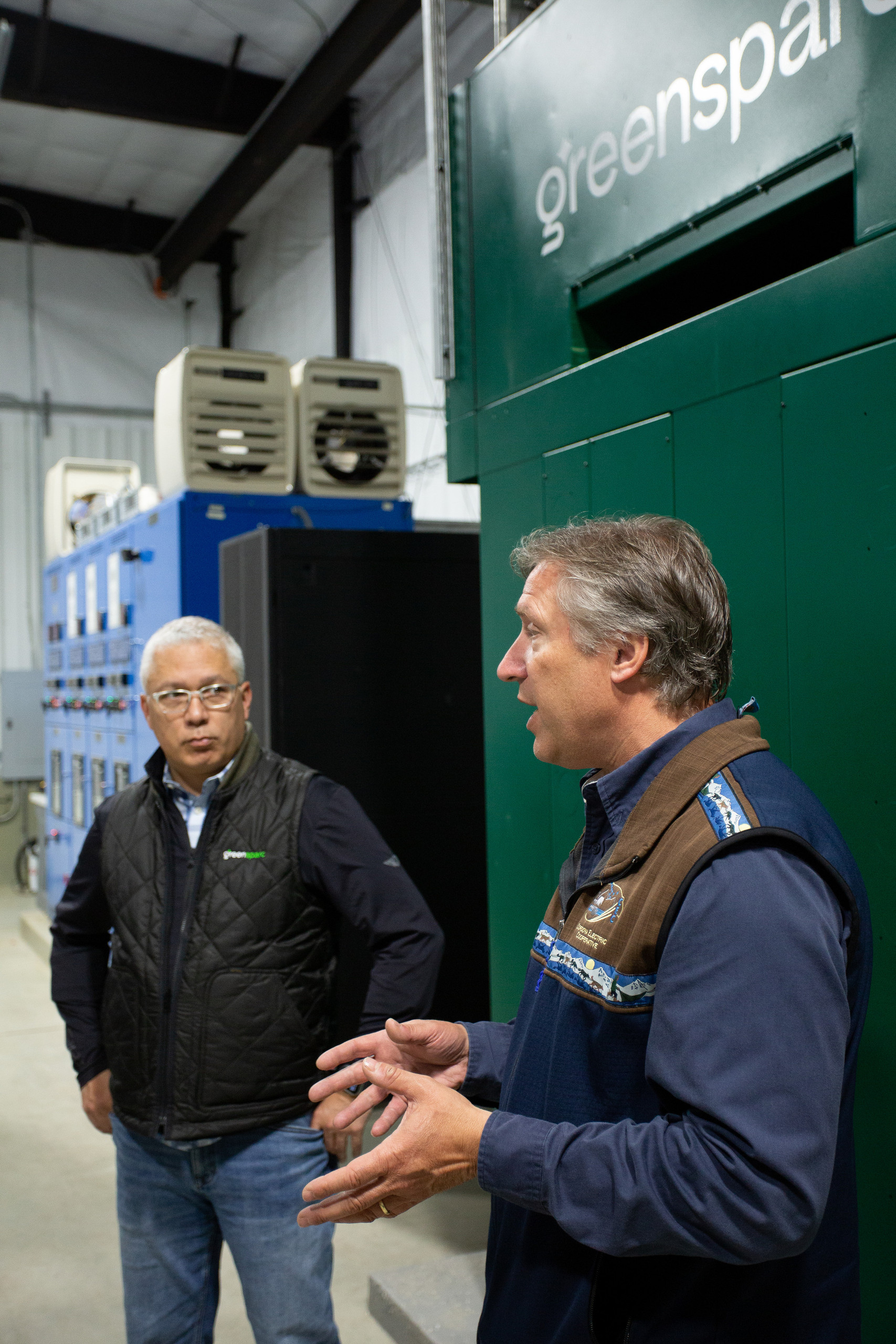
The flagshipA data center inside a power plant, inside a microgrid
The Cordova deployment is the proof of concept everything else hangs on. Working with Hewlett Packard Enterprise on the compute and with Cordova Electric Cooperative as host utility, Greensparc installed a module in the 150-to-170 kW range at the Humpback Creek hydro facility in 2024 - staged in Anchorage, then trailered and ferried in, with the on-site build taking about 30 days. The plant powers the servers and helps cool them, recycling excess heat back into the building; the community, in exchange, gets local edge compute, lower latency, and a new revenue path for its surplus energy. Cordova Electric's CEO, Clay Koplin, called the infrastructure "not an advancement" but "a transformation."
For a remote community, the second-order effects are the point. Better local infrastructure means telemedicine that actually works, online education that does not stall, and remote employment that does not require leaving town. Greensparc frames connectivity as "both a human right and an engine of growth," and its customer list on the deployment side reflects that - rural electric cooperatives, tribal organizations, minority-serving institutions, and small municipalities, rather than the usual enterprise buyers.
Find stranded power
Locate a community with surplus or under-used renewable energy - hydro, wind, solar.
Drop the module
Deploy a prefabricated, OCP-standard data center on-site in about 90 days.
Sell the compute
Rent GPU capacity, hosting, and cloud back to AI and enterprise customers.
The numbers it claimsCleaner, faster, cheaper - on paper
Greensparc's marketing rests on three comparisons against a conventional on-premises or hyperscale build: energy use, speed, and cost. The company reports up to a 50% reduction in energy versus on-premises setups, deployment roughly 90% faster with a 90% smaller footprint, and total-cost-of-ownership savings in the 30-40% range with operating-expense savings quoted as high as 50-80%. Those are the company's own figures, and the sample size is still small - but they map cleanly onto the underlying logic of cheap power plus prefabrication.
The businessWhat it actually sells
Under the hood, Greensparc is a B2B infrastructure company with four product lines. There is the modular data center itself. There is GPU-as-a-Service - hosted GPU clusters and bare-metal capacity aimed at AI and high-performance-computing customers. There is straightforward Infrastructure-as-a-Service and enterprise cloud hosting. And there is a software layer: real-time ESG analytics and energy-cost management that tracks the carbon, water, and cost profile of a fleet of these sites.
The margin, in theory, sits in the gap between two prices. Greensparc secures energy at wholesale or bilateral rates in places where power is under-valued, then sells premium AI compute at market rates. The community wins because its stranded power finally earns its keep and local energy costs can come down; Greensparc wins on the spread. It is an energy-arbitrage business wearing a data center's clothes - which is exactly what you would expect from a founder who traded power for 15 years.
The teamEnergy traders, an Air Force colonel, and a hyperscale builder
Enoka co-founded Greensparc with Manu Kalia, who leads data science and brings a background in analytical modeling and financial management. The rest of the roster is unusual for a startup this size: George Reitz, who has spent nearly three decades building hyperscale data centers; Vikki Ellison, a retired U.S. Air Force colonel who handles federal services and organizational change; Dava Guthmiller on strategy and operations; and Jesus Arredondo on regulatory affairs. It is a team built less for a fast consumer launch and more for the slow, permit-heavy work of putting infrastructure in the ground in places with complicated stakeholders. Enoka himself is a Robert A. Toigo Foundation fellow, and the company leans openly into workforce development for people from underrepresented backgrounds.
The moneySmall round, big state backer
Greensparc's disclosed venture funding is modest: a $300,000 convertible note in mid-2024, backed by climate accelerator Launch Alaska and the 49th State Angel Fund. The more consequential number may be public rather than private. In 2025, the Alaska Industrial Development and Export Authority - the state's development bank - advanced financing to support a micro data center program, with figures reported around $17 million tied to Greensparc's expansion. For a company whose whole model is capital-intensive local infrastructure, a patient state financier that wants to diversify Alaska's economy is arguably a better fit than a growth-stage VC chasing a quick multiple.
The competitionA different shape of buildout
Greensparc sits in an increasingly crowded lane of energy-first compute companies - Crusoe Energy, Armada, Soluna, and modular-infrastructure vendors like Vertiv all circle nearby, and the hyperscalers loom over the demand side. What separates Greensparc is the size and the siting. It is not trying to out-build Amazon or Microsoft. It is deliberately going small, renewable-only, and community-embedded, chasing the towns that are too remote, too cold, or too small for a mega-campus to bother with. That narrows the near-term market, but it also removes Greensparc from the fiercest grid and land competition - and gives it a story about local benefit that a hyperscale operator cannot easily tell.
The road aheadBeyond Cordova
The open question is whether one hydro town becomes a hundred. Greensparc has signaled additional Alaska deployments, with small-scale data centers explored in communities such as Wrangell and Petersburg - and, as those local debates show, not every town says yes without questions about noise, water, and who actually benefits. The model works cleanly where surplus renewable power, a willing utility, and a real compute customer line up at once. Where any one of those is missing, the math gets harder. For now, Greensparc is a small team with a sharp thesis and one working example next to a waterfall - which, in infrastructure, is how these things usually start.