The most important piece of an artificial-intelligence system may be the one no one puts in the product demo: the plumbing. Pack enough accelerators into a rack and the elegant abstractions disappear. Electricity has to arrive in startling quantities. Heat has to leave just as quickly. Coolant must stay clean. A failed switch or a warm aisle can turn a billion-dollar computing plan into expensive furniture. This is Vertiv's territory - the mechanical, electrical and increasingly digital layer between the grid and the chip.
Vertiv makes uninterruptible power supplies, switchgear, busbars, power distribution, batteries, chillers, cooling distribution units, racks, controls and monitoring software. It also designs modular data-center systems and sends technicians to commission and maintain them. The pitch is less about a heroic black box than an orchestra: power, cooling and controls designed together, then supported after the ribbon cutting.
An 80-year-old answer to a brand-new furnace
The corporate name is young. The problem is not. Ralph Liebert started the predecessor business in 1946 and established Liebert Corporation in 1965, helping turn precision computer-room air conditioning into a category. Emerson bought Liebert in 1987, then folded it into Emerson Network Power in 2000 alongside critical-power and control technologies. Platinum Equity bought that division for more than $4 billion in 2016 and renamed it Vertiv. A Goldman Sachs-led blank-check merger took the company public in 2020 at a pro forma enterprise value of about $5.3 billion.
That history matters because AI has revived an old truth with more punishing numbers. Conventional enterprise racks once lived comfortably in the single-digit or low-double-digit kilowatt range. Vertiv's new MegaMod HDX configurations are built for 50 kilowatts to more than 100 kilowatts per rack and up to 10 megawatts across a prefabricated installation. Future designs contemplate even denser systems. At that point, the data center is not a room with computers. It is a power plant and thermal system whose payload happens to be compute.
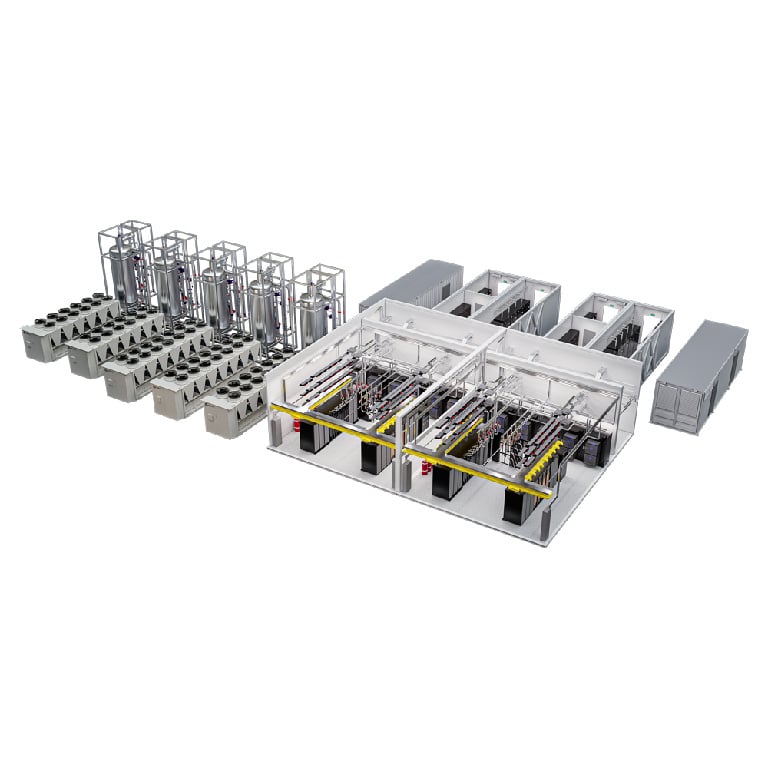
The physical chain behind an AI answer
The stumble that made execution interesting
Vertiv's rise was not one clean line drawn by AI demand. In 2021, the company misread inflation and moved too slowly on pricing while component shortages and premium freight battered profitability. In its shareholder letter, management offered the unusually plain admission: “We underestimated inflation and were initially slow to adjust our pricing.” Demand and backlog were strong, but those orders had been booked without enough protection against rising costs.
Demand was never the first thing to fail. Pricing speed, supply-chain resilience and execution failed first.Vertiv's 2021 lesson, in its own numbers
What changed their mind was not a strategy off-site. It was a bad second half and the arithmetic of material, freight and labor costs. In February 2022, Vertiv laid out a reset: additional sources of supply, closer sales-and-operations alignment in the Americas, more accountability and aggressive price increases. The company realized $365 million of pricing that year. By 2023, price, volume, productivity and better supply flow were expanding profit again. The lesson is copyable and boring, which is why it is useful: price long-lead projects against the costs you will actually incur, not the costs visible when the order arrives.
The repaired operating system met an extraordinary market. Vertiv reported $10.2 billion in 2025 revenue, up from $4.4 billion in 2020. Its year-end backlog reached $15 billion, 109 percent above the prior year, after fourth-quarter organic orders rose 252 percent. By the second quarter of 2026, sales were up another 24 percent and the company had raised the midpoint of full-year guidance to $14 billion. Small timing shifts still appeared when supply chains congested and multi-phase projects grew more complex. A backlog is a promise to execute, not cash already earned.
Selling optionality before the chips arrive
The customer's headache is uncertainty. A data center ordered today may host a different accelerator generation by opening day. Air cooling is familiar and serviceable, but direct-to-chip liquid cooling carries away concentrated heat more efficiently. Committing too early can strand capital; waiting can leave a facility unable to host the racks customers want.
Vertiv and Compass Datacenters spent 11 months developing CoolPhase Flex around that dilemma. The packaged system combines refrigerant-based air cooling and direct-to-chip liquid cooling, and can be converted in the field. The move is clever because the product sells an option, not a prophecy. A customer can build for current loads while reserving a path to denser ones inside the same footprint.
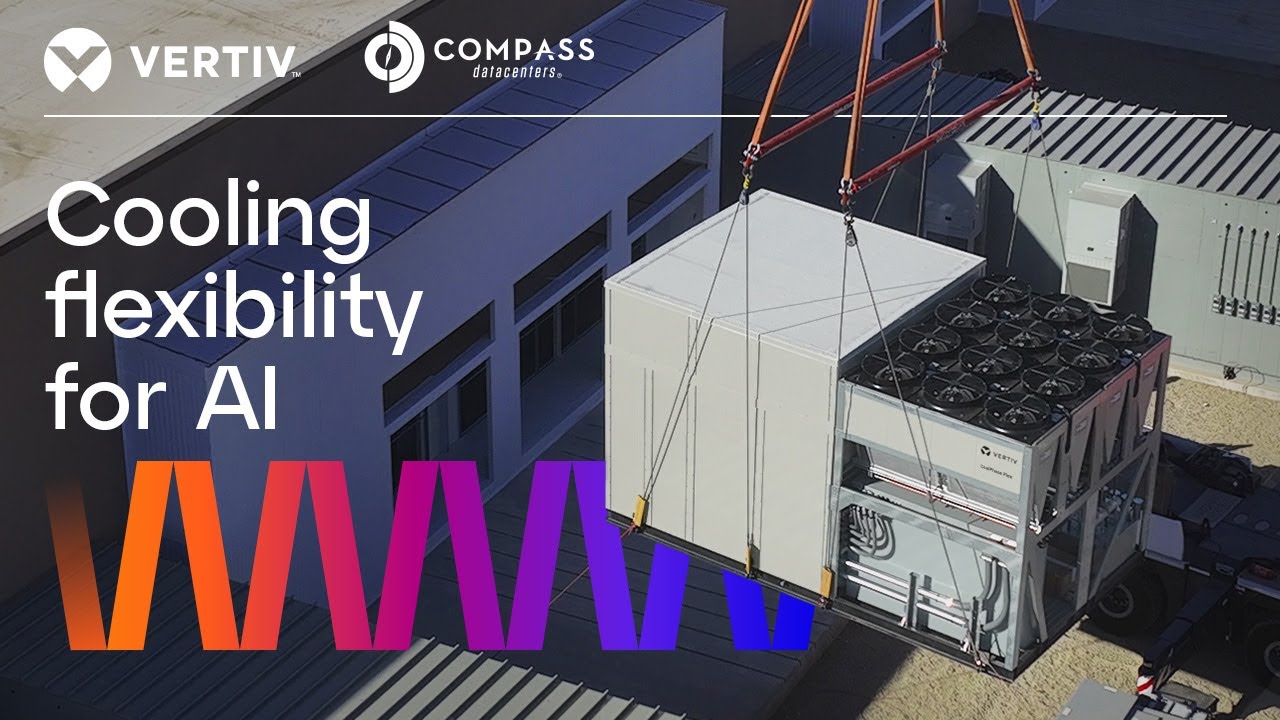
Vertiv is applying the same logic higher up the stack. MegaMod HDX packages power and hybrid cooling into repeatable modules. SmartRun, introduced in 2026 for NVIDIA Omniverse DSX, models power, cooling and controls as one digital twin before crews build the system. Its planned 800 VDC platform tackles another looming constraint: moving megawatt-scale power toward future racks without absurd copper losses and conversion steps. With NVIDIA, Vertiv is testing the architecture ahead of Rubin Ultra deployments rather than waiting for finished servers to land on a loading dock.
The play readers can copy
Design for the transition, not one perfect forecast.
Vertiv's best idea is modular optionality: common building blocks, factory testing, field conversion and digital simulation. It works when demand is real but the exact technology path is uncertain. It works less well when loads are small, sites are highly bespoke, cheap conventional cooling is sufficient, or local water, power and service capacity cannot support the design.
Why one throat to choke is a product
Schneider Electric, Eaton and Huawei offer broad alternatives; STULZ, CoolIT, Motivair and Envicool compete in parts of thermal management. Vertiv's distinction is concentration. It spends most of its energy on critical digital infrastructure and covers much of the path from grid connection to rack, then from chip heat to heat rejection. Its acquisitions make that map denser: CoolTera added liquid-cooling technology, Great Lakes added custom racks, PurgeRite added fluid services, and ThermoKey added heat exchangers and manufacturing capacity.
Customers include hyperscalers and colocation operators, but the public case studies show the breadth: Equinix redesigning UPS architecture in France; eStruxture converting a Montreal printing plant into a high-density data center; Compass preparing for AI cooling; Telefónica supporting remote telecom sites; and the Naval Postgraduate School installing an NVIDIA DGX GB300 system. Hospitals, banks, factories and utilities buy the same basic outcome - electronic systems that keep running when electricity, heat or maintenance gets complicated.
The expertise is partly accumulated scar tissue. An electrical engineer can optimize a UPS, a mechanical engineer can size a coolant loop, and a construction team can assemble a module. The harder work is predicting how those decisions collide during a fast deployment, then finding the technician and spare part when something misbehaves at 3 a.m. Vertiv's global service footprint turns that institutional memory into a sales argument. So does its habit of working beside chip companies and operators before specifications settle. The public language around its culture - speed, innovation, customer service and accountability - sounds conventional. Its recent investments make it concrete: test labs, local factories, digital simulation and people who can commission the hardware in the field.
The economic engine mixes large equipment orders with engineering, installation, monitoring, parts and maintenance. The box wins the project; the installed base creates years of service work. Liquid cooling strengthens that loop because coolant chemistry, flushing, commissioning and leak-free operation demand expertise after construction. Vertiv's roughly $1 billion purchase of PurgeRite, plus up to $250 million tied to performance, is a wager that the pipes will need caretakers.
The company is also spending before every order becomes revenue. In March 2026 it committed about $50 million to expand operations in Ohio, including an expected 45 percent capacity increase for liquid-cooling and chilled-water systems at its Ironton facility. The expansion is supposed to be operational in 2027. This is the industrial bargain behind a giant backlog: customers want shorter lead times, but capacity built for urgency becomes costly if projects slip. Vertiv's job is to add factories just ahead of demand without reliving the forecasting errors that exposed it in 2021.
There are limits. Prefabrication pays when designs repeat; it loses power when every site is a snowflake. An integrated vendor simplifies accountability but can reduce component choice. Liquid cooling earns its complexity at high density, not in every server closet. Advanced nuclear collaboration with Oklo is intriguing, yet depends on licensing, deployment and economics outside Vertiv's control. And record orders can strain the very supply chain the company spent years repairing.
Vertiv's advantage is not that it predicted every chip. It built around the certainty that more compute means more electricity and more heat.The durable bet beneath changing architectures
That is where Vertiv fits in the market: not the brain of AI, but its circulatory system. Chips will change. Model fashions will change faster. The watts still have to arrive, and the heat still has to go somewhere. For a company descended from computer-room air conditioning, the future looks surprisingly familiar - only hotter, denser and much larger.
Continue exploring