A graphics processor can do an extraordinary amount of arithmetic. It cannot arrange its own electricity bill. Nor can it connect itself to thousands of other processors, move training data, or carry its heat out of a building. Those dependencies are where Supermicro earns its living. The company’s story begins with computer boards and ends, increasingly, with the water running through a data center.
- The product: configurable servers, storage and complete racks for AI and enterprise computing.
- The advantage: reusable designs help turn new chips into systems customers can deploy.
- The tension: rapid growth demands cash, careful integration and controls that keep pace.
The useful part is the join
Charles Liang, Sara Liu and Wally Liaw founded Supermicro in 1993. Liang’s background was in motherboard and system design. The idea that persisted was architectural: develop reusable building blocks, then combine them around a customer’s requirements. The company was describing that approach in its 2006 IPO registration statement, long before a chatbot made GPU capacity a dinner-party subject.
Consider the difference between designing every server afresh and maintaining a family of compatible boards, chassis, power supplies and cooling options. Reuse gives engineers a head start. Customers retain choices about processors, storage and form factors. Supermicro supplies the engineering that makes the chosen combination work. Its expertise sits in those connections, including the decidedly physical business of fitting everything into a box.

That positions Supermicro among Dell, HPE and Lenovo, while also exposing it to manufacturers such as Quanta and Wiwynn. The distinction is emphasis: configuration breadth and rapid adoption of partner technology anchor its pitch. These remain competitive claims to test against an actual workload, delivery schedule and support agreement.
A customer buys a working service
Sakura Internet offers a useful view from the other side of the invoice. In an April 2025 Supermicro case study, the Japanese cloud provider described 260 server nodes, each carrying eight NVIDIA H100 GPUs. That makes 2,080 GPUs. Customers could rent access rather than procure and operate the machines themselves. For them, the server manufacturer disappears behind a usable cloud service.
“flexibility in hardware configurations”
Takefumi Sudo, Sakura Internet, describing one reason for choosing Supermicro
Lamini needed a different combination. Its published deployment used Supermicro systems with AMD EPYC processors and eight AMD Instinct MI300X accelerators per server for language-model tuning and inference. Applied Digital’s published build used Intel processors and NVIDIA H100s, alongside networking and other infrastructure systems. The applications differ. Each customer needs components to become an operating service.
This is how Supermicro makes money: sell configured equipment and integrated infrastructure, directly and through channel partners, then supply software, support and deployment services. It occupies the layer between chip suppliers and the organizations running workloads. It does not need to invent the language model to sell the machinery underneath it.
Follow the heat
AI changes the scope of that machinery. Concentrate more computation in a rack and power delivery, networking and cooling become part of the same design problem. Supermicro’s Data Center Building Block Solutions, or DCBBS, extends its modular method outward: servers become racks, racks become validated clusters, and cooling reaches from cold plates to facility equipment.

The proposition is practical. A buyer wants fewer unresolved handoffs between whoever supplied the server, whoever connected the network and whoever designed the cooling. Supermicro can combine those responsibilities with validation and onsite services. Its stated Green Computing agenda also becomes a purchasing argument: power and cooling affect the cost of every hour the equipment runs.
Choose compute02Rack
Join the parts03Cluster
Test together04Facility
Power + cooling
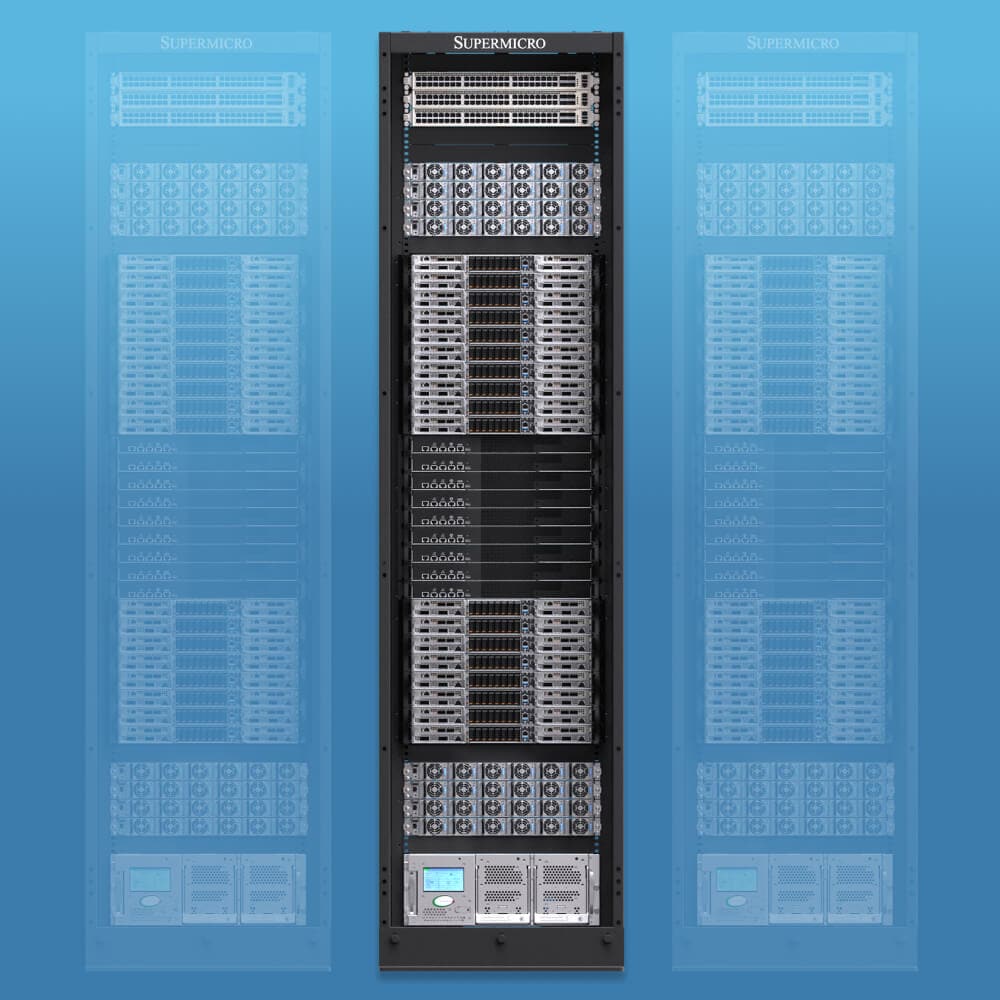
That shift changes what the customer must specify. The useful conversation begins with how much power the site can deliver, how heat will leave, and who will service the equipment. A faster accelerator can make all three questions more urgent. Buying the complete rack moves some integration work to the supplier, but the building still has to cooperate.
The savings require scrutiny. Supermicro advertises up to 40% lower data center power use and up to 20% lower total ownership cost for its liquid-cooling approach, based on its estimates. Those are conditional ceilings. An existing building, a different workload or different electricity prices can change the calculation. Air-cooled products remain in the portfolio for good reason.
Big sales. Narrow room for error.
Annual sales reached $39.1 billion in fiscal 2026, compared with $22.0 billion a year earlier. Gross margin was 10.8%. For a hardware supplier, that gap matters: the impressive sales figure includes expensive components passing through the business. Inventory and customer timing can absorb substantial cash before the finished systems earn their keep.
Growth also needs financing. In February 2025, Supermicro priced $700 million of convertible notes, explicitly including working capital for expansion among the intended uses. Buyers face their own version of that arithmetic: a rack purchase brings power, networking, installation and maintenance obligations along with the equipment.
The operational record supplies a harder lesson. Delayed reports led to Nasdaq filing noncompliance in 2024. Supermicro filed the outstanding statements in February 2025 and regained compliance. Separately, an August 2026 board-led export review prompted personnel actions and control improvements. The company said investigators found no evidence current senior management knew of the alleged diversion scheme. Supermicro was not named a defendant; government investigations remained ongoing.
Steal the interface, not the shopping list
For another business, the equivalent move might be a reusable manufacturing fixture or a consistent software interface. The generalizable idea is to make repeated work predictable, then spend engineering effort where customer requirements actually differ. It is an interpretation of Supermicro’s method, rather than a promise that modularity automatically produces its growth.
The portable lesson is to standardize connections while leaving useful choices open. For buyers, that means starting with the workload, testing the software stack, and checking facility readiness before copying someone else’s hardware order. A well-integrated rack cannot fix low utilization or unsuitable applications. Supermicro’s expanding remit makes the point tangible: getting AI plugged in includes everything that happens after choosing the chip.
Go around the back of the rack
Explore Supermicro, its GPU systems, liquid cooling and newsroom. Read the Sakura Internet deployment and Lamini configuration.
Watch the hardware
Level1Techs: inside the GB300 NVL72 rack ↗
Supermicro: fiscal 2026 results recap ↗