Dillon Rolnick runs one of the most closely watched laboratories in artificial intelligence, and he did not arrive there through the usual door. As chief executive of Nous Research, he oversees a lab that builds open-source language models, publishes its weights for anyone to inspect, and is trying to prove that frontier systems can be trained across the open internet rather than inside the walls of a handful of well-funded companies. It is an unusual mission, and Rolnick came to it from an unusual place: the trading desk.
Nous Research, founded in 2023 and rooted in New York with ties to Austin, Texas, sits at the center of a debate that has come to define the AI industry. Should the most capable models be closed products, controlled and metered by a few labs? Or should they be open - downloadable, auditable, and improvable by a global community? Rolnick has planted his flag firmly on the open side, and the company he leads has become a reference point for what that looks like in practice.
What he is building now
The clearest expression of Rolnick's bet is the Psyche network, Nous Research's decentralized training system. Rather than renting a single hyperscale data center, Psyche coordinates compute contributed across many machines, using the Solana blockchain for coordination and verification. The idea sounds almost heretical to anyone used to the economics of modern AI: training runs are supposed to be centralized, expensive, and private. Nous is trying to make them distributed, community-powered, and verifiable.
The team put the theory to the test. In late 2024, Nous demonstrated distributed pre-training by training a 15-billion-parameter model in a distributed setup - a proof point that a serious model could be produced without a single owner holding all the compute. In May 2025 the Psyche testnet went live. Nous describes its work as the largest verifiable over-the-internet pre-training run published anywhere before a token generation event. Alongside the infrastructure sits the Hermes family of models, the open-weight systems that have made Nous a household name among developers who want models they can actually run and study.
The open-versus-closed fight
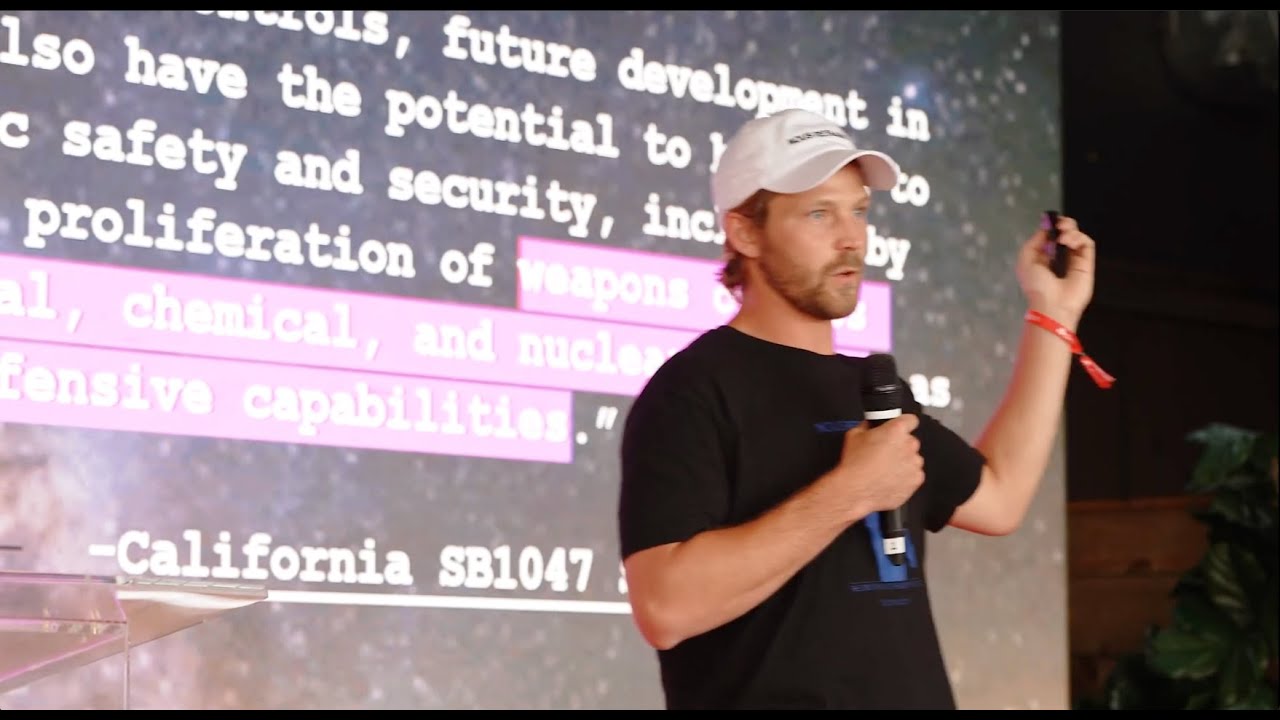
Rolnick's public appearances circle back to one theme. When he took the stage at Akash Accelerate in 2025, dressed in a Nous cap and t-shirt, the slide behind him quoted the language of AI regulation - the sort of text from bills like California's SB 1047 that frames advanced models as potential public-safety hazards. His counter-argument is that the greater danger is a world where only a few organizations can build and control the models everyone else depends on. Open weights, in this view, are not a giveaway. They are a form of accountability.
How he got here
Rolnick studied at Vanderbilt University from 2013 to 2017. His first professional chapter was in quantitative finance, where he worked at Effex Capital making markets in foreign exchange, metals, futures, contracts for difference, and cryptocurrencies. Market-making is a discipline of probabilities and edges - reading where price and value diverge, and acting quickly. It is a useful lens for someone who would later bet on an unfashionable idea about how AI should be built.
He then founded Crysknife Capital, a firm whose name nods to Frank Herbert's Dune. Crysknife started around merger and litigation opportunities and evolved toward purchasing class-action settlement claims, applying a quantitative approach to valuing pending and future payouts. It was, in essence, another search for mispriced assets - this time in the legal system rather than the currency markets. Before Nous, Rolnick also served as a research lead at a large venture capital fund, a role that put him close to the frontier of what was being funded and built in technology.
From finance to the operating seat
That combination - trading instinct, a builder's appetite for overlooked opportunities, and a VC's view of where the puck was heading - explains how a non-engineer ended up running an AI lab. Rolnick is the operator. His long-time collaborator Jeffrey Quesnelle handles the technical direction as chief technology officer. Together they have carried Nous from a scrappy open-source collective into a company that serious investors take seriously.
The money has followed. In April 2025, Paradigm led a $50 million Series A. By mid-2026, reports indicated Nous was finalizing a round of roughly $75 million at a valuation near $1.5 billion, with new backers joining earlier investors. For a lab whose core product is given away, that is a striking vote of confidence - and a sign that the market is starting to price openness as a strategy rather than a sacrifice.
Nous Research funding trajectory
Series A led by Paradigm (Apr 2025). 2026 round reported near a $1.5B valuation. Figures per public reporting.The mind behind the mission
People who follow Nous describe Rolnick as contrarian and systems-minded, comfortable holding a position that the broader industry finds uncomfortable. The company's culture leans heavily on community - the developers, researchers, and hobbyists who use Hermes models, contribute compute to Psyche, and stress-test ideas in public. In a sense the community is Nous Research's real capital, as important as any venture check.
There is also a streak of intellectual playfulness in his story. A firm named after a Dune weapon. A career that zig-zags from currency markets to litigation claims to machine learning without ever quite fitting a résumé template. What ties it together is not a field but a habit of mind: looking for value where others are not looking, and being willing to act on it before consensus forms.
Why it matters
The stakes of the open-versus-closed question keep rising as AI moves deeper into the economy. If Rolnick is right, the most trusted models of the future will be the ones anyone can inspect, and the most resilient training infrastructure will be the kind no single entity controls. If he is wrong, Nous will still have pushed the frontier of what distributed, verifiable AI can do. Either way, he has helped make sure the argument is being had out in the open, with working code rather than only white papers.
For now, Rolnick keeps the lab moving - shipping models, expanding Psyche, and making the case, conference by conference, that intelligence is too consequential to be owned by a few. It is a big claim. Nous Research is the experiment built to test it.