Jeffrey Quesnelle knew the youth section of his local library well enough to notice when the furniture moved. New books were easier still to spot. Among the shelves, one series held a particular attraction: Choose Your Own Adventure. Here was a book that handed the reader a small amount of authority. Turn to another page and the plot obeyed. For a child interested in both stories and computers, that was a rather persuasive interface.
Years later, Quesnelle tried to recreate that pleasure with a language model. He could write the software. Writing the fiction was another matter. He described himself as a poor creative writer, and saw generative AI as a way to try a form of expression that had previously been difficult. The obstacle was wonderfully mundane: a story needs to remember its own characters. Early models had a habit of running out of room.
That private project belongs near the beginning of any account of the Nous Research co-founder. It gives the technical work a human scale. Before there were papers about context windows and distributed optimization, there was a reader asking for a longer adventure. A character should be able to leave the village without the machine forgetting which village it was.
The library had a command line
In May 2023, Quesnelle published his branching-story application, cyoa. Readers could accept one of two suggested next moves or write their own. The model generated illustrated stories; the reader could intervene, make a character do something, then return the pen to the machine. This was an experiment in shared authorship, with a programmer building the mechanism that let him participate.
The childhood library had supplied an earlier piece of technical education. Its inter-library search system used a terminal, and finding books meant learning how to operate it. Quesnelle credits that necessity with helping make him a programmer. It is a pleasingly practical origin: the incentive to master an interface was waiting on a shelf somewhere else.
His story model was fine-tuned at an 8,000-token context length. Tokens are the pieces of text a language model processes, rather than a direct count of words. More space let the application carry more of its story forward. He also acknowledged that it could struggle with major plot changes. Even an automated adventure sometimes needed a human to announce a new chapter. The reader still had work to do.
- 01ReadBranching adventure books
- 02Buildcyoa · May 2023
- 03ExtendYaRN · August 2023
Before the model, the network
Quesnelle’s earlier professional world was automotive software. At Intrepid Control Systems, he was the lead software architect of Vehicle Spy, a tool for developing and debugging communication networks inside vehicles. That work put him close to the difficult business of making interconnected systems behave predictably. An impressive interface is of limited consolation when the messages underneath it go astray.
He worked with automotive manufacturers and suppliers on cybersecurity standards, and presented at DEF CON’s Car Hacking Village. His 2018 RSA Conference talk concerned AUTOSAR Secure Onboard Communication. He also co-authored Automotive Ethernet - The Definitive Guide, published in 2015. These are fairly literal credentials in the mechanics of machines talking to other machines.
A domestic version of the problem appeared in 2016, when his home network kept failing. Restarting the router brought temporary relief. Quesnelle opened Wireshark and unplugged cables until he traced unusual traffic to his television. It was emitting Ethernet PAUSE frames. His investigation suggested the router was forwarding messages that should have been filtered, effectively passing a command to stop along to other devices.
He wrote a small program to reproduce the failure and examined the relevant standards and switch-chip behavior. The television, in other words, had become an unusually effective household administrator. Quesnelle’s account is funny because its scale is so ordinary. It also records a habit: when a system behaves strangely, inspect the traffic, reproduce the behavior, and keep following the mechanism.
Privacy, examined transaction by transaction
His academic path combined computer science and mathematics at Oakland University with an M.S. in computer science at the University of Michigan-Dearborn. Cryptography became a research interest. His master’s thesis examined anonymity in Zcash, a cryptocurrency whose shielded transactions use zero-knowledge proofs to conceal transaction information.
In a 2017 paper, he investigated coins moving from transparent addresses into shielded addresses and back out again. Matching amounts, especially when the transactions happened close together, could make those journeys linkable. His heuristic matched 31.5 percent of the coins sent to shielded addresses in the analyzed data. The result concerned usage patterns and observable transactions; it was no claim that he had broken the underlying cryptography.
There is a family resemblance between this research and the television investigation. Both begin with the behavior of a working system. A feature can be mathematically sophisticated and still produce surprises when people and hardware use it. Quesnelle published the Zcash analysis with code and transaction data. Readers could inspect the route from observation to conclusion, rather than simply accepting the conclusion on trust.
A podcast assembled from spare parts
By early 2023, he was making another literary machine. literAI turned novels into visual podcasts through a chain of open models: summarize the book, generate a dialogue, produce descriptions for images, create the images, and synthesize the voices. The project was an assemblage, with each component doing a different job. A single impressive model would have made for a much less interesting engineering exercise.
He had encountered deep learning at NVIDIA conferences around 2018 and taken an early Udacity course to understand its machinery. Later, Stable Diffusion and ChatGPT renewed his interest. His preferred way to learn was to get software running locally and step through it. With literAI, he wanted to find out how much of the process could work using open models and consumer hardware.
The attraction was freedom to experiment repeatedly. A metered service changes the atmosphere of a loop: every iteration has a price attached. Open software offered room to be wasteful while learning. Quesnelle admitted that running his own models could cost more than paying for an API. His preference was therefore about access and control as well as the bill. The tinkering itself was part of the point.
“I wanna do dumb shit in a tight for loop without the fear of a gazillion dollar bill!”
Jeffrey Quesnelle, writing about literAI, 2023
The teenager’s exam becomes an experiment
Another experiment followed a question raised by literAI: how well could language models understand extended prose? Quesnelle used publicly available SAT reading tests. It was an economical choice of instrument. Teenagers already had considerable experience with the unpleasant business of proving that they had understood a passage; now some models could take a turn.
He excluded questions requiring charts and other visual data, then compared model performance on the remaining text questions. He reported that FLAN-T5’s 11-billion-parameter version matched text-davinci-003 on the ten practice tests he used. He also separated questions that referred to specific line numbers, finding weaker results there. Counting and interpretation turned out to be awkward companions.
He fine-tuned models on eight tests and reserved two for validation, then checked selected SuperGLUE tasks for signs that gains had come at the expense of broader performance. The experiment was bounded, with a small collection of tests. Its appeal was the method: ask a concrete question, make the comparison reproducible, and look for the particular place where the system trips. A benchmark score becomes more useful when someone asks what produced it.
More room for the adventure
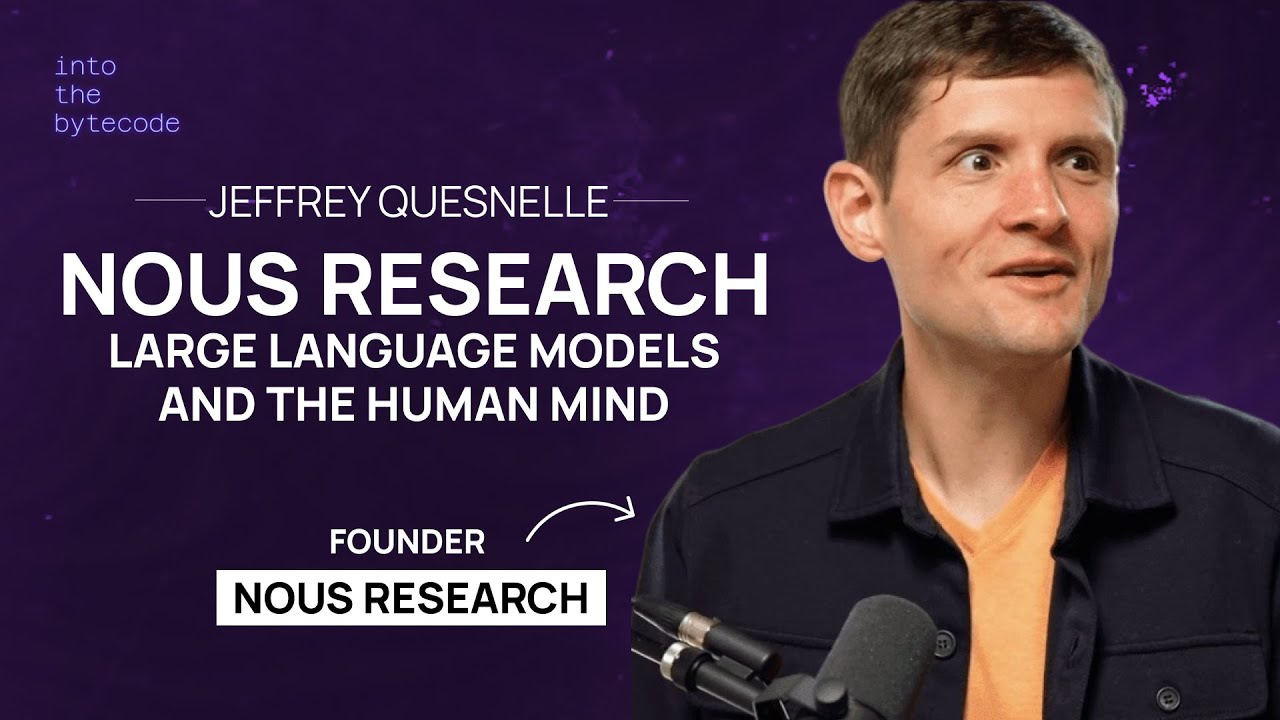
The context-length work brought Quesnelle into contact with Bowen Peng, then with the open AI researcher known as Teknium and a small private Discord group. That group became part of the origin of Nous Research. Quesnelle’s compressed description was “homies on Discord who got big.” It is a less ceremonious founding story than the customary garage, and supplies rather better evidence that the people involved were already talking to one another.
The resulting research reached a formal milestone with YaRN, co-authored by Peng, Quesnelle, Honglu Fan and Enrico Shippole. First submitted in August 2023 and associated with ICLR 2024, the paper addresses context extension for models using rotary position embeddings. These embeddings help represent where text belongs in a sequence. A model trained with a particular sequence length can struggle beyond it.
YaRN describes a more efficient way to extend that window. The paper reports using ten times fewer training tokens and 2.5 times fewer training steps than earlier methods in its comparisons. Those figures describe the research setting, rather than a universal saving for every model. They nevertheless give the original storytelling problem a measurable outcome. Making more room for text had become a contribution other researchers could examine and use.
Then make the computers talk less
With DeMo, Quesnelle’s research turned to another constraint: communication between the machines doing training. A distributed model can have abundant computing power and still spend too much time exchanging updates. The technical bottleneck has an almost social quality. Everyone has done their homework; the meeting to compare notes is taking too long.
Quesnelle is a co-author of DeMo alongside researchers including Peng and Diederik P. Kingma. The February 2026 version describes transforming and sparsifying local momentum updates, sending selected information instead of dense raw gradients. Experiments on 300-million- and one-billion-parameter language models report up to 85 times less data transmitted per GPU than the AdamW-DDP comparison, with comparable loss and accuracy.
The paper supports an ambition that reaches beyond a faster training run. Reducing communication requirements can make training across multiple locations more practical. That connects with Psyche, Nous’s infrastructure for coordinating distributed training. Its architecture separates the coordinator, the GPU clients and the data provider. Clients also take part in checking other participants. Getting machines to contribute is only part of the job; getting them to trust the process requires its own machinery.
In October 2025, Nous described a shift in Psyche’s work from demonstrating distributed training toward improving model performance, with new experiments and an expanded training scope. That distinction matters. Showing that a network can train a model and producing a useful model are separate achievements. A system earns its place through the results it enables, however appealing its arrangement of computers may be.
Leave a choice for the reader
Quesnelle’s argument for open AI includes giving users control over a model’s behavior. Nous’s Hermes models belong to that effort, while the training research asks who gets to build the underlying systems. The two questions meet at the user: how much can someone change, and how much of the machinery can they inspect?
There is something apt about arriving here from branching fiction. The attraction of those books was the invitation to take part. His early projects let a reader steer a story, or let a programmer assemble a podcast from components whose workings were available to study. The later research works on the practical limits that determine who can join in.
The adventure has acquired more authors, more computers and rather more mathematics. Its original appeal remains easy to recognize. Open the book. Try a choice. See where it leads. And if the machine runs out of room before the interesting part, there is always the possibility of changing the machine.