A red light is a small exercise in helplessness. The driver waits. The engine idles. The light knows when it will change and declines to share the information. In 2011, Emmanouil Koukoumidis was working on a way to make that arrangement less wasteful. Put a smartphone on the dashboard. Point its camera at the road. Let several phones compare what they see.
The project was called SignalGuru. Its ambition was pleasantly specific: predict traffic-light changes and advise drivers when slowing down could save them a stop. Long before he became the CEO and co-founder of Oumi, before Google Cloud’s PaLM and the current arguments over who owns AI, Koukoumidis was asking how ordinary devices could cooperate to do something useful.
He goes by Manos. His career now includes university research, Microsoft’s conversational AI, Facebook’s Portal, and Google’s model development. Those names can make a biography look like a collection of prestigious departures. The traffic-light experiment offers a better beginning. It puts a concrete problem on the road, where an elegant idea has to survive contact with an intersection.
The phone that watched the lights
SignalGuru used cameras already present in smartphones to collect observations about traffic signals. Rather than requiring a new transmitter inside every light, it treated passing phones as contributors to a shared picture. The system estimated schedules and fed those predictions to a driving advisory application. Intelligence emerged from observations that could be gathered, combined, and put to work.
During his Princeton doctoral work, Koukoumidis followed his adviser Li-Shiuan Peh to MIT after she moved there in 2009. They developed SignalGuru through the Singapore-MIT Alliance for Research and Technology’s Future Urban Mobility program. Princeton’s Margaret Martonosi was his other thesis adviser and the paper’s third author. The research crossed institutions before its phones crossed intersections.
The tests also crossed environments. Cambridge, Massachusetts, provided traffic lights with fixed schedules; Singapore supplied the more difficult problem of schedules that changed with traffic. His account of the project reported average prediction errors of 0.66 seconds for pre-timed signals and 2.45 seconds for traffic-adaptive signals. The associated driving application recorded average fuel savings of 20.3 percent in its measurements.
These were experimental results, attached to a particular system and its tests. They mattered because the work joined sensing, networking, prediction, and a usable instruction. A driver cannot do much with a beautifully organized database of red lights. The useful output is advice that arrives before the next stop.
An intelligence with a day job
Koukoumidis completed his Princeton PhD in 2011. His research concerned the co-design of mobile and cloud intelligent systems: where computation should happen, how devices should exchange information, and how the parts should fit. It is a background in the practical geography of computing, with consequences for how much a system costs and how quickly it responds.
He went on to Microsoft, working in applied science and later software development management. His projects included Cortana and Zo, the company’s conversational chatbot. His public career record includes patents involving conversationally relevant content, mathematical chatbots, and a digital conversation assistant. A conversation, like an intersection, presents a stream of changing conditions. An answer must be appropriate to the moment.
In 2015, he conceived and led an artificial emotional intelligence project with a seven-person team at Microsoft’s company-wide hackathon. It won first place in the consumer category, among roughly 3,500 projects, according to his career account. He presented it to executives and secured funding. The episode captures a familiar transition in engineering: making the demonstration is one task; finding a route into the organization is another.
His subsequent work included integrity and assistant development around Facebook’s Portal. He also worked at Biscuit Labs. The sequence gave him experience with products expected to function in everyday life, rather than only inside an experiment. A chatbot meets users with jokes, ambiguities, distractions, and requests its designers did not anticipate. Shipping exposes all the untidy edges.
More than 300 people behind a model
At Google Cloud, the scale changed. Koukoumidis led engineering and science for natural-language AI services and some multimodal services. For Cloud PaLM, he established a virtual team of more than 300 contributors drawn from over 30 teams. His responsibilities spanned training and quality, infrastructure, safety, and pricing. This was a model-development effort with a considerable human network behind it.
He describes bringing PaLM to general availability in May 2023. The effort subsequently moved to DeepMind as Gemini, and he continued contributing. The particular attraction of this chapter is its breadth. Quality determines whether a model gives useful answers; infrastructure determines whether those answers arrive; pricing determines whether customers can afford to keep asking.
Across more than 30 teams
A public model name compresses that work into a word. The internal task is less compact. People have to agree on interfaces, priorities, constraints, and what counts as ready. Koukoumidis’s account of PaLM is useful precisely because it includes the less glamorous responsibilities. There is no launch without them, however impressive the demonstration might be.
A school of fish, with a balance sheet
Oumi made its public entrance in January 2025 with an open-source platform and a $10 million seed round. Venrock and Obvious Ventures led the financing, with participation from Plug and Play and Ascend. The company’s name expands to Open Universal Machine Intelligence. Its stated purpose was to give researchers and developers a shared foundation for building and advancing models.
Koukoumidis called for a Linux moment in AI: common infrastructure that a community could use and improve. The founding argument concerned access to the development process, as well as access to a finished model. Researchers should be able to experiment. Businesses should be able to adapt the technology to their own requirements. The platform supported work from training through evaluation and inference.
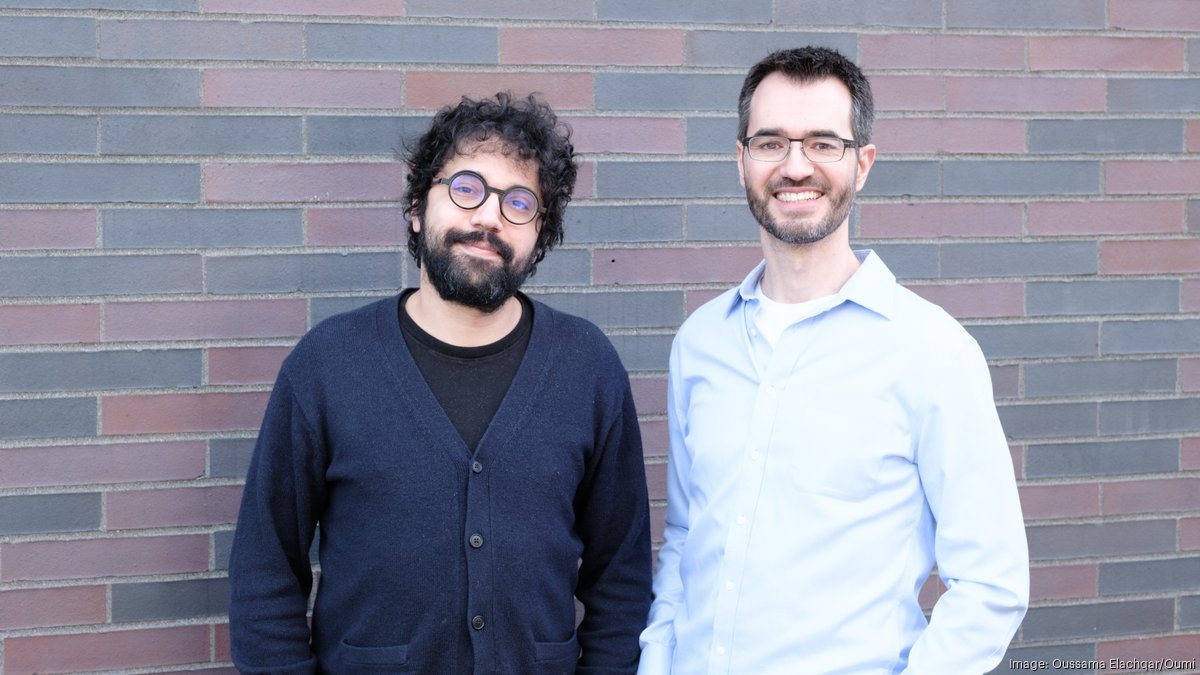
His co-founder Oussama Elachqar brought experience at Apple, Twitter, and Microsoft. Oumi’s wider founding team included Matthew Persons, Jeremiah Greer, William Zeng, and Kostas Aisopos, with experience in Google’s language models, alignment, and engineering. Its academic network included researchers such as Carnegie Mellon’s Ruslan Salakhutdinov, Caltech’s Georgia Gkioxari, and Berkeley’s Sergey Levine.
Oumi was structured as a public benefit corporation. Its investors described a business connecting academic research with enterprise customization. That combination creates a practical obligation: the shared tools need to remain useful, and the commercial work needs to support a continuing company. A mission statement cannot maintain a training pipeline on its own.
Koukoumidis has a more entertaining picture of collective effort. Oumi’s internal mascot, he has explained, is a school of small fish beside a shark. In the company’s version, the small fish win. It is an unusually aquatic piece of corporate strategy, and a concise way to express his belief that a coordinated community can challenge concentrated resources.
He also shared a small indignity of life among AI startups: somebody sent Oumi an invoice addressed to Thinking Machines. He corrected the identity with a laughing emoji and returned to his argument for open development. Founders may spend years distinguishing their companies. Accounts payable can undo the work in a single salutation.
The invoice is the test
By March 2026, Oumi had launched its commercial platform for building custom models. Users could describe a task in ordinary language, and the platform would handle work including training-data generation, fine-tuning, and evaluation. Koukoumidis’s pitch brought the argument down to a business question: what kind of model does a particular job actually require?
Consider invoice validation. Oumi reported that Divisions Maintenance Group used its platform to fine-tune a model with fewer than one billion parameters, increasing accuracy from 72 percent to 99 percent on that task. The company said the result matched GPT-5.2’s performance in the comparison. Another customer, Aurasell, built an eight-billion-parameter model for extracting information from web pages.
These are company-reported examples, rather than a promise about every future workload. Their relevance to his story is the choice of target. An invoice-validation system has a defined job and a way to measure success. The ambition becomes narrower and easier to inspect. The entertaining chatbot and the accounts department have different ideas of a productive afternoon.
Build, measure, repeat
In his October 2025 writing, Koukoumidis identified time as a barrier to custom models. Teams had to assemble test sets, discover failures, curate or generate data, train, and repeat. Oumi’s proposition was to connect those steps and let AI help perform the work. A model could contribute to building another model, with evaluation steering the next experiment.
- 01 Evaluate
- 02 Find gaps
- 03 Create data
- 04 Train
Repeat the evaluation. Deploy when the task meets its target. Keep improving.
Oumi’s August 11, 2026 event placed continuing improvement at the center of its message, under the title “Get Ready to Compound Your AI.” The company’s framing had moved from opening the development process to helping organizations build, deploy, and improve specialized intelligence. Ownership mattered because the business could keep working on the model as its requirements changed.
“We can only achieve it, if we work together.”Manos Koukoumidis
The line appears on his personal website, as an invitation to join Oumi’s mission. It also makes a fitting thread through the career: phones pooling observations, researchers working across institutions, engineers coordinating a launch, and contributors developing shared tools. Each arrangement asks what people can accomplish when the useful parts of their work can meet.
A traffic light still has the advantage of a very clear job description. Enterprise AI is messier. Koukoumidis’s next experiment is whether more organizations can make that mess their own: define the task, inspect the failures, change the model, try again. The question that started on a dashboard now sits inside a company’s daily work.