BREAKING Oumi raises $10M seed to give AI its 'Linux moment' 2026 Oumi launches commercial custom-model platform PaLM shipped May 2023 with a 300+ person team HallOumi: open model that catches AI lies Open data. Open code. Open weights. Open recipes. BREAKING Oumi raises $10M seed to give AI its 'Linux moment' 2026 Oumi launches commercial custom-model platform PaLM shipped May 2023 with a 300+ person team HallOumi: open model that catches AI lies Open data. Open code. Open weights. Open recipes.
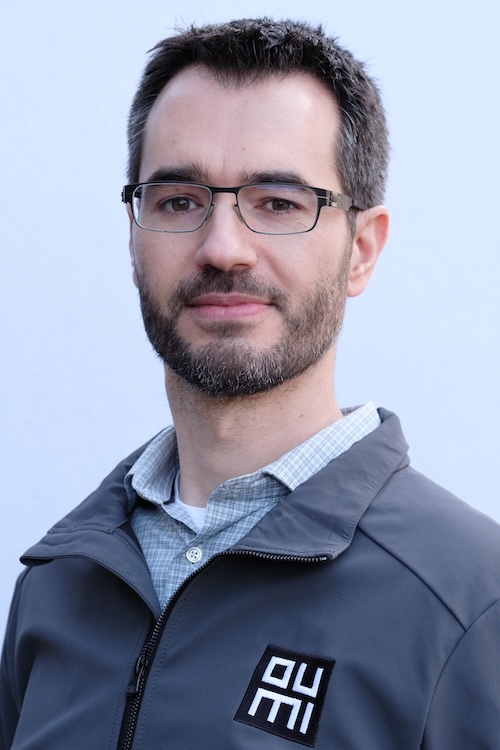
Emmanouil 'Manos' Koukoumidis, CEO and co-founder of Oumi
The view from the top of PaLM was excellent. He climbed back down on purpose.
Person · Founder · Engineer

Emmanouil
Koukoumidis

He scaled one of the world's biggest AI models, then walked away to give the technology back to everyone.

RoleCEO, Oumi
BasedKirkland, WA
FromGreece
Trained atPrinceton

A researcher called him on a Sunday night to say his students could not reach the frontier anymore. That sentence became a company.

Most people who get an AI model to ship for a company like Google stay to enjoy it. Emmanouil Koukoumidis - everyone calls him Manos - did the opposite. In May 2023 he had just steered Google Cloud's PaLM to general availability, coordinating a virtual team of more than 300 contributors spread across thirty-plus internal groups. The effort then folded into DeepMind and became Gemini. By most measures, he had arrived.

Then a friend in academia, the machine-learning researcher Ruslan Salakhutdinov, told him on a quiet weekend evening that his students "cannot contribute to the frontier anymore." The cost and complexity of assembling the infrastructure had grown so steep that even brilliant graduate students were locked out. For Manos, who had spent his life moving between universities and corporate labs, that was the problem worth quitting a good job over.

The result is Oumi - short for Open Universal Machine Intelligence - a public benefit corporation building what he flatly calls AI's "Linux moment." The bet: that open models, open data, open code and open training recipes will stop chasing the proprietary giants and start setting the pace themselves.

What Oumi actually is

Oumi is an open-source AI lab structured as a public benefit corporation, which means it is a for-profit company with legally binding commitments to the public good written into its charter. The platform lets anyone experiment across the full lifecycle of a model - training, fine-tuning, evaluation - without being boxed in by a closed vendor's API.

Its calling card is a model called HallOumi, an open claim-verification system that spots hallucinations - the confident, wrong statements that large language models produce. In Oumi's testing it beats general-purpose LLMs at the job. The name is a wink: HallOumi, like the cheese, sitting inside Oumi, the lab. The humor is doing real work here. It signals a team that takes the mission seriously and itself a little less so.
300+Contributors he led on PaLM
$10MOumi seed round
6Co-founders
25+Founding scholars with equity

Numbers from public reporting and Oumi's own company page. The 300-person figure is the virtual team behind Google Cloud PaLM.

The four-part definition of "open"

Plenty of companies call their models open. Manos finds most of that generous. His standard, which he calls "unconditionally open," asks for four things at once: the data, the source code, the model weights, and the training recipes. Drop any one and you cannot truly reproduce, extend, or improve the model - which, to him, is the whole point.

The argument is partly philosophical and partly practical. Pre-training a frontier model from scratch costs more than almost any lab can afford, so the near-term action in open AI sits in post-training: taking existing open models and making them better, safer, and more useful through shared effort. Oumi is the infrastructure for that shared effort.

There is a safety case folded inside the openness case. Manos argues that AI can be advanced faster and more safely in the open, where many eyes can inspect and stress-test models, than behind closed doors where a handful of people decide what is safe on everyone's behalf.

Open source models, tools and related infrastructure won't be trying anymore to close the gap - they will be the ones defining the state-of-the-art.

- Manos Koukoumidis

From CERN to Cortana to a charter promise

The path here was not a straight line. Manos grew up and did his early schooling in Greece, then earned a diploma from the National Technical University of Athens before crossing the Atlantic for a PhD at Princeton, where his research focused on the co-design of mobile and cloud intelligent systems. Along the way he passed through some of the most demanding research environments in the world - MIT, Microsoft Research, the SMART program in Singapore, and CERN, the particle-physics laboratory.

At Microsoft he worked on conversational AI years before it was fashionable. He led the engineering and science behind Zo, an open-ended multimodal chatbot, and helped pioneer what the team called artificial emotional intelligence - giving a bot a sense of tone and feeling. He also contributed to Cortana. By his own account he had built an LSTM-based system and a retrieval-augmented prototype back in 2016, ideas that the rest of the industry would rediscover and rename later.

Then came Google, and the model that mattered

At Google Cloud he led the engineering and science for the Natural Language and some multimodal AI services, and bootstrapped the Cloud PaLM effort. Getting a model that size into customers' hands meant wrangling training quality, infrastructure, safety, and even pricing - the unglamorous machinery that turns a research artifact into a product. When PaLM became Gemini under DeepMind, he kept contributing. A later stop took him into Apple's healthcare foundation-model work before he left to start Oumi.

Oumi is not a solo act. He co-founded it with five others, several of them fellow Greeks - including Konstantinos Aisopos, a Princeton PhD, and Panos Achlioptas - alongside engineers and researchers from Google, Apple, and Meta. The founders have spoken openly about wanting to open an office in Greece, so that talented Greek scientists can work on frontier AI without having to leave home.

Why "Linux," and why it's not a throwaway line

When founders reach for a metaphor, they usually want borrowed glory. Manos reaches for Linux because he means the mechanics of it. Linux did not win because it was free. It won because anyone could read it, fork it, fix it, and ship on top of it - and because that collective work eventually outran what any single vendor could do alone. He wants foundation models to become that kind of common utility: something you build on without asking permission.

It is a tall order, and he knows it. The honest version of the pitch admits that pre-training the very largest models is still out of reach for a community lab. So Oumi starts where leverage is highest - post-training, evaluation, and the shared tooling that lets thousands of contributors push the same models forward. The 25-plus founding scholars from Carnegie Mellon, Stanford, Princeton and Berkeley are not decorative advisors; they hold equity and stay involved. That detail tells you what kind of company this is meant to be.

In His Own Words

// on openness, community, and the future of AI

QUOTE 01

Just as Linux became the foundation for operating systems, AI models should become a common utility that anyone can build upon.

QUOTE 02

AI can be advanced faster and safer in the open, and should be accessible to all.

QUOTE 03

Our strength lies in the thousands of scientists from top universities in the U.S. and the U.K. who are committed to our effort.

QUOTE 04

Open source... won't be trying anymore to close the gap - they will be the ones defining the state-of-the-art.

Watch / Listen

"Building a Trustworthy, Open-Source AI Future" - Manos lays out the case for open AI on The GenAI Summit Podcast.

▶ Watch on YouTube

Things You Won't Find on the Org Chart

// THE NAME

Oumi stands for Open Universal Machine Intelligence. The hallucination model inside it is named HallOumi - yes, after the cheese.

// PARTICLE PHYSICS

Before AI, he did a stint at CERN, the home of the Large Hadron Collider.

// THREE GREEKS

He and two co-founders grew up and were educated in Greece before earning PhDs in the US.

// EQUITY FOR ACADEMICS

Oumi's 25+ founding scholars hold real equity - not just an advisor's business card.

// LEGALLY GOOD

Oumi is a public benefit corporation - doing public good is written into its charter, not just its marketing.

// EARLY TO THE PARTY

He says he built RAG-style and LSTM systems back in 2016, well before they became standard practice.

Follow the Thread

SHARE THIS PROFILE