In artificial intelligence, the model tends to enter through the front door wearing a dinner jacket. The data comes around back carrying boxes. Ha Dao has built a career among the boxes: speech samples, transcripts, labels, permissions, annotation workflows and the inconvenient question of who is allowed to keep what. It is less photogenic than a chatbot. It is also where an impressive demo begins its long negotiation with reality.
Dao is the co-founder and CEO of AIxBlock, a company whose history reads like a useful correction to the usual startup fable. It began in late 2019 doing training-data work for machine-learning teams. It later expanded into a broad software proposition: collect and label data, train models on distributed compute, deploy them, automate workflows and create marketplaces around the pieces. Then the company paid attention to the request that would not disappear. Customers kept coming back for training data.
The path curled back toward the beginning. AIxBlock now presents itself around enterprise training data for voice AI and large language models, including multilingual collection, transcription, dialogue annotation and self-hosted delivery. The years spent building software did not vanish. They became machinery behind the original service. In a culture fond of the clean pivot, Dao's route is messier and more instructive: a loop can contain more learning than a straight line.
Listen to the request that repeats
The company's public account of its evolution is refreshingly specific. Four years of data projects came first. Two years of broader AI technology followed. Through it all, previous clients continued asking for data. The repetition was market research delivered as an inbox problem. AI teams may talk in models, but they often purchase their progress in hours of recorded speech, reviewed labels and well-governed examples.
There is a founder lesson hiding here. New products produce louder stories than durable services. A platform diagram can seem more ambitious than a project plan for multilingual annotation. But ambition is not measured by the number of boxes in a product graphic. Sometimes the serious work is making one stubborn operational problem reliable enough for a large company to trust.
Dao's public roles make the continuity clearer. Wow AI materials identify Dao as CEO and co-founder. WowDAO, launched through a Worldwide AI & Web3 Summit, lists Dao as a co-founder and working-group member. AIxBlock became the vehicle for a broader thesis about the AI supply chain: data, human contributors, computing resources and models could be coordinated with more openness and less dependence on a few centralized vendors.
- 2019Training-data work begins for machine-learning teams.
- 2022Dao opens the Worldwide AI Webinar as CEO and founder of Wow AI.
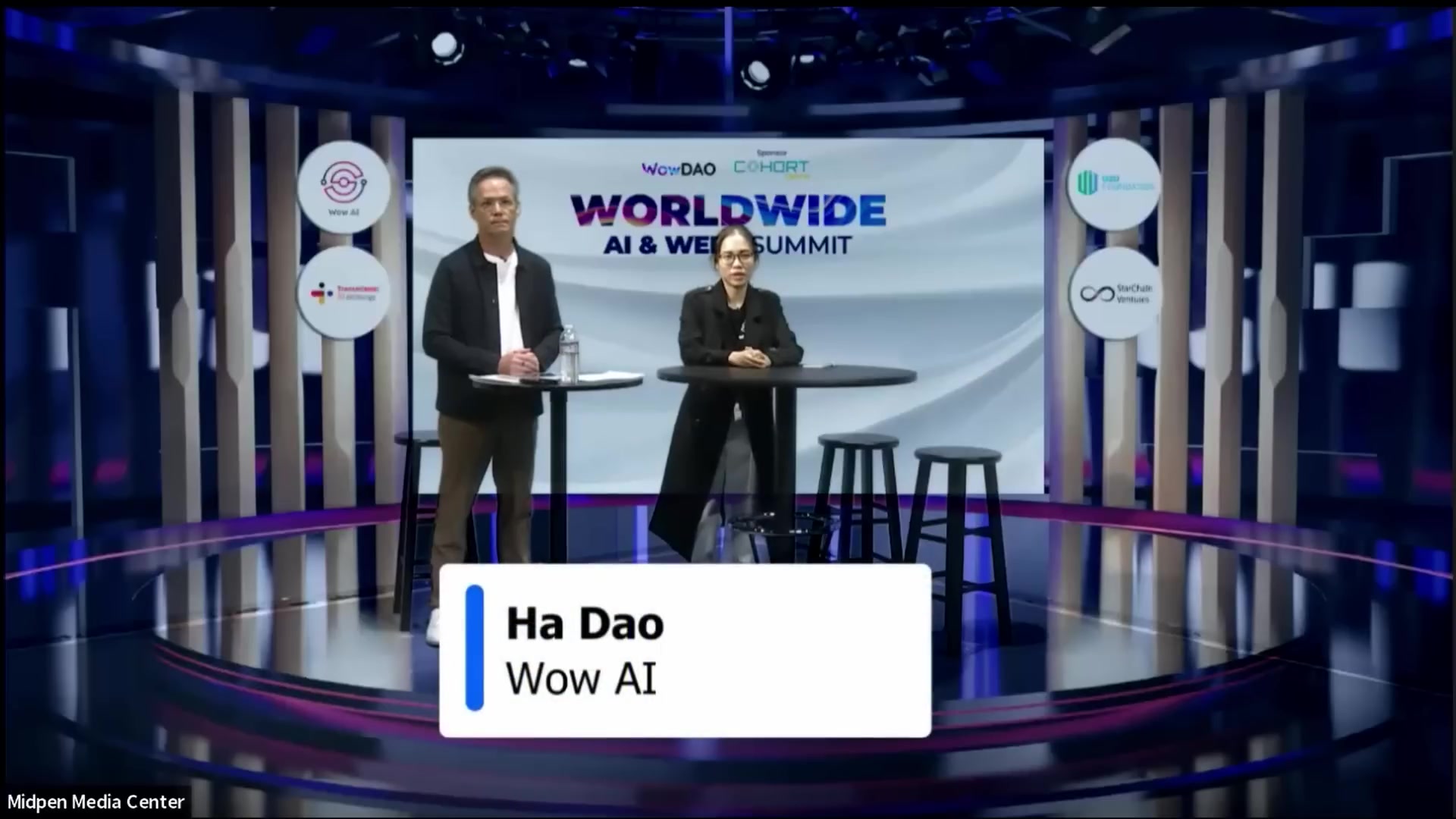
- 2023The Worldwide AI & Web3 Summit opens with Dao and marks WowDAO's launch.
- 2024At VTIS, Dao moderates discussions on decentralized AI and enterprise adoption.
- 2025Dao hosts technical forums and co-authors the CallCenterEN dataset paper.
- 2026AIxBlock emphasizes enterprise speech and LLM data with customer-controlled delivery.
A dataset with boundaries
In June 2025, Dao appeared as one of four authors on a paper introducing CallCenterEN, a dataset of real-world English call-center transcripts. The scale gives the project its immediate force: 91,706 conversations corresponding to 10,448 hours of calls, with accents from India, the Philippines and the United States. The transcripts were released for noncommercial research after personally identifiable information had been removed.
One decision says as much as the big numbers. The public release does not include the audio because of biometric privacy concerns. That choice leaves researchers with a large conversational corpus while withholding the part that could expose voices as biometric material. The dataset is useful, but it has edges. In a field that often treats scale as a moral argument, an explicit boundary is a small act of editorial taste.
The work also places Dao close to a practical tension in modern AI. Systems improve with varied, real-world examples. Real-world examples arrive attached to people, contexts and obligations. Removing identifiers is painstaking; deciding what not to release can be just as important. The data layer is full of these uncelebrated judgments. Every clean row has a backstory.
Custody is the connecting idea
Dao's interest in decentralized AI can sound, at first, like a separate chapter from enterprise data operations. It is better understood as the same question at a different altitude: who controls the useful resource? In public remarks about artificial general intelligence, Dao warned about advanced systems controlled by centralized organizations and expressed support for decentralized management and open-source approaches.
In a partnership announcement with DePIN company Hivello, Dao described a vision of decentralizing AI compute so individuals and businesses could contribute resources and benefit from the resulting economy. AIxBlock's earlier platform put that idea into product form through distributed training and a compute marketplace. Its current enterprise language approaches control from the customer's side, emphasizing data that remains inside client infrastructure.
The two architectures are not identical. One distributes supply; the other protects custody. Yet both resist an easy concentration of power. The recurring concern is less about making AI sound democratic and more about locating the keys. Who owns the GPU? Where does the recording sit? Which annotator touched a sample? Can a vendor retain a copy? These questions lack the romance of machine consciousness. Procurement teams, security officers and working engineers are likely to ask them anyway.
The operator at the microphone
Dao's public presence is often that of a convener rather than a solo prophet. At the 2022 Worldwide AI Webinar, Dao gave the opening remarks before a program featuring speakers from SAP, Mastercard, Oracle, AWS, Samsung SDS and Thomson Reuters. The later Worldwide AI & Web3 Summit began with Dao alongside Thomas Neubert, a former Intel executive, then moved through discussions about decentralized AGI and the AI knowledge economy.
At VTIS 2024, Dao appeared as AIxBlock's CEO and co-founder and moderated panels on decentralized AI and enterprise digital transformation. In 2025, Dao hosted an online discussion on the Model Context Protocol and AI agents with speakers from Mind Network, io.net and Exabits. Another workshop put Dao in the moderator's chair for a conversation about decentralized compute with leaders from SAP and Exabits.
Moderation is an underrated operating skill. It requires a person to set a useful frame, keep several vocabularies in the same room and resist turning every question into a speech. Dao's event record also maps the company strategy in public: enterprise adoption on one side, decentralized infrastructure on the other, and data moving between them.
The humans in the machine
Training data is routinely described as if it were discovered in a cupboard. Much of it is made. People record phrases in particular languages and environments. Annotators identify speakers, intents and entities. Reviewers compare decisions, resolve disagreements and send broken instructions back up the chain. A useful dataset is therefore both a technical artifact and a record of coordinated human attention.
AIxBlock's materials place that labor inside the product story rather than outside it. The platform has described custom labeling interfaces and human-in-the-loop workflows alongside automation and distributed training. Its more recent data-first position keeps collection, transcription and quality control close to the center. The arrangement matters because a weak guideline can multiply its confusion across thousands of examples, while a careful review process can make ordinary source material unusually valuable.
Dao's record as an operator fits this terrain. The public moments are often group moments: co-founders on a team page, researchers sharing a byline, speakers arranged around a panel, contributors invited into a community. Even the decentralized-compute argument depends on coordination. The computer contributes capacity, the organization sets terms, and participants need a credible way to see how value moves. Infrastructure may be drawn as boxes and arrows, but it behaves like a set of relationships.
The advantage of returning
By 2026, AIxBlock's public materials spoke more directly about speech collection, transcription, human-in-the-loop labeling, private datasets and data sovereignty. The language is narrower than the earlier promise to unify nearly every stage of AI development. It may also be closer to what the company knows with unusual depth. A team that has built the surrounding stack can understand where the data operation breaks and which tooling actually helps.
This is the part worth stealing. Follow the durable demand, but do not return empty-handed. The first version of a service may rely on people stitching together brittle tools. A detour through product development can turn that service into an operation with better interfaces, traceability and control. The destination looks familiar. The vehicle is different.
Dao's career remains more public in company rooms than in personal mythology. The visible record is workmanlike: founding teams, opening sessions, moderation, research collaboration, hiring technical staff and explaining why control matters. Even the central aspiration is architectural. Dao wants more participants to contribute to AI and more organizations to retain authority over the resources they bring.
The AI industry will continue giving the model the good chair and flattering light. Someone still has to carry the boxes, check the labels and decide which ones should never leave the building. Ha Dao has made that backstage work the main plot. The applause may be quieter there. The signal is not.