Artificial intelligence likes to enter through the front door. It arrives with a chatbot, a generated image, a machine that appears to reason. Shachar Fienblit has spent his career in the back rooms, where the questions are less photogenic and more stubborn. Where does the data live? How quickly can it move? What happens when a component fails halfway through a write? Can a system remain simple after it becomes enormous?
These are not cocktail-party questions, although an inventive host might try. They are the questions that decide whether the dazzling thing onstage works twice. Fienblit began asking them years before artificial intelligence turned racks of infrastructure into a subject of general conversation. He studied computer science at the University of Haifa, graduating in 2000 with the program’s first cohort, and went into storage engineering at IBM. The timing gave him a front-row seat to a world becoming ravenous for data while remaining rather fussy about losing it.
At IBM, his work ranged across concurrent software, continuous data protection, backup relationships, deduplication and the little dramas of atomic writes. A 2004 presentation on the “Interleaving Review Technique” dealt with the difficulty of reviewing concurrent systems, where several correct-looking actions can combine into one very incorrect afternoon. By 2007, he was among the authors presenting architectures for controller-based continuous data protection. Patents bearing his name later addressed the same durable anxieties: copies, failures, synchronization, recovery, reliability.
Chapter one
The glamour of things not breaking
Storage engineers practise a peculiar craft. Success often looks like absence: no corrupted file, no interrupted service, no customer discovering that “eventual consistency” has become a lifestyle. Fienblit’s early record is full of attempts to make absence dependable. The topics sound dry until the moment they fail. Then everyone becomes a storage enthusiast.
In 2009 he moved to Kaminario as vice president of engineering. There, the research problems acquired the impatient cadence of a product company. He helped build the K2 all-flash array and rose to chief technology officer in 2015. Flash promised speed, but speed alone is merely a fast way to arrive at trouble. Enterprise systems also demanded reliability, security and a convincing reason for cautious buyers to change their habits.
A small remark from that period captures his managerial taste. Discussing a security validation project, he praised the provider for keeping its promise and making a difficult certification painless. Engineers are supposed to admire difficulty. Engineering leaders learn to admire the removal of it.
By the time Fienblit left Kaminario, he had spent years turning technical trade-offs into products and products into arguments a market could understand. That distinction matters. A machine can be technically elegant and commercially mute. New categories are especially awkward: the person who understands the problem may not have the budget; the person with the budget may require a committee; the committee may have discovered the calendar.
He would later give this advice to Caroline Meidan, the CEO of BonData, during a Growth+ mentoring session. If a product resembles a thousand existing products, the buyer is obvious. If it is genuinely new, the founder must talk across the organization and locate several kinds of authority. At large companies, he explained, VAST projects can require broad consensus. Innovation may begin with a blank sheet of paper, but the purchase order usually arrives covered in signatures.
Chapter two
A clean sheet, then an untidy world
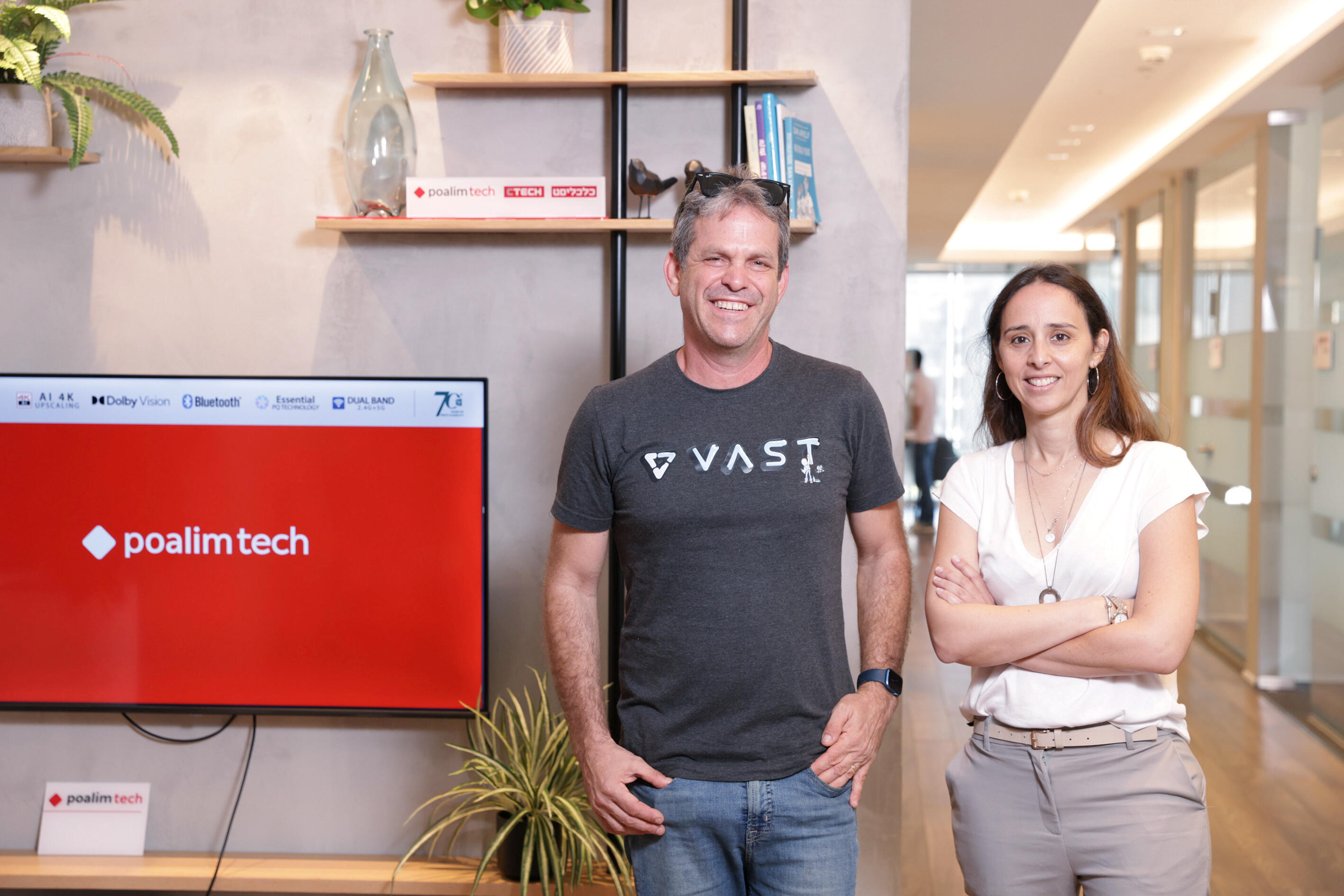
Fienblit joined VAST Data in 2017 as a co-founder and Chief R&D Officer. The founding team set out to redraw the storage architecture rather than polish an inherited diagram. VAST called the result DASE, short for Disaggregated Shared Everything. Its promise was audacious in a very engineering way: separate parts that needed to scale independently, let the system behave as one, and reduce the traditional bargains among performance, resilience, simplicity and cost.
The architecture arrived just as the unit of computing began to change. AI training did not merely need processors. It needed huge quantities of data delivered steadily enough to keep expensive processors busy. Images, video and audio widened the stream. Models grew, clusters multiplied and yesterday’s edge case became tomorrow morning’s capacity meeting.
At the SYSTOR conference in 2024, Fienblit described the practical algorithms inside VAST’s platform: similarity compression, error-correction techniques and scalable data structures for file systems, database queries and AI pipelines. The subject was exabyte-scale infrastructure, yet the intellectual thread reached back to those IBM years. Concurrency still mattered. Reliability still mattered. Cost still mattered. The future had not abolished the old constraints. It had given them a larger office.
VAST gradually widened its description of itself from a storage company to an AI operating system company, unifying data, computing and real-time processing. By 2026, the company said its environments supported millions of GPUs around the world. Its customer list stretched from cloud providers and AI laboratories to Lowe’s and the U.S. Air Force. Fienblit’s remit stretched with it: global engineering, strategic design choices and the software at the center of the platform.
Storage architecture and research at IBM.
Engineering leader, then CTO, at all-flash storage company Kaminario.
Joins VAST Data in stealth as co-founder and Chief R&D Officer.
Explains exabyte-scale AI data architecture in a SYSTOR keynote.
Presents the CoreWeave collaboration and begins VAST’s next R&D chapter.
Chapter three
The human system
Fienblit’s public language is notably less grand than the scale of the machinery. Asked about a crisis early in the startup journey, he reached for a roller coaster, the traditional vehicle of founders and people who have misread a theme-park map. There are many ups and downs, he said, and the trick is knowing how to grow from the ride. The hardest part, in his telling, is getting people to buy the product. Each sale carries both a technological problem and a business problem.
It is a useful correction to the mythology of the technical founder. Code does not escape human systems. It enters procurement, politics, budgets, trust and timing. Fienblit’s career contains plenty of algorithms, but his advice to a younger founder was to identify the people around the algorithm. Who feels the pain? Who understands it? Who pays? Who must agree?
His comments about VAST’s employees follow the same attention to systems of participation. During the company’s 2026 financing, he described employees as partners in its success. Secondary share transactions, he said, could let people buy apartments or pay off mortgages without waiting for an IPO. The principle is plain: if many people built the value, many people should feel its arrival.
That financing valued VAST at $30 billion, more than three times its late-2023 valuation. Fienblit marked the occasion by crediting the team, customers and partners who had shaped the platform. Then he pointed forward. The next chapter was already underway in R&D, and the company was hiring.
The months around the announcement show what that next chapter looks like in practice. At VAST Forward, he appeared with CoreWeave engineering leader Chen Goldberg to discuss their technical collaboration. In June, he shared a conversation with Microsoft about building AI pipelines together. Partnerships that large are another form of distributed system: independent organizations, shared objectives, unavoidable latency.
The beach and the machine
Fienblit lives in Ein Ayala, near Habonim Beach in northern Israel. The fact surfaced almost accidentally in the mentoring conversation, as good human details often do. It offers a pleasing contrast: the engineer responsible for software operating across a planet of data returns to a small community by the Mediterranean.
From there, the career’s shape becomes clear. University of Haifa. IBM’s storage work. Kaminario’s flash arrays. VAST’s distributed architecture. The scale widens at every step, but the questions remain remarkably stable. How do many moving parts act as one? How does the system recover? How can complexity be hidden without pretending it has disappeared?
AI has made those questions urgent enough for the rest of the world to notice. The models may receive the applause, but they are hungry performers. They need data, continuously and at industrial scale. Somewhere underneath, an architecture has to remember everything, deliver it quickly and refuse to panic.
Fienblit has spent more than two decades arranging that composure. His work is a reminder that technological revolutions depend on people who began early, stayed with unfashionable problems and learned to sell the solution as carefully as they built it. The future, when it finally appears at the front door, is often standing on infrastructure installed by someone in the back.