private-cloud
(17)
Estuary and the hidden price of free data
A data pipeline can be free and still cost a fortune in attention. Estuary sells a different bargain: capture the changes once, keep them, and deliver them when the business needs them.
HPE SimpliVity and the art of doing less
Seven minutes saved at the racetrack. Fewer copies in the data center. HPE SimpliVity makes a business of removing the work that gets between a question and its answer.
Zoot Enterprises and the machinery of yes
A Montana software company makes the complicated business of credit decisions move faster. Its real trick is giving lenders room to change their minds.
Tintri made storage see the VM. Then the business went dark.
Tintri taught storage to recognize individual virtual machines, making a difficult job less tedious. Its 2018 bankruptcy exposed a different problem: a useful product still needs a business that can pay its bills.
Automated Financial and the art of the uneventful bank
A loan is a promise. Servicing it is thousands of small obligations. Inside AFS, the company helping banks keep those obligations straight - and occasionally move 50,000 of them in a hurry.
CTS Built the Cloud Beneath British Law. Then One Outage Changed the Verdict.
For years, CTS sold law firms a persuasive idea: specialist technology, one accountable partner, fewer moving parts. Its rise - and the cyber incident that forced its MSP arm into a sale - is a case study in both the power and the peril of concentration.
Avatara Wants to Put Your Entire IT Department on One Monthly Bill
Most cloud vendors rent you parts. Avatara wants to run the whole machine - desktops, security, support and compliance - for one per-user fee. A defense contractor's perfect CMMC score shows why that unusual bet is getting timely.
Cloudian Survived a Telco Crash. Now It Wants to Feed AI Without Shipping Your Data Away
Cloudian turned the wreckage of a mobile-messaging company into an enterprise storage business. Its newest wager is that the AI race will be won as much in the data room as in the GPU rack.
The Open-Source Company That Quietly Runs Other People's Clouds
It bet on OpenStack, bought Docker Enterprise, and now wants to turn your GPUs into an AI factory - all without locking you in. In August 2026, IREN bought the whole thing for $625 million.

Prashanth Shenoy Is Selling the Cloud Back to the Data Center
After 22 years at Cisco, an engineer-turned-marketer walked into VMware just before its ownership changed. Now Prashanth Shenoy has the delicate job of making private cloud feel like the practical future, not a retreat to the past.

Steve Tuck
Steve Tuck is the co-founder and CEO of Oxide Computer Company, a hardware-software startup building a rack-scale 'cloud computer' that brings hyperscaler-style elastic infrastructure to on-premises data centers. After nine years at Dell and roughly a decade at cloud provider Joyent, Tuck teamed with Bryan Cantrill and Jessie Frazelle in 2019 to co-design servers, networking, and software from the ground up. Under his leadership Oxide has shipped its first commercial racks and raised more than half a billion dollars, including a $200M Series C, to expand its take on enterprise cloud ownership.

Atolio
Atolio is a private, AI-powered enterprise search platform that runs inside a company's own cloud (AWS, Azure, or GCP) or on-premises. It connects to workplace systems like Slack, Google Workspace, Office 365, Salesforce, and ServiceNow, then indexes them with document-level permissions so employees only see what they are already authorized to view. Founded in 2019 by Splunk and PagerDuty veterans, Atolio pairs hybrid semantic-plus-keyword search with permission-aware retrieval-augmented generation, giving enterprises secure question answering across siloed knowledge without their data ever leaving their environment.
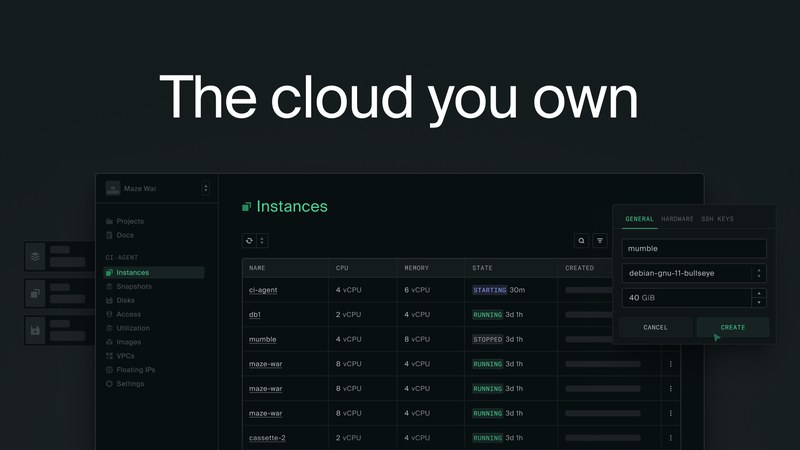
Oxide Computer Company
Oxide Computer Company builds the Oxide Cloud Computer, a rack-scale system that fuses purpose-built hardware with open-source software to give enterprises the elastic, API-driven experience of a public cloud inside their own data centers. Founded in 2019 by Joyent and Docker veterans, Oxide designs everything from the sheet metal, power distribution, and boot firmware up to the hypervisor and control plane, selling a single integrated rack rather than a pile of parts. It has raised over $577M, counts national labs and Fortune 1000 enterprises among customers, and is known for radical engineering transparency including a uniform company-wide salary.

Sihua Technologies Inc
Sihua Technologies Inc is a Cupertino, California enterprise-infrastructure software company that helps organizations build private and hybrid clouds inside their own data centers. Its software-defined stack - the ExpressVM virtualization engine, the MegaBric hyper-converged storage suite, and the XOS operating layer - collapses compute, virtualization, and storage onto standard x86 servers, aiming for enterprise-class performance and high availability without the price of proprietary appliances. Founded in 2000 and paired with its Shanghai-based sibling company KXTech, Sihua also ships media-streaming (XView) and AI data-acceleration (NeuADC) products for telecom and enterprise customers.

MetalSoft
MetalSoft is a Chicago-based infrastructure software company that turns racks of physical servers, switches, and storage into cloud-like, self-service infrastructure. Its CloudPlex platform automates the full lifecycle of multi-vendor bare metal hardware - discovery, OS and firmware deployment, network fabric configuration, and storage - so enterprises and service providers can provision dedicated infrastructure on demand via a UI or API. Spun out of cloud hosting company Hostway in 2019 and led by serial founder Lucas Roh, MetalSoft raised a $16M Series A in December 2022 and has since pivoted hard toward orchestrating GPU clusters and 'AI factories' for telcos, data center operators, and Fortune 500 enterprises.
Nutanix
Nutanix is a San Jose-based enterprise cloud software company that pioneered hyperconverged infrastructure (HCI), collapsing servers, storage, virtualization and networking into a single software layer that runs the same way in a private data center, at the edge, or in the public cloud. Its platform lets IT teams run virtual machines, containers, databases and AI workloads across clouds without the operational sprawl of traditional three-tier architecture. Now a public company (NASDAQ: NTNX) with more than $2.5 billion in annual revenue and roughly 7,000+ employees, Nutanix competes head-on with VMware as enterprises rethink their virtualization stack.
MinIO
MinIO is a high-performance, S3-compatible object storage company building the data layer for AI. Its software-defined storage runs on commodity hardware in private clouds, on-prem, and at the edge, and is used by more than half of the Fortune 500 to power analytics, ML training, and exascale AI workloads.