Here is a fact about the modern computer industry that, once you notice it, is hard to un-notice: nobody actually sells you a computer. They sell you parts. You buy a server from one company, a network switch from another, storage from a third, an operating system from a fourth, and a management layer from a fifth, and then you - or, more realistically, a team of expensive people - spend months making those parts pretend to be one machine. This is fine. It is how the entire on-premises data center industry works. It is also, if you think about it for more than a few seconds, slightly insane.
Oxide Computer Company thinks about it for more than a few seconds. Founded in December 2019 by Steve Tuck, Bryan Cantrill, and Jessie Frazelle - a group whose collective resume includes Joyent, Docker, GitHub, and Google - Oxide's founding observation was that the big cloud providers had solved this problem for themselves and only for themselves. Amazon, Google, and Microsoft do not buy servers and bolt them together. They design their own hardware and their own software as a single, coherent system, because at hyperscale the seams between components are where money and reliability go to die. Oxide's pitch, which the company likes to phrase as hyperscaler infrastructure for the rest of us, is simply that you should be able to buy that too.
"They set out to close an innovation gap in server hardware - and started, as computer companies are contractually required to, in a garage."
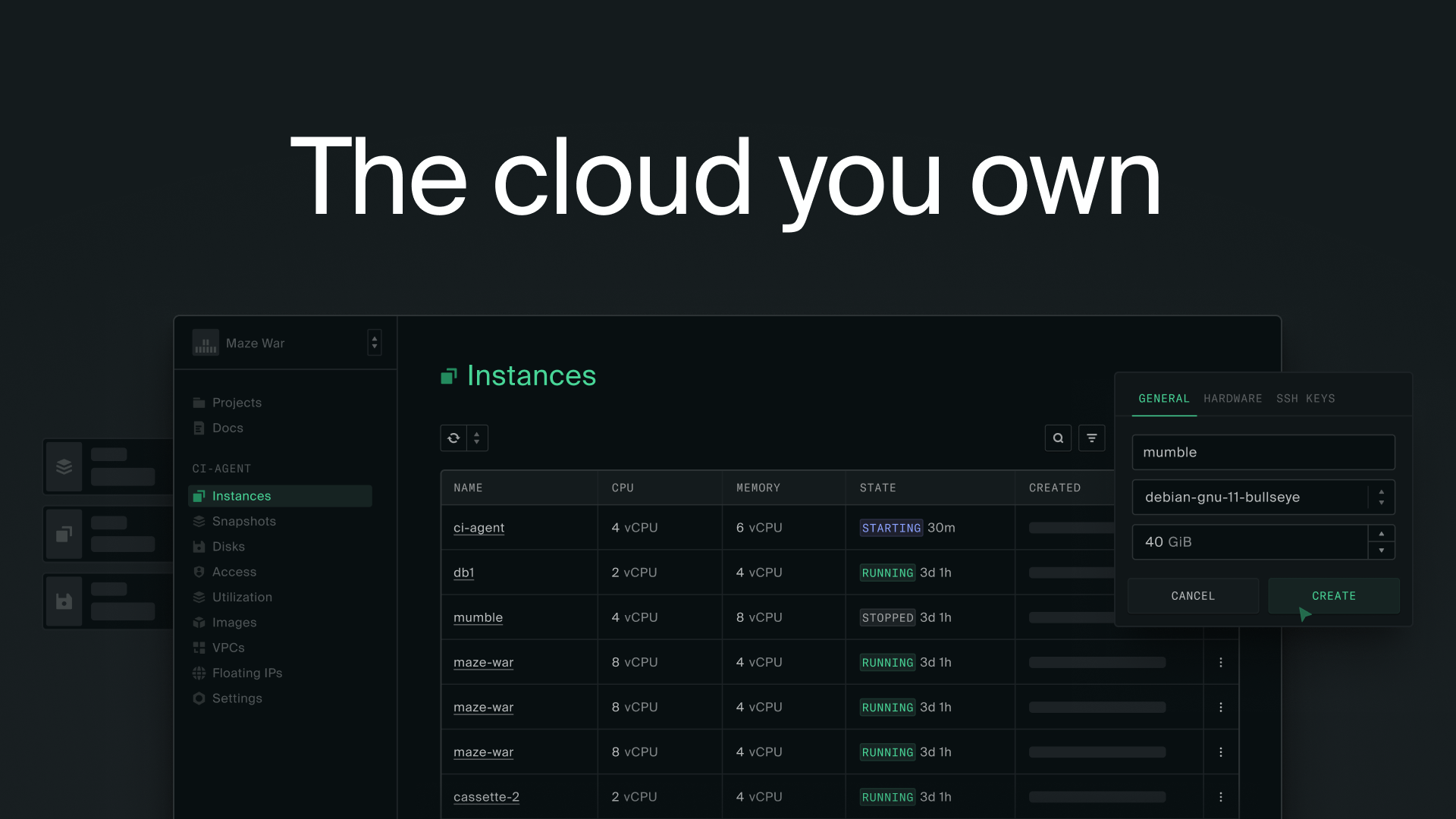
So Oxide builds the whole thing. Not the metaphorical whole thing - the literal whole thing. The sheet metal. The power distribution shelf that replaces the rats-nest of individual power supplies most racks carry. The networking. The service processors. The boot firmware. The host operating system. The hypervisor. The control plane and the API that sits on top of all of it. The product is called the Oxide Cloud Computer, and the important word in that name is the singular: it is a computer, a rack that arrives on a pallet, gets rolled onto your floor, plugged in, and behaves like a cloud region you happen to own.
The unglamorous layer nobody wanted to fix
The most Oxide thing about Oxide is what they did with firmware. Every server on Earth boots on a layer of software - the BIOS or its modern descendants - that is, to put it charitably, historical. It is a compatibility archaeology dig, full of assumptions from a computing era that no longer exists, and it is proprietary, opaque, and a favorite hiding spot for security problems. The reasonable engineering response to this is to grumble and live with it, because rewriting the boot path of a server is the kind of project that sounds like career suicide.
Oxide rewrote the boot path of a server. They built an all-Rust, microkernel-based embedded operating system called Hubris to run on their service processors, threw out the legacy firmware model, and then - and this is the part that tells you what kind of company this is - open-sourced it. Their host OS, Helios, is built on illumos. Their commercial thesis, stated plainly, is that open source belongs in the lowest layers of the stack, not despite the fact that they are selling hardware but because of it. If you are going to ask a bank or a national laboratory to trust a box with their most sensitive workloads, letting them read every line of how it boots is a competitive advantage, not a giveaway.
What you can actually do with it
The practical payoff is that a developer inside an organization running Oxide gets something that feels like the public cloud. There is an API. You provision an elastic virtual machine, attach block storage, wire up virtual networking, and tear it all down again - self-service, programmatic, no ticket to the infrastructure team, no waiting three weeks for a physical server. The difference is that the machine lives on your floor, the data never leaves your building, and there is no monthly bill that grows mysteriously every quarter. For organizations with regulatory, sovereignty, latency, or cost reasons to keep computing close - which is a longer list than the last fifteen years of cloud marketing would suggest - this is the whole ballgame.
"A rack that arrives on a pallet and behaves like a cloud region you happen to own."
It is worth being precise about who this is for, because Oxide is not trying to win the argument that everyone should abandon the public cloud. That argument is silly, and the company does not make it. The pitch is narrower and therefore more credible: there is a real, growing set of organizations for whom renting infrastructure from three American hyperscalers is a poor fit - because of data sovereignty rules, because of latency, because a workload runs constantly and the cloud bill for constant workloads is brutal, or simply because they would like to own the thing they depend on rather than lease their future one API call at a time. For those buyers, the historical alternative was to assemble a private cloud out of Dell or HPE boxes, VMware or Nutanix software, and a great deal of integration labor. Oxide's wager is that a single vendor who designed the hardware and the software together can deliver that experience without the assembly.
The customers bear this out. Oxide's first publicly named buyer was Idaho National Laboratory, a Department of Energy research facility. Lawrence Livermore National Laboratory followed. A global financial services organization is in the mix, along with Fortune 1000 enterprises, and Oxide has parked racks at a CoreSite data center in Silicon Valley so prospective buyers can poke at the real thing. These are not customers who buy on vibes. National labs and banks are, professionally, the most skeptical hardware buyers alive, and they are the ones signing.
The salary thing
No profile of Oxide is complete without the salary thing, because it is the detail that makes people either love the company or squint at it. For most of its life, Oxide has paid nearly every employee the same base salary - reported at $201,227, later reset to $275,000 - regardless of role, seniority, or location. The CEO makes it. The new engineer makes it. The founders arrived at the number by asking what they themselves needed to live without financial distress and then deciding that if it was good enough for them it was good enough for everyone. Salespeople have incentives; almost no one else does.
You can read this as a stunt, but the company's own argument is more interesting and probably more correct: when nobody is negotiating salary or guarding compensation as a secret, an entire category of politics simply evaporates. People discuss their actual struggles instead. There are, the founders report, no internal silos, a culture that rewards openness and curiosity over empire-building, and a ritual called Demo Friday where engineers show each other what they made. It is a bet that transparency is not a virtue you tolerate but a system you build the company on - the same instinct that led them to open-source the firmware, applied to the org chart.
There is also a texture to Oxide that predates its first shipped rack, and it explains a lot about how the company recruited the people willing to rebuild a server from the atoms up. Before there was hardware to demo, the founders made a podcast. "On the Metal" - later succeeded by "Oxide and Friends" - was a series of conversations at the hardware/software interface, which the hosts cheerfully described as the nerdiest podcast on the planet. This is not a marketing footnote. It is how a small company signaled to a very specific kind of engineer that here, at last, was a place that took the boring and difficult lower layers of computing seriously. You do not staff a project like Oxide with a job listing. You staff it by being visibly, publicly obsessed with the same unglamorous problems the best systems engineers privately obsess over, and letting them find you.
The money and the math
Investors have found the whole thesis persuasive enough to fund it heavily. A $20M seed from Amplify and Eclipse got the company off the ground. A $44M Series A in 2023, led by Eclipse with Intel Capital, paid for the commercial launch. And in February 2026, Oxide closed a $200M Series C led by Thomas Tull's US Innovative Technology Fund, with Eclipse, Riot Ventures, Jane Street, and Intel Capital along for the ride - pushing total funding past $577M. That is an enormous amount of capital for a hardware company, which is the point: building the sheet metal, the firmware, the OS, and the control plane all at once is expensive precisely because it is the thing everyone else outsources.
Whether Oxide becomes the default way enterprises own their cloud, or a beloved niche for the institutions that most need it, is genuinely unresolved. What is not in doubt is that the company built a real, shipping, from-scratch cloud computer at a moment when the entire industry had agreed that owning your own infrastructure was a solved and somewhat embarrassing problem. Oxide's answer to that consensus was to design a better rack and let the national labs decide. So far, the national labs are deciding in its favor.