At CACI, the storage problem had become a problem of space. The systems integrator was running out of capacity, its data center was crowded, and a maintenance renewal threatened another bill. The old arrangement occupied 44 rack units. After a move to Tintri VMstore, the published case study says, the storage occupied two. That is a rather good disappearing act for equipment whose chief purpose is to keep things.
- The idea: manage the individual virtual machine, rather than making people interpret shared storage containers.
- The customer: IT teams running virtual desktops, business applications, development environments and private clouds.
- The complication: Tintri filed for bankruptcy in 2018; DDN bought its assets for $60 million.
- The second act: VMstore now sits alongside container integration, cloud offerings and a Platform9 partnership.
But the smaller footprint was only part of the change. CACI’s account also describes a reduced need for specialist storage administration. The appeal was a machine that took away some of the work associated with owning a machine. Enterprise technology has a habit of selling a box and delivering a new occupation.
Tintri’s proposition was to reverse that transaction. Its storage would understand the applications sitting on it, and administrators would spend less time translating between the language of an application and the language of a disk array. The product found buyers. The company’s finances, as it turned out, needed their own intervention.
01 / The machine you could finally see
A virtual machine is a software-defined computer sharing a physical server with other software-defined computers. It has its own workload, its own demands and, occasionally, its own talent for inconveniencing its neighbors. A storage volume, meanwhile, can contain data belonging to many of those machines. Knowing that the volume is busy does not necessarily tell you whose application is suffering.
Imagine a building superintendent who can see the total electricity consumption but cannot identify the apartment running six heaters. The building’s meter is accurate. It is simply measuring at an inconvenient level. The storage equivalent is an administrator trying to explain why one application feels sluggish while an aggregate performance chart appears respectable.
Founded by Kieran Harty and Mark Gritter in 2008, Tintri brought its first products to market in 2011. Harty had worked on VMware’s engineering leadership. The company tackled the mismatch between virtualized computing and storage designed around physical abstractions. Its answer was VM-aware storage: make the virtual machine an object the storage system could recognize.
One aggregate view
Its own protection policy
That changes the conversation. An administrator can inspect the affected VM, examine its behavior and assign policies to the workload in question. Quality of service controls address the familiar “noisy neighbor” problem, in which a hungry workload monopolizes shared resources. Visibility helps distinguish storage trouble from trouble elsewhere in the computing stack.
“Issues that used to take days to troubleshoot now take minutes.”
Jan Adolfsson, Cambio Healthcare Systems
Customer quotation published by Tintri
The difference matters because flash storage alone does not settle the question of who gets served. Tintri’s expertise lies in the relationship between the storage system, the virtualization layer and the individual workload. A faster queue can still be a badly managed queue.
02 / Forty-four rack units, two left standing
CACI supplies a useful, limited piece of evidence. Tintri’s customer summary reports power costs falling from $33,000 to $1,600 alongside the rack consolidation. It does not identify the billing period, so those figures should be read as the reported before-and-after comparison. They are not an annual savings forecast for the next buyer.
The customer base extends beyond systems integrators. Tintri publishes accounts from healthcare providers, municipalities, financial organizations and technology companies. These are environments where a small IT team may be responsible for many applications, and where recovering an application can matter more than winning a throughput contest.
Development teams offer another telling use case. In Tintri’s account of Mentor Graphics, a completed software build triggers a test cycle: create the required VMs, run tests, gather results, delete the VMs and repeat. Storage becomes part of a repeatable workflow. Tintri’s public REST API, Python SDK and PowerShell tools give administrators ways to automate management rather than click through every operation.
The lesson a reader can copy is straightforward: choose a unit of management that matches the task. If the task is to diagnose an application, start with the application. If the task is to refresh a test environment, make the refresh repeatable. Requiring a human to translate between layers is a cost even when the invoice has no line for it.
03 / The product’s finances had a noisy neighbor
By August 2015, Tintri had raised a disclosed $260 million, including a $125 million Series F led by Silver Lake Kraftwerk. It went public in 2017. There were substantial customers and an intelligible technical proposition. Those facts made the next chapter uncomfortable.
For the fiscal year ended January 31, 2018, Tintri reported approximately $125.9 million in revenue and a $157.7 million net loss. Revenue had barely moved from the previous year’s roughly $125.1 million. The loss had grown. These are historical standalone-company figures, and they describe a business whose financial demands had outrun its sales.
Fiscal year ended January 31, 2018. A net loss is an accounting measure, not the same thing as cash burned.
On July 10, 2018, Tintri filed for Chapter 11. DDN announced its $60 million acquisition of Tintri’s assets on September 4, after an auction and court approval. What failed first in this account was the independent business’s ability to keep funding itself. The bankruptcy did not demonstrate that every customer’s storage system had stopped being useful.
DDN’s immediate priorities included restarting support, expanding the roadmap and rebuilding staffing. Its president, Paul Bloch, said customer validation had encouraged DDN to hire former Tintri employees even before the auction outcome. That explains the buyer’s conviction more concretely than a vague faith in the brand: there was an installed base with reasons to keep the technology.
04 / Recovery belongs beside performance
A storage product has to answer two questions: can I use my data, and can I get it back? Tintri’s protection offering includes immutable snapshots, replication and role-based access controls. Its current ransomware material puts recovery alongside application-level management, rather than treating protection as a separate conversation after performance has been discussed.
That is useful for a virtual desktop, a business application or a database that needs a previous state restored. It is also a reason to demonstrate recovery in a realistic environment. A locked snapshot helps preserve a recovery point; a successful recovery still involves the application, its dependencies and the procedures people follow.
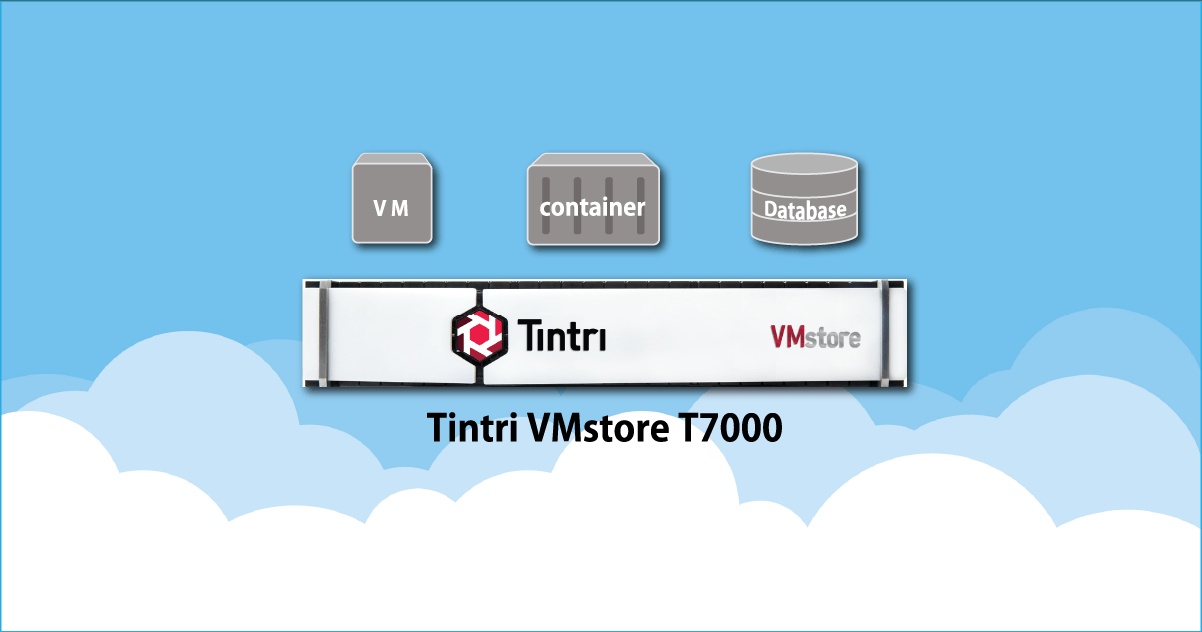
In September 2025, Tintri announced the T7290 and TxOS 6.0. The documented additions included dual-custody snapshot locking and expanded platform support. Tintri also reported support for 30 TB drives and up to 2.58 PB in one system. Those capacity claims describe the announced platform; usable capacity and application performance need configuration-specific evaluation.
05 / The box becomes optional
The present portfolio has three related routes. VMstore is the on-premises storage and workload-management platform. Tintri Cloud Engine separates Tintri software from its dedicated hardware and supports cloud replication use cases. Tintri Cloud Platform offers managed infrastructure, including a virtual data center, infrastructure services and disaster recovery services.
This is an enterprise infrastructure business: appliances, software and support sold directly and through partners, with managed services extending the model. A buyer needs a quotation for the actual configuration and operating arrangement. Capacity, support, migration work and cloud charges belong in the same calculation as the purchase price.
In March 2026, Tintri and Platform9 announced a bundled solution for virtual machines, containers and AI-related infrastructure. The announcement addresses another mixed-household problem: different workload types sharing resources. In July, Tintri reported two Storage Awards wins. The partnership and product releases provide the more practical evidence of an active roadmap under DDN.
06 / Make the demonstration earn the purchase
Tintri sits among enterprise storage alternatives such as NetApp, Dell and Pure Storage. Buyers may also consider Nutanix when deciding whether to combine compute and storage in hyperconverged infrastructure. The appropriate comparison is the architecture and daily work each choice requires for a particular environment.
Its proposition is most persuasive when many virtualized workloads share storage and administrators need granular control. An organization whose main requirement is unrelated to those capabilities should demand evidence for its own use case. A cloud-only deployment also changes which parts of Tintri’s portfolio are relevant. Product versions and supported integrations matter.
A useful evaluation gives competing workloads something to fight over, then checks the affected application’s latency. It restores a VM or database while other work continues. It refreshes a development environment. It asks who manages the system, what the support contract covers and how migration will proceed. These tests turn promised simplicity into observable steps.
Tintri’s history leaves a final, unusually practical buying lesson. Examine the application and examine the supplier. Customers can love a product whose maker runs out of money. The storage may remember every virtual machine perfectly; someone must still remember to keep the company solvent.
Go meet the machinery
Explore Tintri, its VMstore platform, customer accounts, news and technical blog.
Watch Mark Gritter and Edward Lee explain VMstore architecture, visit Tintri’s technical demonstrations, or browse Geek Out! demos.