There is a whole class of technology company that you depend on without ever seeing. It does not run an app on your phone. It does not send you a newsletter. It sits three or four layers underneath the software you actually touch, keeping the lights on. Mirantis is one of those companies - and in August 2026, an AI data-center operator called IREN paid $625 million to own it.
If the name rings a faint bell, it is probably from the DevOps world, where Mirantis has been a fixture for more than a decade. It is the company that helped build OpenStack. It is the company that bought Docker's enterprise business when Docker fell apart. It owns Lens, the Kubernetes tool that sits open on a lot of engineers' second monitors. And lately it has been telling a new story about turning raw racks of GPUs into working AI infrastructure. For a company founded in 1999, that is a lot of lives.

From an outsourcing shop to an open-source bet
Mirantis is older than most of the technology it now sells. Alex Freedland and Boris Renski started it in 1999, and for its first decade it looked nothing like a cloud company - it was an engineering services shop, doing outsourced software work. The turn came around 2011, when the team threw its weight behind OpenStack, the open-source project for building private clouds. That was the bet the company still runs on: that open, shared infrastructure would beat proprietary stacks, and that a firm willing to do the unglamorous work of hardening it could build a real business.
The bet took years to pay off, and it nearly went sideways more than once as OpenStack's early hype cooled. What kept Mirantis relevant was its willingness to follow the workloads. When containers and Kubernetes became the way software actually shipped, it moved there too, adding Kubernetes support in 2015 and reshaping itself around cloud-native infrastructure rather than any single project.
What Mirantis actually does
Strip away the acronyms and the pitch is simple: most companies would rather not become Amazon Web Services, but they still want the things AWS gives them - elastic compute, containers, a place to run their software reliably. Mirantis builds the software that lets an enterprise, a telecom, or a cloud provider stand up that capability on their own hardware, in their own data center, or across several clouds at once. You own the cloud instead of renting it.
The through-line across every era of the company is open standards. Mirantis' products are built on projects anyone can inspect - OpenStack, Kubernetes, and its own open-source releases like k0s and k0rdent. The business is not the code. The business is running it for you and standing behind it at 3 a.m.
"We're not going anywhere. We're just getting started."Mirantis, on the IREN acquisition
Who actually uses it
The customer list is heavy on the kind of institutions that cannot afford to guess. Mirantis says it has served roughly 1,500 enterprises across financial services, telecom, insurance, government and tech - names like PayPal, Reliance Jio, Adobe, DocuSign, Liberty Mutual, Societe Generale, Splunk and Volkswagen.
Two of those tell the story better than a brochure. PayPal moved more than 700 applications - over 200,000 running containers - onto Docker Enterprise, the platform Mirantis now owns, and reported building, testing and deploying software about 50% faster afterward. In India, Reliance Jio went from startup to the country's largest telecom on a base of OpenStack running on 4,000 bare-metal nodes, with Kubernetes stitched over the top to serve on the order of 400 million subscribers.
The problem it solves
The recurring enemy in the Mirantis pitch is lock-in - the slow trap of building your entire operation on one vendor's proprietary stack and discovering, years later, that leaving is impossible or ruinously expensive. Enterprises felt it when Broadcom took over VMware and repriced it; Mirantis showed up offering OpenStack as the exit. AI teams are feeling a newer version of it now, as proprietary GPU stacks harden into technical debt.
Mirantis' answer is to make the underneath layer neutral and composable. If it is built on open standards, you can swap pieces, mix hardware from different makers, and move workloads between on-prem, cloud and edge without rewriting everything. That is a less exciting promise than "revolutionary AI," but it is the one CIOs actually sign.
"Our contributions to k0rdent, Kubernetes, k0s, OpenStack and more continue."Shaun O'Meara, CTO, Mirantis
How it is different from the competition
Mirantis competes with Red Hat's OpenShift, with Broadcom's VMware, with SUSE's Rancher, Canonical, Platform9 and Nutanix. What sets it apart is less a single feature than a posture: it is unusually all-in on open source, to the point of giving away its crown-jewel projects and betting the revenue on support and managed operations. Where a rival might guard a proprietary control plane, Mirantis open-sourced k0rdent under Apache 2.0 and dared the community to judge it on its contributions.
The other difference is appetite. Mirantis grows by absorbing the tools engineers already use. Docker Enterprise, the Lens IDE, Amazee.io's Lagoon, Shipa - each acquisition pulled a piece of the DevOps workflow into the fold. The strategy is quieter than launching something flashy, and it keeps working.
Products and services
The portfolio spans from bare metal all the way to AI models. A few of the load-bearing pieces:
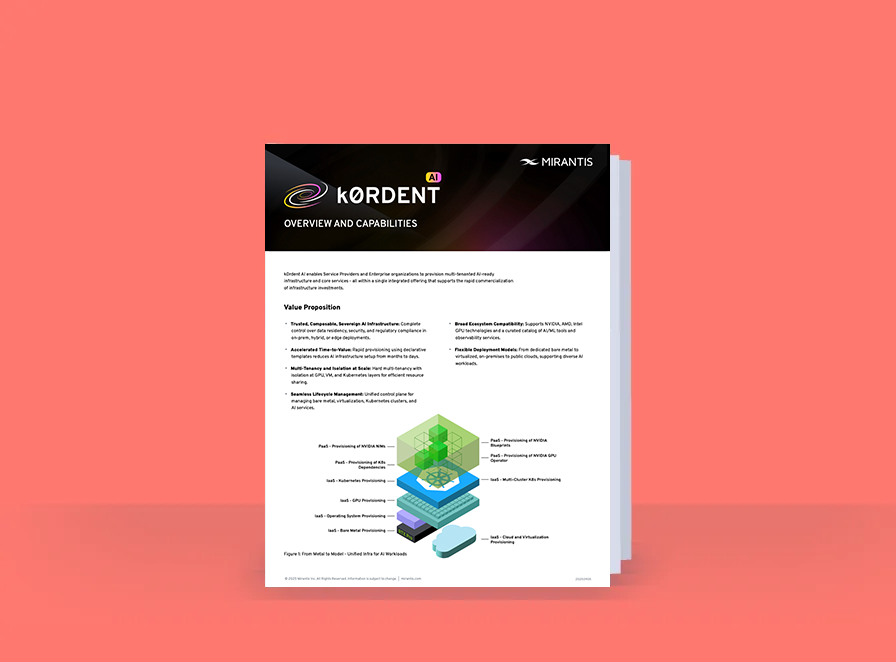
- k0rdent AIA control plane that automates deploying and managing AI/ML infrastructure - GPUs, Kubernetes, NVIDIA Run:ai, inference services - with a Model Registry and Inference Mesh to host, route and meter models.
- k0rdentOpen-source distributed container management: one pane of glass for Kubernetes across cloud, on-prem and edge, doubling as a base for internal developer platforms.
- MKEMirantis Kubernetes Engine - the enterprise platform formerly known as Docker Enterprise.
- LensThe widely used Kubernetes IDE for managing, debugging and monitoring clusters, with Pro and Enterprise tiers.
- k0sA certified, single-binary Kubernetes distribution that runs from edge devices to servers.
- MOSKMirantis OpenStack for Kubernetes - containerized private cloud, pitched as a VMware replacement.
The business model, in one line
Open core. Give away k0s, k0rdent and Lens; make money on enterprise subscriptions, 24/7 support, and a fully-managed "ZeroOps" tier where Mirantis runs the whole thing for you. The free software is the funnel; the contract is the product. It is a model that only works if the open-source contributions are real - which is why the company keeps pointing to its OpenStack track record, where it ranks third all-time by both commits and lines of code.
Funding & the exit — headline amounts
Intel Capital
Series B
Intel / Goldman
IREN buyout
Expertise and where it fits
Mirantis' deep bench is in the unglamorous middle of the stack: distributed systems, container orchestration, secure runtimes, and the operational discipline of keeping other people's production clouds alive. That expertise is exactly what the AI boom suddenly needs. Everyone is buying GPUs; far fewer know how to turn a warehouse of them into something an enterprise can safely use.
Which is what the IREN deal is really about. IREN runs data centers and compute; it was missing the software layer between the metal and the model. Buying Mirantis - announced in May 2026 and closed that August for $625 million in stock - filled that gap in one move. Co-founder Alex Freedland, who returned as CEO in 2024, steered the company through the pivot and out the door. For a firm that started in 1999 doing engineering outsourcing, it is a fitting last act: still selling the plumbing, just for a much bigger building.
Twenty-seven years of pivots
Bar length is illustrative of the company's arc, not a precise metric.What can you take from the Mirantis story? If you build developer tools, the open-core lesson is blunt: give away the thing engineers love, sell the thing their bosses need. If you invest, the pattern of buying momentum when incumbents stumble - Docker's breakup, VMware's repricing - is a repeatable read on the market. And if you run infrastructure, the quiet bet Mirantis kept making holds up: in a hype cycle, the neutral plumbing tends to outlast the shiny thing on top.