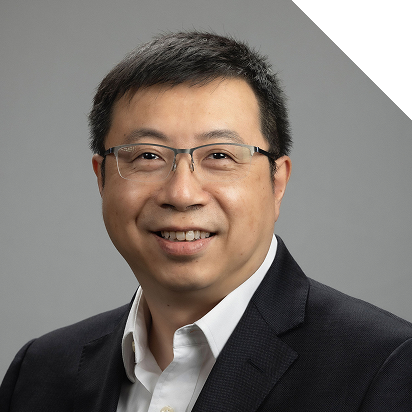
The Engineer Who
Keeps Finding the Next Problem
In 2019, Tenry Fu walked away from Cisco three years after the company had paid $260 million for his startup. He didn't take a sabbatical. He didn't angel invest. He called the same two people he'd built CliQr with - Saad Malik and Gautam Joshi - and they started again. Same team. New problem. Spectro Cloud was born.
That decision - to rebuild with the same founding team twice - tells you almost everything about how Fu operates. He doesn't chase markets. He chases problems he's lived with long enough to know where the body is buried. At CliQr, the problem was cloud deployment automation: how do you move applications across hybrid cloud environments without a nine-month engineering project? At Spectro Cloud, the problem is Kubernetes: how do you manage tens of thousands of clusters across data centers, multiple clouds, and the tactical edge - including on military aircraft, ships, and tanks - without losing your mind?
"We founded Spectro Cloud five years ago aiming to make Kubernetes easy to manage and consume in any environment, and this investment from Goldman Sachs is validation of the tremendous opportunity we have ahead of us."- Tenry Fu, on the $75M Series C, November 2024
Fu started his career in 1999 at McAfee - back when enterprise security meant something very different, and the cloud didn't exist yet. Eight years there gave him a security-first perspective that quietly informs everything Spectro Cloud builds: the FIPS and FedRAMP compliance capabilities that now make Palette a serious option for regulated industries and the U.S. Department of Defense are not an afterthought. They're foundational.
Then came VMware from 2007 to 2010, where Fu worked as a Staff Engineer/Architect at the company that effectively invented modern enterprise virtualization. He arrived there just as the industry was figuring out that virtual machines would change everything, and left just as the cloud computing era was beginning. The timing, in retrospect, looks almost prescient.
"There is a huge adoption trend for cloud-native in government, and every moving object - such as planes, tanks, ships - all become edge locations."
- Tenry Fu, Spectro Cloud CEOCliQr: The $260M Rehearsal
In November 2010, Fu co-founded CliQr Technologies with Gaurav Manglik and others, serving as CTO. The premise was straightforward and, at the time, genuinely hard: give enterprises a way to deploy and move applications across public, private, and hybrid cloud infrastructures through declarative application modeling. Write what you want, not how to do it. Let the platform figure out the rest.
By 2016, Cisco paid $260 million to acquire the company. Fu stayed for three years as Sr. Director and Chief Architect for Cisco's Cloud Platform Solutions Group, leading architecture for the Cisco CloudCenter Suite and Cisco Container Platform. He was, in other words, one of the chief architects of how Cisco thought about cloud for three years post-acquisition - which is exactly the vantage point from which he noticed the next problem.
Kubernetes was becoming the de facto standard for container orchestration. But nobody had solved management at scale. At the enterprise level, running Kubernetes in one environment is a project. Running it across dozens of environments - on-premise, in three clouds, at remote edge locations - is a full-time organizational nightmare. Fu had seen the pattern before with cloud deployment. He knew what an unsolved problem looked like from the inside.
"There needs to be a way to make Kubernetes more approachable and manageable."- Tenry Fu
He recruited Malik and Joshi - the same engineers he'd trusted at CliQr - and they went back to work. The willingness of two experienced technologists to bet on the same person twice, in the same domain, says something about what it's like to work with Fu. Founder credibility is easy to fake once. Recruiting the same founding team a second time is harder to fake.
Spectro Cloud: Kubernetes, Everywhere
Spectro Cloud's Palette platform takes a declarative approach to Kubernetes management - the same intellectual DNA as CliQr's approach to cloud deployment, applied to a harder problem a decade later. The idea: define your cluster configuration as code, let Palette handle provisioning, updates, security policies, and lifecycle management across any environment. On-prem. AWS. Azure. Google Cloud. Bare metal. The edge. All of it.
The customers tell the story more efficiently than any marketing copy could. GE HealthCare. T-Mobile. Nokia. The U.S. Air Force. The U.S. Navy. These are organizations with sprawling, heterogeneous infrastructure operating under real compliance requirements. They chose Palette because the alternative - managing Kubernetes clusters manually across dozens of environments - stops scaling somewhere around "more than ten clusters." Spectro Cloud's platform is designed to manage tens of thousands.
The Series C in November 2024 - $75M led by Goldman Sachs, valuing the company at $750M - came on the back of three consecutive years of triple-digit ARR growth. Goldman Sachs' Michael Reilly specifically called out "bare metal deployments in data centers for VM and GPU management, and AI inference at the edge" as the growth drivers ahead. This is not a coincidence. Fu has been positioning Spectro Cloud for the AI infrastructure wave: making GPUs and virtual machines "first-class citizens in Kubernetes" is precisely the problem that enterprises running AI workloads at the edge need solved.
The company is also betting big on government and defense. Fu noted that "every moving object - planes, tanks, ships - becomes an edge location" in the cloud-native era, and Spectro Cloud's public sector product edition has been in development for two years. The U.S. Air Force and U.S. Navy aren't just logo wins. They're proof points for an entirely different class of enterprise customer: one where security, compliance, and disconnected-edge operation aren't nice-to-haves.
"By providing one or many declarative and flexible 'stacks' for their Kubernetes deployments, Spectro Cloud enables enterprises to manage multicluster, multidistro in multi-environment efficiently."
- Tenry FuBuilt, Sold, Built Again
- Co-founded CliQr Technologies (2010); acquired by Cisco for $260M in 2016
- Holds 15+ patents in scalable distributed systems, enterprise system management, and security
- Led Spectro Cloud to triple-digit ARR growth for three consecutive years
- Raised $142.5M total: seed (2020), Series B $40M (2022), Series C $75M led by Goldman Sachs (2024)
- Customers include U.S. Air Force, U.S. Navy, GE HealthCare, T-Mobile, and Nokia
- Named Gartner Cool Vendor for Edge Computing (2022)
- Named GigaOm Leader and Outperformer: Edge Kubernetes and Managed Kubernetes (2024)
- Named CRN Tech Innovator
- 20+ years building enterprise software infrastructure at McAfee, VMware, Cisco, and two startups
Twenty-Five Years, One Through-Line
Eight years building cybersecurity and enterprise security frameworks. The security-first instinct that now drives Spectro Cloud's FedRAMP capabilities starts here.
Three years at the company defining enterprise virtualization, as cloud computing begins its takeover of the data center.
Pioneers declarative application modeling for cross-cloud deployment automation. Grows the company to an acquisition-ready product and team.
Fu joins Cisco as Sr. Director and Chief Architect, Cloud Platform Solutions Group. Leads architecture for Cisco CloudCenter Suite and Cisco Container Platform.
Reunites with Saad Malik and Gautam Joshi to tackle enterprise Kubernetes management. Incorporates the declarative philosophy from CliQr into a new platform called Palette.
Spectro Cloud recognized for edge computing innovation. Triple-digit ARR growth begins.
GigaOm names Spectro Cloud Leader and Outperformer in both Edge Kubernetes and Managed Kubernetes categories.