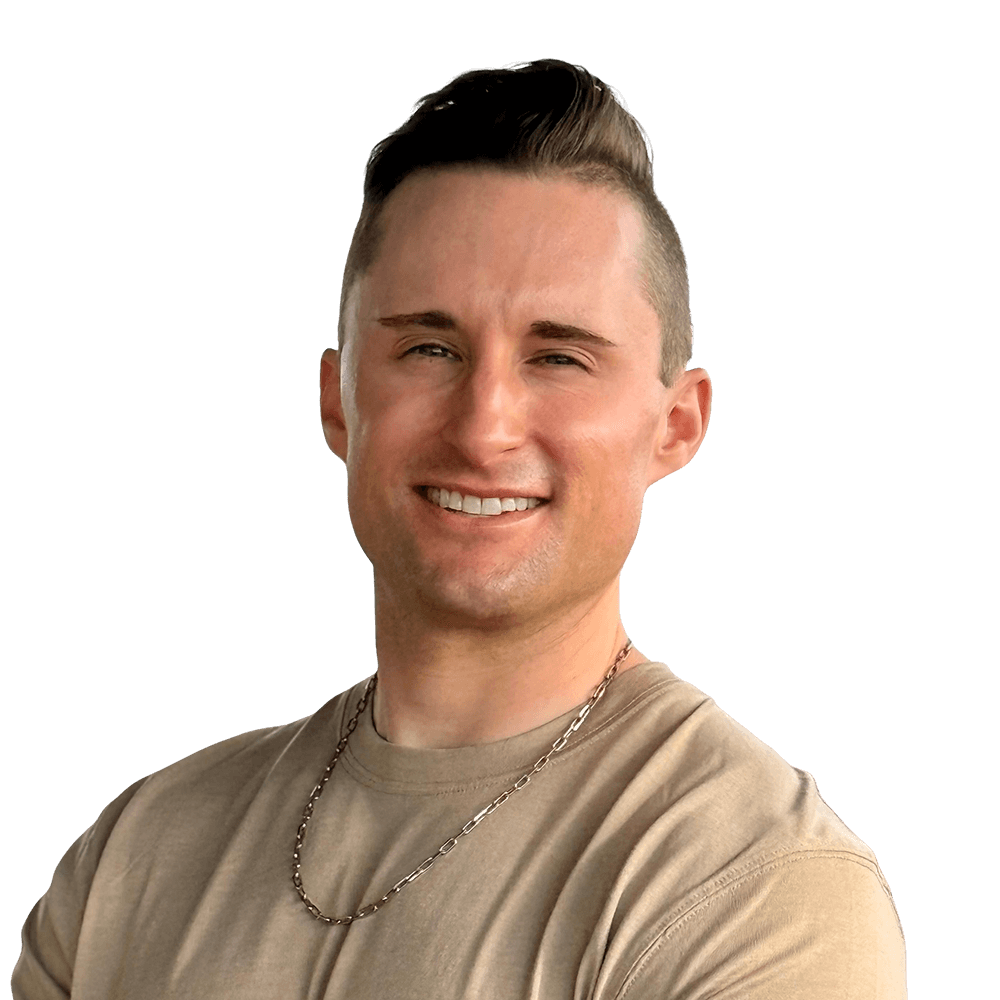
Profile — Investor / Operator / AI
Chase
Roberts
The guy who vowel-dropped his name and sent a cold email to a CEO - then did it all again at the biggest VC in the world.
"Product is an act of discovery, not of invention."
The guy who vowel-dropped his name and sent a cold email to a CEO - then did it all again at the biggest VC in the world.
"Product is an act of discovery, not of invention."
There is a version of Chase Roberts' career that looks like a straight line. Sell software. Study finance. Do VC. Operate. Repeat at larger scale. That version is technically accurate and almost entirely useless. The real version involves reading a book, cold-emailing a CEO, and moving across the country for an entry-level sales job nobody thought was glamorous - which turned out to be the whole point.
Roberts grew up in rural Oklahoma. He studied Finance and Entrepreneurship at the University of Oklahoma, graduated summa cum laude, and then spent time at a venture fund-of-funds and an equity research desk before a specific book landed in his hands: Clayton Christensen's The Innovator's Dilemma. What followed was not a gradual pivot. He emailed Box CEO Aaron Levie directly, landed a sales development role in Silicon Valley, and spent five years moving through the go-to-market machinery of one of enterprise tech's most influential cloud companies - from SDR to Sr. Manager of Partner Strategy and Alliances.
Five years of being told no in sales, he notes, teaches you something about yourself. It also teaches you something about how enterprise buyers actually work - the budgets, the executives, the security teams, the internal politics that no amount of product-market-fit theory prepares you for. That operational fluency would define everything that came after.
If it's true that the product solves a problem that a buyer also hopes to solve, then it's the salesperson's job to help the buyer perceive that alignment.
Chase Roberts - Authority Magazine InterviewAfter Box, he joined Segment as its first business development hire - helping launch the BD function at one of data infrastructure's defining companies of that era. He was doing this while simultaneously completing an Evening and Weekend MBA at UC Berkeley's Haas School of Business, graduating in 2019. That same year, Vertex Ventures US came calling through his network. Roberts had not applied through traditional VC recruiting. Vertex found him. That detail says something about how he operates.
At Vertex, he focused on early-stage B2B startups - data infrastructure and enterprise software specifically. He made roughly two investments per year, preferring depth over volume. His approach was coaching-oriented: enable founders, don't control them. He studied 300+ companies annually and context-switched across quantum computing, e-commerce APIs, and data platforms with the practiced ease of someone who had learned to be fluent across domains without needing to be expert in any single one.
In October 2022, he led the Seed round investment in Northflank, a production workload platform built to abstract the operational complexity of Kubernetes and multi-cloud deployments. Two years later, he joined Northflank as its COO. That move - from lead investor to operating executive at the same company - is uncommon enough to warrant a Medium post, which he wrote. The thesis was simple: software development had not yet had its manufacturing revolution. Internal developer platforms were consuming engineering margins without shipping better products. Northflank was the industrialization play.
Roberts' favorite analogy for internal platform overinvestment: companies that spend months building elaborate internal developer platforms are like bakers who construct beautiful, expensive bakeries - then never bake croissants. The infrastructure becomes the product when the product was supposed to be the product. He watched this pattern from the VC side, then went inside to fix it at the operator level.
By 2025, Roberts had landed at Andreessen Horowitz as an AI Ops Partner on the Infrastructure team. At a16z, he sits alongside Alex Hawayek, Flori Del Valle, Ivana Osuna, Katie Baynes, Rebecca Lewis, and Sharon Chang in a team built to operationally support the firm's infrastructure and AI portfolio companies. The work is less about picking winners and more about making winners - helping portfolio companies build operational rigor, go-to-market muscle, and the kind of organizational infrastructure that can survive rapid scaling.
His public writing gives a clear window into how he thinks. In February 2025, he published a direct rebuttal to Chamath Palihapitiya's prediction that AI would shrink the enterprise software market from $5 trillion to $500 billion. Roberts' counterargument was methodical: enterprise sales are complex because organizations are complex, not because salespeople add friction. History shows that even companies with armies of developers - like GE - still buy software because customers don't pay them to build file-sharing tools and CRM platforms. AI will generate new software categories, not eliminate existing ones. It was the kind of take that required knowing how enterprise buyers actually behave, not just how they theoretically should.
He communicates with a practicality that comes from having been both the person pitching the sale and the person who had to make the capital allocation decision afterward. His five principles for non-salesy selling - be curious, be complete, be the authority, seek evidence, be direct - read like a compressed MBA thesis built from scar tissue rather than coursework. He credits multiple advocates - Aaron Levie, Chris Penner, Eric Purcell - for creating opportunities behind closed doors at critical moments in his career. He talks openly about the role those relationships played, which is itself an unusual kind of honesty in VC circles.
Roberts' Twitter handle is @chsrbrts: his name with every vowel removed. It is a small and revealing choice. Not a personal brand. Not a title. Just the shape of a name, compressed to fit the medium. That compression is something he has gotten very good at - taking complicated operational realities and stripping them down to what actually matters, then communicating that to the people who need to act on it.
People who thrive in VC are curious about everything - learning enough to be dangerous in many areas.
Chase Roberts - Haas School of Business PodcastHe built his entry into venture entirely through relationships - Vertex called him, he didn't recruit in. He completed an MBA at night while building Segment's BD function during the day. He backed a company, watched it grow for two years, then climbed inside to help scale it operationally. Now he does that same work - the difficult, unglamorous, absolutely necessary work of building businesses that can survive their own success - for the portfolio of one of tech's most influential firms.
The cold email to Aaron Levie was not a one-time move. It was a method. Identify what you actually want. Figure out who controls access to it. Write something worth reading. Send it anyway. Roberts has done a version of that at every inflection point in his career. What changes is only the scale of what he's after - and where he ends up sitting when the email gets answered.
Early-stage B2B software with a strong data infrastructure or developer tooling angle. Prefers coaching depth over portfolio breadth - roughly two investments per year. Believes AI expands software markets rather than cannibalizes them.
After reading The Innovator's Dilemma, Roberts cold-emailed Box CEO Aaron Levie. He landed the job. Years later, he's at a16z. The cold email wasn't a one-off - it was a method he returned to at every career inflection point.
Roberts led the Seed round in Northflank in October 2022 while at Vertex Ventures. Two years later, he joined as COO. Rare, deliberate, and publicly documented in a Medium essay that reads like both a manifesto and a job announcement.
"AI will generate more software categories, not fewer. The enterprise software market will grow, not shrink. Anyone betting otherwise hasn't watched how enterprise buyers actually make decisions."
You learn a lot about yourself when you're told no all the time.
Product is an act of discovery, not of invention.
Position yourself on the same side of the table as your customer - next to them trying to see what they see.
People who thrive in VC are curious about everything - learning enough to be dangerous in many areas.
DevOps is eating software - consuming margins through infrastructure complexity.
If the product solves a real problem, then selling it shouldn't feel salesy. That's the whole point.
His Twitter handle @chsrbrts is his full name with every vowel removed. A compression algorithm applied to a personal brand - which is either minimalist genius or the most efficient possible statement about VC Twitter culture.
He graduated summa cum laude from the University of Oklahoma with dual degrees in Finance and Entrepreneurship/Venture Management, plus minors in Economics and Spanish. That's a lot of credentials for someone who then became known for cold emails.
He completed his Berkeley Haas Evening and Weekend MBA while simultaneously serving as Segment's first business development hire. EWMBA means you're working full-time and studying nights and weekends. He did this while building a BD function from scratch.
He backed Northflank in October 2022 at the Seed stage while at Vertex Ventures, then joined as COO roughly two years later. The arc from investor to operator at the same company is uncommon. He documented the whole thesis publicly on Medium before doing it.
Originally from rural Oklahoma. There is a very small number of paths from rural Oklahoma to AI Ops Partner at Andreessen Horowitz. His involved reading a disruption theory book and sending an unsolicited email to a tech CEO.
In a published interview, he noted that his wife prefers written communication while he prefers in-person or video. He uses this as an example of why salespeople should adapt their communication style to their counterpart - not their own default preferences.