platform-engineering
(41)
Egen’s AI business starts with the work nobody sees
Faster grocery orders. Cheaper cloud operations. A travel agent that tests its answers. Inside the engineering company making AI useful one working system at a time.

Pulumi Put the Cloud in Real Code - Then One Customer Tried to Leave
Pulumi replaced configuration dialects with TypeScript, Python, Go and friends. The more revealing victory came later, when a customer discovered that the expensive part was not the tool - it was rebuilding everything around it.

Neil Cresswell Made the Container Revolution Clickable
He spent a career watching useful infrastructure disappear behind expert-only interfaces. Portainer is Neil Cresswell’s long campaign to put the controls back where ordinary operators can reach them.
Kubex Spent 27 Years Learning Why Cloud Savings Die in a Spreadsheet - Then It Built the Autopilot
Most cloud tools can point at waste. Kubex is betting that the valuable part is changing production safely - and that a 27-year-old analytics company can teach Kubernetes to tune itself.
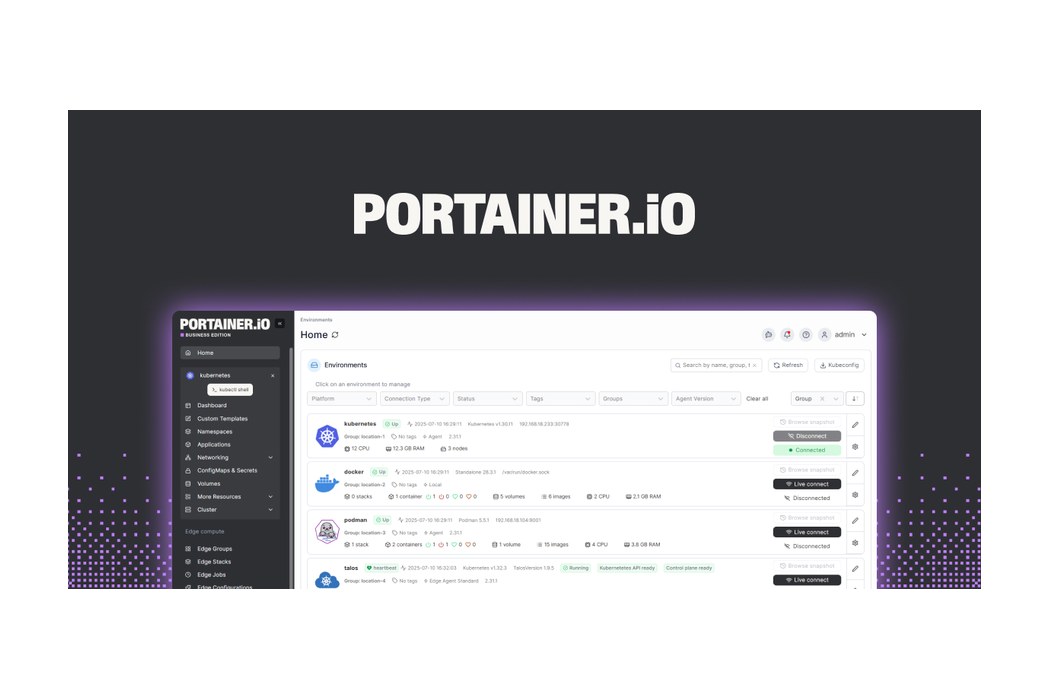
Portainer Turned Kubernetes Expertise Into a Button - Now 1 Million Users Want the Shortcut
The Auckland company started by taking the migraines out of Docker. Its bigger business is selling operational control to teams that cannot afford to make every employee a Kubernetes expert.
The Open-Source Company That Quietly Runs Other People's Clouds
It bet on OpenStack, bought Docker Enterprise, and now wants to turn your GPUs into an AI factory - all without locking you in. In August 2026, IREN bought the whole thing for $625 million.

Asim Razzaq Put a Price Tag on the Cloud's Blind Spot
He left PayPal with a stubborn question: if engineers create the cloud bill, why are they the last people given a useful way to read it? Yotascale became his decade-long answer.
The 36-Year-Old Engineering Firm Turning Enterprise AI Into Actual Work
Xoriant spent three decades doing the unglamorous engineering beneath enterprise software. Now a private-equity-backed acquisition run is turning that foundation into a broader bet on applied AI, modern platforms and the testing required to trust them.
Virtusa
The 1996 startup that bet enterprises would move their software off-premise now runs on an 'Engineering First' creed - and is wiring generative AI into banks, insurers and hospitals that can't afford to guess.
Cortex
Cortex is the engineering operations platform - an internal developer portal that catalogs services, scores them against engineering standards, and pushes teams to act on what's broken. Born out of the chaos of Uber-scale microservices, it gives platform teams a single pane of glass over ownership, quality, and operational maturity.

env0
env0 (pronounced "env zero") is an Infrastructure as Code (IaC) management and cloud governance platform that lets engineering teams run Terraform, OpenTofu, Terragrunt, Pulumi, CloudFormation, Kubernetes and Helm with self-service workflows, policy-as-code guardrails, cost visibility and drift detection. Founded in Israel in 2018, the company gives developers a fast, GitOps-driven way to provision cloud environments while platform and finance teams keep control over cost, security and compliance.
Qovery
Qovery is an internal developer platform and agentic Kubernetes management solution that lets engineering teams deploy and run production-grade infrastructure inside their own cloud accounts. Founded in 2020 and headquartered in New York with a remote team, it layers a Heroku-like developer experience on top of AWS, GCP, Azure and Scaleway - automating environment provisioning, ephemeral pull-request environments, and day-2 Kubernetes operations so developers can ship without becoming DevOps experts. The company raised a $13M Series A in 2025 and is used by tens of thousands of developers across more than 100 countries.
Grid Dynamics
Grid Dynamics (NASDAQ: GDYN) is a digital engineering and technology consulting firm that helps Fortune 1000 companies modernize software platforms, build cloud-native systems, and deploy AI and generative-AI solutions. Founded in 2006 out of a Silicon Valley open-source engineering community, the company blends product engineering, data engineering, and digital-engagement services, with a particular strength in retail, financial services, and consumer-facing commerce. It reported record 2025 revenue of $411.8 million and employs roughly 4,900 people across the Americas, Europe, and India.

Milestone Technologies, Inc.
Milestone Technologies is a Fremont, California-based global IT services and digital solutions company founded in 1997. It helps large enterprises run and modernize their technology at scale - spanning digital workplace services, IT service desk and NOC operations, cloud and infrastructure, application and digital engineering, AI/automation, and platform work on ServiceNow and Salesforce. The company employs roughly 2,600-3,100 people, serves more than 200 clients across about 31 countries, and is majority-owned by The Halifax Group with a minority stake held by Two Sigma Impact.
Akuity
Akuity is the enterprise company founded by the creators of the open-source Argo project. It offers a fully managed, GitOps-based continuous delivery platform for Kubernetes, built around managed Argo CD, the Kargo promotion engine, KubeVision real-time visibility, and AI agents that troubleshoot and remediate deployments. Headquartered in Sunnyvale, California, Akuity helps enterprises adopt Kubernetes with less operational complexity and stronger security.
EverOps
EverOps is a San Francisco-based IT and cloud managed services provider that embeds small teams of senior engineers - called TechPods - directly inside client organizations to run DevOps, SRE, ITOps, and security work. Founded in 2012 and re-capitalized in 2022, the firm pitches itself as an alternative to advice-only consulting and staffing shops: pods sit in the client's toolchain, attend standups, and take ownership of outcomes across cloud infrastructure, platform engineering, observability, and cloud cost reduction.
Okteto
Okteto is a developer platform that moves Kubernetes development, preview, and testing environments into the cloud. Founded in 2018 by three former Atlassian, Docker, and Google engineers and backed by Y Combinator, Okteto lets developers spin up production-like environments with a single command, sync code changes live in seconds, and automatically create preview environments for every pull request. In 2025 the company extended the same infrastructure to AI coding agents, giving each agent its own isolated, production-like environment to build, test, and verify code at scale.

Romaric Philogène
Romaric Philogène is the CEO and co-founder of Qovery, a platform-engineering company that turns cloud infrastructure into a self-service experience for developers. A former site reliability engineer with a decade in ad-tech and financial systems, he started Qovery in 2019 with Pierre Mavro and Morgan Perry and, in September 2025, raised a $13M Series A led by IRIS and Crane Venture Partners, with angel checks from Datadog's Olivier Pomel and Alexis Lê-Quôc.

Zelar
Zelar (ZelarSoft) is a cloud-native engineering and consulting firm that helps banks, telcos, oil & gas, and government teams adopt Kubernetes, DevOps, and AI without the usual pain. Founded in 2018 and led by CEO Vasu Maganti, the company pairs hands-on services - cloud migration, SRE, security, and data engineering - with its own platforms: Klusternetes for self-service Kubernetes multi-tenancy, OpenOps for production-ready GKE stacks, and Cokpit for agentic AI DevOps. A Google Cloud Premier Partner with offices across the US, Canada, India, and the UAE, Zelar bets that most teams want cloud-native outcomes, not cloud-native homework.

DuploCloud
DuploCloud is a San Jose-based DevOps automation platform that turns plain-English application requirements into production-ready, compliance-aware cloud infrastructure across AWS, Azure and GCP. Founded by ex-Microsoft Azure engineer Venkat Thiruvengadam, it aims to give Main Street IT the hyperscale automation patterns once locked inside Big Tech.
Gruve
Gruve is an outcome-based enterprise AI services company that helps large organizations move from AI strategy to production-grade deployment across customer experience, cybersecurity, data and platform engineering — billing on results rather than billable hours.

Kong Inc.
Kong Inc. builds the connectivity fabric for APIs, microservices, and now AI traffic. Its open-source gateway sits in front of billions of requests at companies like Cargill, SkyScanner, GE, and Sky. In 2024 it raised a $175M Series E at a $2B valuation, sharpened its pitch as 'the AI connectivity company,' and shipped an AI Gateway that brokers calls to LLMs the same way Kong has long brokered calls to REST APIs.

Abhishek Choudhary
Abhishek Choudhary is the Co-Founder and CTO of TrueFoundry, a Series A-backed AI infrastructure platform that helps enterprises deploy, manage, and govern machine learning models at scale. A former Senior Staff Engineer at Meta — where he worked on infrastructure serving over a billion users — he left to build the platform he wished had existed at Facebook: one that brings Meta-level AI automation to every enterprise. An IIT Kharagpur alumnus, he co-founded TrueFoundry in 2021 alongside batchmates Nikunj Bajaj and Anuraag Gupta, and has since grown it to serve clients like NVIDIA, Siemens Healthineers, and ResMed, raising $21.3M in total funding.

Anish Dhar
Anish Dhar is the Cofounder and CEO of Cortex, a San Francisco-based internal developer portal company he co-founded in 2019 after spending nearly five years as an engineer at Uber. Watching Uber's microservices sprawl into chaos—thousands of undocumented services named after video games, ownership lost every time someone quit—he rented an Airbnb for a weekend hackathon with two friends and built the first version of what would become a $470M company backed by Sequoia, Scale Venture Partners, IVP, and the Collison brothers. Cortex raised $60M in Series C funding in September 2024 and is used by engineering teams at Adobe, Grammarly, Xero, TripAdvisor, and Canva to catalog, score, and continuously improve their software services.

Don Johnson
Don Johnson is the CEO of Docker, Inc., the company behind the world's most widely used container platform. Appointed in February 2025, he brings decades of hyperscale cloud infrastructure experience from founding Oracle Cloud Infrastructure (OCI) and serving as a founding technical leader at Amazon Web Services. A builder at heart who spent years constructing the plumbing of the modern cloud, Johnson now leads Docker's mission to make software development frictionless, secure, and AI-ready for the world's 20 million developers.

Hans Dockter
Hans Dockter is the founder and CEO of Gradle Technologies, the company behind the Gradle build tool - downloaded over 23 million times per month - and Develocity, an enterprise developer toolchain observability platform. A German-born physicist-turned-software-engineer, he co-created Gradle in 2008 out of personal frustration with existing build systems, transforming it into one of the most widely adopted build automation tools in software development. Under his leadership, Gradle Technologies has raised $53.2M in total funding and grown to 170+ employees, serving enterprises including Netflix, Google, LinkedIn, and Airbnb.

Haseeb Budhani
Haseeb Budhani is the Co-founder and CEO of Rafay Systems, a Sunnyvale-based infrastructure orchestration platform that simplifies Kubernetes and AI infrastructure lifecycle operations across public clouds, private data centers, and the edge. A serial entrepreneur with a track record of building and selling enterprise technology companies, Budhani previously co-founded Soha Systems - a secure remote access startup acquired by Akamai Technologies in 2016 - and has held senior product and engineering roles at Citrix, Infineta Systems, and others. Under his leadership, Rafay has raised $37.1M in total funding, built partnerships with Verizon, NVIDIA, and Cisco, and grown to serve major enterprise customers at the intersection of Kubernetes operations and AI infrastructure.

Jeyappragash Jj
Jeyappragash 'JJ' Jeyakeerthi is the co-founder and CTO of Tetrate, the company that made Istio enterprise-ready and brought FIPS-verified service mesh to regulated industries including the US federal government. An IIT Madras graduate who once ran Twitter's Cloud Infrastructure, JJ co-founded Tetrate in 2018 with Varun Talwar to secure the cloud-native stack from edge to datacenter - building one of the most technically credible teams in the service mesh ecosystem, trusted by the US Air Force and some of the world's largest enterprises.

Jonathan Trevor
Jonathan Trevor is a Co-Founder of Observe, Inc., an AI-powered observability platform built on a streaming data lake that unifies logs, metrics, and traces to help engineering teams detect, investigate, and resolve incidents faster. He came to Observe from Wavefront (now VMware Tanzu Observability), where he served as Frontend Lead, and before that led frontend engineering at Shocase. Trevor holds a PhD in Computer Science from Lancaster University. Observe - co-founded with Jacob Leverich (ex-Splunk), Jon Watte (ex-Roblox), and Philip Unterbrunner (ex-Snowflake) and incubated by Sutter Hill Ventures - raised $156M in Series C funding in July 2025 before Snowflake announced its intent to acquire the company for approximately $1 billion in January 2026, its largest acquisition to date.
Rafay Systems
Rafay Systems is a Sunnyvale-based platform-engineering company that builds infrastructure orchestration and workflow automation software for Kubernetes, GPU workloads and AI/ML pipelines. Its cloud-based platform lets enterprises offer self-service compute to developers and data scientists while keeping platform teams in control of cost, security and compliance across AWS, Azure, GCP and on-prem environments.