- Tabula sold programmable chips that reused the same physical logic across rapid slices of time.
- ABAX promised 220,000 to 630,000 virtual lookup tables at volume prices between $105 and $200.
- Cisco was a customer; Intel became the manufacturing partner for the second generation.
- The company raised more than $200 million, then shut down in March 2015 after limited market impact.
- The copyable lesson: validate tools, IP, support, and buyer trust as aggressively as the core technology.
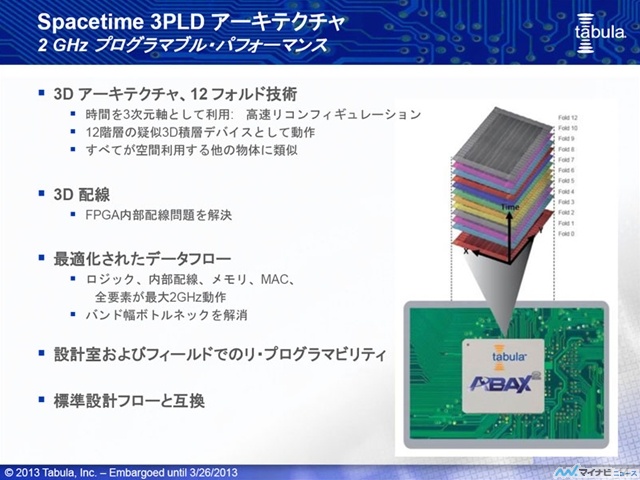
The easiest way to misunderstand Tabula is to picture a very tall chip. The Santa Clara startup described its programmable logic as three-dimensional, called the architecture Spacetime, and drew diagrams that looked like a stack of brightly colored floors. Yet nothing was physically stacked. There was one ordinary plane of silicon. The extra dimension was time.
At 1.6 billion ticks a second, Tabula's first ABAX devices swapped configurations so quickly that one set of logic cells could do the work of several. Imagine a tiny theater in which the scenery changes eight times during every beat of the play. The audience sees eight rooms. The landlord sees one stage. Tabula called those rooms folds.
The third dimension had a clock
Founder Steve Teig had already built a career around making chip design less geometrically obedient. At Simplex Solutions, before its acquisition by Cadence, he championed diagonal wiring. At Tabula, the rebellion moved from direction to duration. Instead of packing every requested function onto the chip at once, Spacetime scheduled pieces of a design across successive configurations, storing intermediate results locally and passing signals through what the company called time vias.
PHYSICAL
DIE
A simplified view: ABAX cycled one fabric through eight configurations. ABAX2 later increased the count to twelve.
The attraction was not mystical. Programmable chips spend a surprising amount of area on routing and configuration. Reusing resources through time could shrink the physical die needed for a given design, or make a given die appear much larger. Shorter physical wires could also be faster. In 2010, the four announced ABAX models offered the equivalent of 220,000 to 630,000 lookup tables, 5.5 megabytes of user memory, 48 high-speed serial channels, and 920 parallel I/O ports.
The product was six products wearing one badge
A novel FPGA is not merely silicon. It is architecture, foundry process, compiler, debugger, verified intellectual property, and a field organization capable of appearing when a customer's timing report turns red at 2 a.m. Tabula had to build nearly all of these at once.
Stylus was the crucial disguise. It accepted the languages hardware engineers already used - VHDL, Verilog, and SystemVerilog - then handled synthesis, floor planning, timing, power analysis, debugging, and three-dimensional placement. Customers were not supposed to choreograph the folds. They were supposed to hand over familiar RTL and receive a working design.
If the architecture was strange, the workflow had to feel boring.
That instinct was right. A ColdFire processor core ported by IPextreme reportedly ran through the standard flow without special hand tuning. But one successful port was a proof point, not an ecosystem. Xilinx and Altera had spent decades filling libraries, training engineers, refining debuggers, and making procurement departments comfortable. Tabula's catalog was sparse by comparison. Every missing block became work for the customer, and every hour of customer work reduced the value of inexpensive silicon.

STEVE TEIG, PROFESSIONAL HERETIC.
First diagonal wires, then time-multiplexed logic. His useful habit was asking which physical rule was merely a convention. The expensive part was turning the answer into a supply chain.
A $200 part with a $200 million backstory
At launch, the smallest ABAX device was priced at $105 and the largest at $200 in quantities of 2,000. A single unit was listed at $500. These were arresting numbers for high-capacity programmable logic. The company claimed alternatives could cost more than $1,000. Yet the apparently cheap part sat atop one of the costliest startup campaigns in semiconductors.
Tabula raised $24 million in 2005, $50 million in 2007, another $24 million in 2008, and $108 million in 2011. Reports put the lifetime total around $214 million. The money bought years of architecture and tool development, multiple process generations, patents, a sales organization, and inventory. It also bought time in a race where time immediately depreciates. The established vendors were already preparing their next manufacturing nodes while ABAX moved toward volume.
The business model was conventional even when the architecture was not: design chips and software, outsource fabrication, sell to equipment makers, and earn semiconductor margins at scale. Scale was the hinge. The fixed cost arrived first; the design wins had to arrive later and live long enough to repay it.
The big idea found a narrower job
Tabula first spoke broadly about a new class of general-purpose programmable logic. Its examples ranged from medical imaging to industrial equipment and military systems. By 2012 and 2013, the story had tightened around network infrastructure - switches, routers, packet inspection, wireless equipment, and the jump from 10-gigabit to 40- and 100-gigabit Ethernet.
This was not an abandonment of Spacetime. It was a search for the place where its peculiar strengths mattered most. ABAX2, manufactured on Intel's 22 nm Tri-Gate process, increased the fabric to twelve folds and as much as 2 GHz. Hard memory controllers and Ethernet blocks joined abundant multi-ported memory. Reference designs showed 100G switching, bridging, packet search, and multiport 10G processing. The company stopped asking buyers to admire an architecture and started offering them a very fast packet machine.
Intel's involvement was remarkable. Intel then allowed very few outsiders onto its leading process. The partnership improved power, speed, and credibility. It did not remove the other five products hiding beneath the badge.
The first thing to fail was trust at scale
There is no public, authoritative Tabula post-mortem naming a single technical defect. The observable failure was commercial. In early 2015, an industry analyst said the company had not made a significant market impact. Soon afterward, a state filing disclosed a closure affecting about 120 jobs. Tabula ceased operations on March 24.
The programmable-logic purchase was larger than the chip
The bars are editorial, not measured data, but the imbalance is the point. Contemporary technical reviews had predicted it. A startup might show a twofold or threefold architectural advantage, then watch an incumbent narrow the gap by moving to a newer process. It might hide reconfiguration beautifully in a compiler, then discover that debugging an unusual fabric exposed the abstraction. It might offer a cheap component, then ask a customer to accept schedule risk worth far more than the component.
Cisco's presence proved that a serious buyer could say yes. It did not prove that enough buyers would say yes quickly. Intel could manufacture transistors. It could not manufacture installed tools, accumulated IP, and the quiet career insurance of choosing a familiar vendor.
What a deep-tech founder can steal
Tabula remains useful because its good decisions are visible alongside its limits. It hid radical internals behind standard languages. It moved toward a workload where its bandwidth and memory architecture had a natural advantage. It recruited manufacturing and IP partners rather than pretending to own every layer.
Let customers use the languages, test benches, and constraints they already trust.
A cheaper component is not cheaper if qualification, porting, and support consume the savings.
Target a job where incumbents are not merely adequate and the advantage survives the next process node.
Validate compiler quality, verified IP, debugging, and field response before scaling the expensive silicon plan.
This approach will not work when the application cannot tolerate time-multiplexing overhead, when deterministic debugging requires visibility the abstraction cannot provide, when a physical stacked design or conventional process shrink erases the density gain, or when customers already have acceptable incumbent tools. It also fails when the technical wedge is real but too small to justify switching costs.
In the end, the clock wins
Tabula's name came from tabula rasa, the blank slate. It referred to chips that could be programmed after manufacturing, but it also described the company's temperament. Start again. Question the floor plan. Replace space with time.
The irony is that customers did not want a blank slate everywhere. They wanted novelty in the place that delivered an advantage and familiarity everywhere else. Tabula understood this well enough to build Stylus, harden common functions, court Intel, and focus on networking. It simply had to make too many unfamiliar pieces feel routine before its money and market window closed.
The architecture was not foolish. It was an unusually pure demonstration of what deep technology must overcome. A chip can borrow time internally. A company has to earn it from customers.
See the machine think
Tabula's original site is no longer an active company home, but its surviving talks and profiles show the architecture in the language of the people who built it.