If your mental picture of Toshiba is a laptop with a slightly stubborn hinge, your memory is doing its job. For decades the red wordmark lived in kitchens, living rooms and office bags. The company made technology visible. Today's Toshiba is almost the reverse: it wants to matter precisely where most people will never see it - inside substations, trains, factories, data centers, power plants and the semiconductors that keep those systems from wasting electricity.
That change is not a clever rebrand. It is the residue of a very expensive education. A 2015 investigation found years of overstated profits. Two years later, cost overruns at U.S. nuclear projects pushed Westinghouse, Toshiba's American nuclear subsidiary, into bankruptcy and dragged the parent toward the edge. Toshiba sold or transferred familiar businesses, fought with shareholders, proposed a breakup, watched investors reject it, and finally accepted a take-private led by Japan Industrial Partners. The transaction valued the equity at roughly ¥2 trillion. Toshiba left the stock market in December 2023.
The first failure was the feedback loop
The scandal is often summarized as bad accounting, which is true but incomplete. The more useful diagnosis is that pressure moved downward better than truth moved upward. Managers faced demanding profit targets. Losses and delays were hard to report. Numbers became the shock absorber. Once an organization trains people to make the target look real, the spreadsheet can stay tidy long after the business has stopped cooperating.
Westinghouse then turned a governance problem into a balance-sheet emergency. Its new U.S. reactors were supposed to prove that modular construction could make nuclear plants easier to build. Instead, design changes, regulatory demands, supply-chain trouble and site delays accumulated inside contracts where the downside was enormous. By 2017, Westinghouse faced billions in costs whether it finished or walked away. Bankruptcy came first; Toshiba's withdrawal from overseas nuclear construction and portfolio retreat followed.
“Complexity is only a moat when the organization can see through it.”The Toshiba lesson, in one sentence
What changed Toshiba's mind
For a while, the answer was corporate surgery. Management proposed splitting Toshiba, first into three listed companies and later into two. Shareholders rejected the two-way plan in March 2022. That vote did not eliminate the need for focus; it eliminated one route to it. The board reopened its strategic review, a Japan Industrial Partners-led consortium emerged with the only comprehensive bid, and private ownership became the new container for the same hard work.
The price was not only the acquisition. Toshiba's 2024 revitalization plan allowed an early-retirement and outplacement program for up to 4,000 people in Japan, focused especially on duplicated staff functions. It began folding major operating companies back into the parent: infrastructure in April 2025, then energy and digital solutions in April 2026. In November 2025, it organized the group around three business segments - Energy Solutions, Digital Infrastructure Solutions, and Devices & Technology.
The early scorecard is encouraging. FY2025 sales rose to ¥3.7091 trillion and operating income increased about 52 percent to ¥300.8 billion. Return on sales reached 8.1 percent. In the first quarter of FY2026, sales rose 27 percent year on year to ¥937.1 billion, while operating income nearly tripled to ¥111.9 billion. Energy, digital infrastructure, devices and retail printing all improved.
One number needs a bright warning label: net income. Kioxia share sales and valuation gains made it spectacular, both for FY2025 and the latest quarter. That is real economic value, but it is not a repeatable turbine-maintenance contract. The cleaner proof is in operating margin, backlog and fewer project provisions. Toshiba is aiming for a 10 percent return on sales in FY2026. That target is a better test of the comeback than a portfolio windfall.
The new product is the whole problem
Toshiba still sells products: SCiB lithium-ion batteries, power MOSFETs, hard drives, motors, railway equipment, GridDB software, and SQBM+, its quantum-inspired optimization system. But the strategic advantage appears when those pieces stop behaving like separate catalog pages.
Take data centers. Toshiba can touch transmission and distribution, power semiconductors, hard-drive storage, energy management, equipment construction and operating analytics. Generative AI creates demand for compute, which creates demand for electricity, resilient grids and efficient power conversion. The old conglomerate problem - too many unrelated businesses - can become an integrated-sales advantage if the divisions share one customer and one accountable project owner.
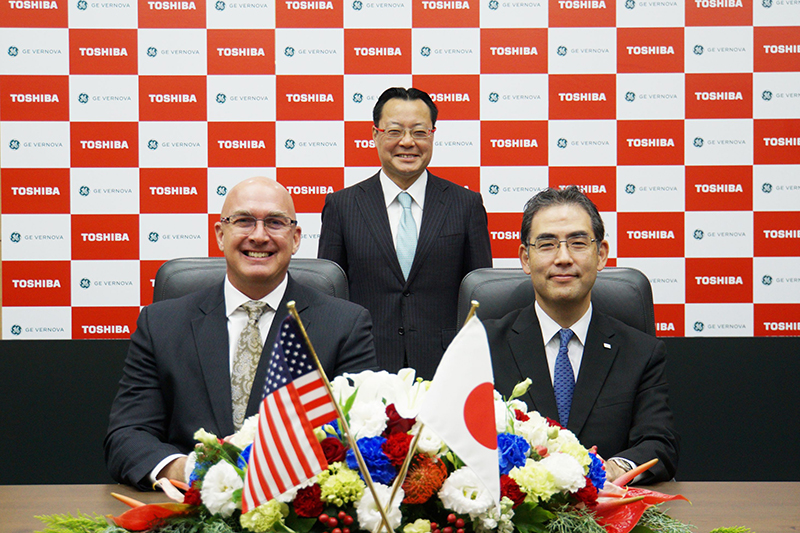
The same logic appears in power generation. In India, Toshiba's EtaPRO platform is slated to monitor 165 thermal and renewable plants operated by NTPC and its joint ventures, using data to predict anomalies and automate maintenance. With GE Vernova, Toshiba is studying a combined gas-turbine and carbon-capture configuration. With NTT, it demonstrated factory equipment controlled from roughly 300 kilometers away on a low-latency network. These are not app-store products. They are large, specific promises about uptime, energy and labor.
That also explains the business model. Utilities and public agencies buy engineered systems that may take years to design and install. Manufacturers and transport operators buy equipment, controls and integration. Semiconductor and storage customers buy components at industrial scale. Then maintenance, monitoring, software, spare parts and performance work extend the relationship across the asset's life. Toshiba is not publishing one neat subscriber count because the unit of value might be a power station, a rail network or a million components. The common denominator is a customer for whom downtime is far more expensive than the invoice.
The expertise is unusually physical. Toshiba knows how heat behaves in a turbine, how a motor fails, how a grid reacts to fluctuating supply, and how factories collect time-series data. That makes its software pitch more credible in places where a dashboard must eventually move a machine. It also creates a practical customer-acquisition loop: win equipment, learn the operation, add monitoring, use the data to improve maintenance, and bring the result into the next bid. The loop is slow, but a good installation can keep paying for decades.
Where Toshiba is different - and vulnerable
Toshiba competes with companies that are easier to explain. Siemens and Hitachi span infrastructure. Schneider Electric and ABB are formidable in electrification and automation. GE Vernova knows power. Seagate and Western Digital know storage. Infineon, onsemi, ROHM and Mitsubishi Electric fight over power chips. IBM, Fujitsu and specialists chase optimization work.
Toshiba's edge is the seam between physical equipment and software. It can arrive with engineers who understand the turbine, the control room and the data. Its long installed base creates service opportunities and operational knowledge that a software-only entrant must borrow. Its SQBM+ optimizer also runs on classical computers, allowing customers to attack logistics, finance and drug-discovery problems without waiting for a fault-tolerant quantum machine.
The vulnerability is equally plain. Big projects carry slow feedback, political exposure, cost inflation and penalties. Cross-selling can become bureaucracy wearing a customer-centric badge. A private owner can encourage patient investment, but leveraged ownership also introduces debt discipline. And if every growth theme - AI, defense, data centers, energy transition, physical AI - becomes a strategic priority, focus can quietly turn back into a list.
What an operator can copy
- Name the few businesses that deserve capital. Toshiba chose three operating segments, not thirty-seven slogans.
- Separate operating proof from financial events. Track margin, backlog, project provisions and recurring service revenue.
- Turn installed hardware into a data loop. Monitoring and maintenance make a one-time equipment sale compound.
- Design a path for bad news. Project risk is useful only when it reaches someone empowered to change the contract.
- Bundle around a customer's full problem, but assign one owner. Integration without accountability is just a meeting.
When the playbook will not work
This approach depends on conditions many companies do not have. Toshiba possesses patents, factories, regulated-domain credibility, customer relationships measured in decades, and an enormous installed base. A young company cannot copy those assets by drawing three boxes. Private ownership helps only when owners can fund restructuring and tolerate the long cycles of infrastructure. Bundling helps only when components genuinely improve one another. And simplification fails if leaders keep every legacy activity alive behind newly painted segment names.
The best version of Toshiba's comeback is not a return to the living room. It is a company that becomes easier to understand as its products become harder to see. Grids stay stable. Trains arrive. Drives keep spinning. Factories catch a defect. A power plant schedules maintenance before the machine makes the decision itself. For a brand once printed on nearly everything, success now means being underneath everything - and finally knowing exactly why it is there.