The cloud has always been a rather successful piece of branding. It sounds weightless, tidy, almost pastoral. Jaymie Scotto Cutaia built a career closer to the other end of that metaphor: the companies, cables, buildings and people that make a connection work. Her subject has machinery. It has meetings. Increasingly, it has neighbors with questions.
Before founding JSA in 2005, she worked in television news and then in marketing and public relations at Telx. That route matters. A news producer learns to make a complicated subject intelligible under pressure. At a colocation and interconnection business, the complicated subject is sitting right there, waiting for someone to explain why it matters.
Today she leads a communications agency focused on digital infrastructure, from telecommunications and data centers to cloud and AI infrastructure. But a useful way to understand her work is to look at the conversations she has created around those businesses. There are interviews, books, panels and networking platforms. For someone whose industry connects machines, she spends a considerable amount of time connecting people.
A writer learns a new beat
Cutaia joined MSNBC in 1999 and spent four years there. Her newsroom years included coverage of September 11 and the war in Afghanistan. She contributed to the network’s Emmy Award-winning September 11 coverage. These were assignments in which the consequences of getting a story wrong were far more serious than an awkward headline.
Writing was also part of her formal education. She earned a bachelor’s degree from Tufts University, graduating cum laude with highest thesis honors, and a master’s in writing from New York University. Her later professional interests retained that literary streak: she has previously served on boards associated with the American Shakespeare Center and the Augusta County library.
The move to Telx gave her a different reporting assignment. Operators and marketers taught her the layers of the OSI stack and how they depended on one another. She described the experience as discovering the machinery that lets the world communicate. The friendships formed during that education lasted beyond the job. Learning the business also meant learning whom to ask.
It is an appealing origin for a specialist agency. She did not arrive with a cable diagram tucked into an English degree. She had to be taught. That experience gave her a practical vantage point on the distance between knowing how a system works and being able to describe it to somebody encountering it for the first time.
An agency with a very particular beat
JSA began in 2005 with a focus on telecom. Specialization gave the firm a defined audience and a defined set of problems: companies needed to explain technical offerings, reach prospective customers and establish a recognizable position among businesses that could sound remarkably similar on paper.
In a 2021 conversation about marketing data center services, Cutaia explained that she wanted to reconsider what clients received from an agency. Public relations, marketing and events were tools in the service of a central message and a clear action. A campaign needed a reason for existing beyond adding one more item to the internet’s already crowded noticeboard.
Her process starts with a workshop involving the client’s stakeholders. The team listens, tests the message against competitors and business objectives, sets measures of success and makes a communications plan for the next six months. The listening comes before the slogan. That is less glamorous than a dramatic campaign reveal, and rather more useful to the people paying for one.
Growth has brought recognition: JSA’s current biography records five appearances on the Inc. 5000 and repeated inclusion in PRNEWS’s Agency Elite Top 100. Those are company achievements under her leadership. They also mark the durability of a decision made in 2005: an agency could keep a narrow industry focus while expanding the ways it served that industry.
Build a newsroom, then invite people in
Cutaia’s television background returned in a different form with JSA TV. Its launch announcement appeared in December 2011, describing a virtual newsroom for telecom professionals. The original format was economical: interviews lasting three to five minutes, featuring executives, journalists and analysts discussing announcements and industry developments.
The distribution plan was as significant as the camera. Interviews would travel through social channels, a video newsletter and the agency’s industry blog. A technical company did not have to wait for its subject to become a general-interest television story. It could speak to an audience already interested in the problem it was solving.
In November 2020, JSA introduced Data Movers, co-hosted by Cutaia and Evan Kirstel. The podcast added room for career histories, difficult moments and executives’ perspectives on their industry. Even the title offered a small improvement on corporate abstraction: somebody was moving the data, and perhaps they had an interesting life.
A 2023 interview with Cologix’s Callum Morrison shows Cutaia doing the work herself, discussing AWS Outposts in Vancouver data centers. The technical subject is specific; the conversation gives it a human entry point. Hosting requires the same basic courtesy as good reporting: know enough to ask a useful question, and leave room for the other person to answer.
The guest list is part of the work
Who gets the microphone has become another part of Cutaia’s work. She created the Women’s Speaking Initiative to encourage more diverse voices on conference panels and keynote programs. An industry can have an abundance of events and still draw repeatedly from a familiar circle of speakers.
In 2019, she was announced as moderator of a diversity and inclusion discussion at the inaugural Global Women in Telco & Tech event in London. The panel brought together leaders from Infinera, Inteliquent, SSE Enterprise Telecoms and Synchronoss. It placed workplace questions on a stage usually associated with networks, services and commercial opportunities.
Her 2025 Women in Tech USA assignment took the conversation into technology and democracy. The scheduled fireside chat paired her with Danielle Adrianna Davis, a technology policy director, and Matthew Steinberg, a technology and public policy scholar. The questions included the influence of technology on public policy and its effects on underrepresented communities. Her beat had become wider without leaving infrastructure behind.
A book that wanted a meeting room
Greener Data began with a question about what Cutaia could do with the network she had assembled. By 2022, she was describing a responsibility to help the digital infrastructure industry share practical approaches to sustainability. An agency’s address book could also serve as a table of contents.
The first book arrived on Earth Day, April 22, 2022, bringing together 24 industry leaders. Its subjects included carbon reduction, biodiversity, resource management, technology and measurement. The contributors came from different parts of the infrastructure business and different countries. The format allowed people working on separate pieces of the system to describe their experience alongside one another.
“Greener Data is more than a book; it’s a movement,” Cutaia said at its launch. The ambition soon had places to gather. A directory followed in January 2023. At International Telecoms Week that year, she moderated a sustainability panel, and the gathering included the reveal of the cover for the second volume.
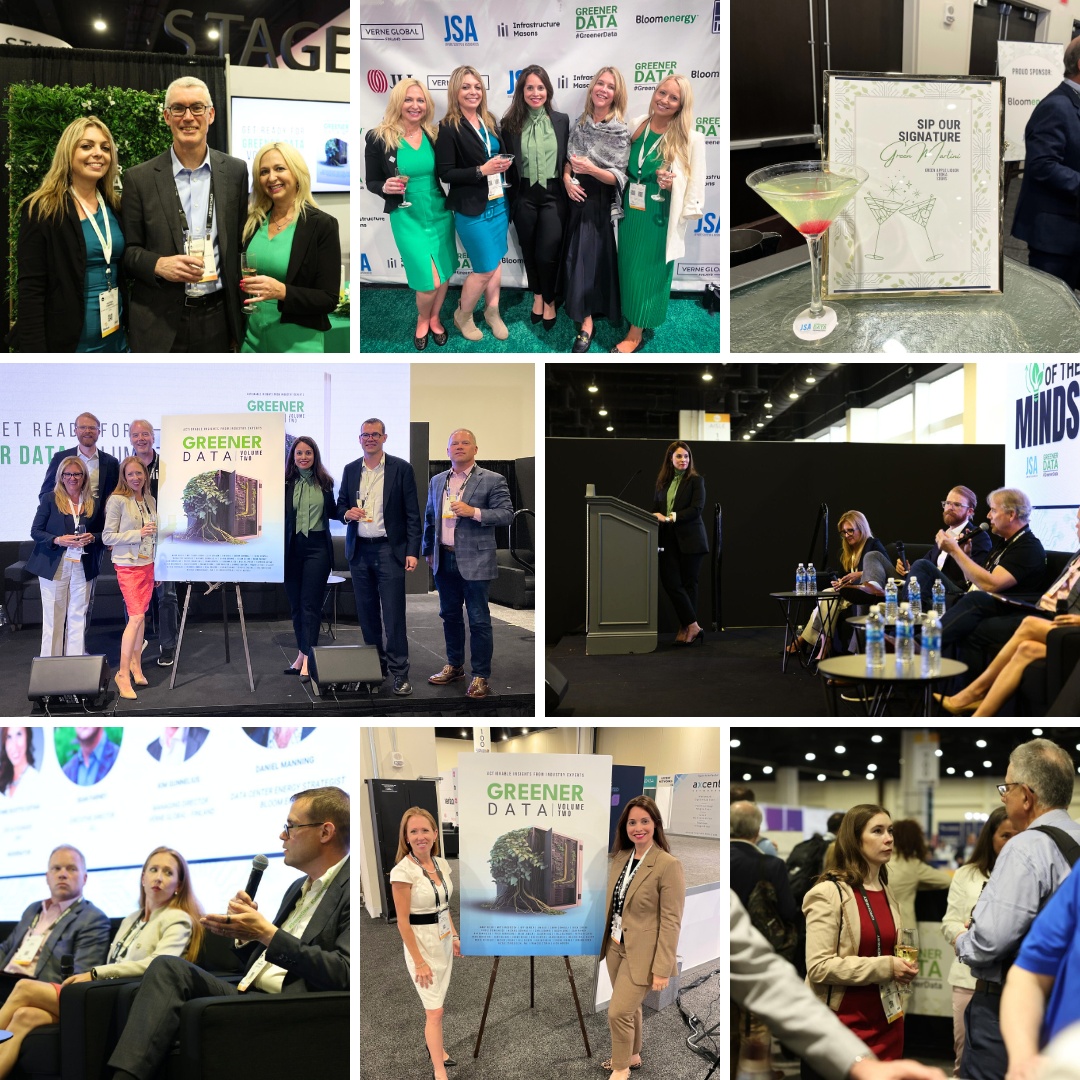
The photographs are pleasingly literal about the theme. Green clothing, a green carpet and a green drink accompanied the conversation. Sustainability may involve difficult accounting, but apparently it can also have a dress code. Cutaia is visible at the lectern and among the guests, doing the convening work behind the book’s premise.
The second question: how do you measure it?
Volume Two’s development put measurement near the front of the conversation. In 2023, JSA released a cornerstone chapter compiled by sustainability analyst Mary Allen. It brought together experts to examine which measures mattered when assessing the environmental footprint of data center networks. The second volume followed on Earth Day 2024.
That attention to measurement fits Cutaia’s communications method. A message needs something beneath it that can be checked. In her 2022 discussion of the industry, she raised concerns about outdated or underused data and the lack of shared metrics and accountability. Greener Data gave those concerns an editorial format rather than leaving them as conference-stage aspirations.
The third volume arrived on Earth Day 2026. Cutaia’s launch post thanked contributors across equipment makers, operators, energy businesses and other organizations. She also noted that each copy sold supports Télécoms Sans Frontières, the emergency telecommunications organization for which she serves as an ambassador. The connection keeps the subject close to a practical purpose: communications matter especially when ordinary systems fail.
Her work with the book continued into a May 29, 2026 iMasons Climate Accord session. The published program named her as moderator alongside Louis Liu of Rehlko, Jim Summers of GPC Infrastructure and Peter Lantry of Equinix. A book can sit on a shelf. A conversation gives its ideas another chance to meet a question.
“Greener Data is more than a book; it’s a movement.”Jaymie Scotto Cutaia, 2022
The audience beyond the fence
Cutaia’s recent public commentary brings the story to the communities around data center projects. In her posts, she argues for engagement early in development, before difficult public meetings or opposition become the first substantial exchange. The timing changes the relationship: residents have a chance to be heard while questions can still inform the conversation.
She also describes stakeholder mapping in concrete terms. A nearby resident may care about noise. An official may focus on infrastructure. Schools and businesses may ask about investment and jobs. Treating those people as a single audience risks giving everyone a polished answer to somebody else’s question.
This is where her career’s two halves meet again. A newsroom asks what people need to understand. A communications business asks how an organization should explain itself. Her current emphasis adds a third consideration: what people want to ask before an organization starts explaining. The neighbors, after all, have a story too.
Still a writer, with a larger address book
Cutaia is based in Las Vegas, and her work reaches beyond it. Her public biography also gives a more personal account of what she values: her daughter, Ava Capri, and her husband, Rory. Rory founded Telx, the company where she first developed the industry knowledge that preceded JSA.
Her professional history makes an interesting circuit: writing, reporting, learning an unfamiliar business, founding an agency, creating interview channels, and gathering contributors into books. The medium keeps changing. The job keeps requiring curiosity about the people on the other side of the conversation.
At the other end of the cable, there is always someone doing the work. Cutaia has spent more than twenty years making introductions.