The machine was part of the offer. In Emmanuel Montero’s first Bitcoin mining business, a customer could buy a physical miner, have it hosted in the UAE and ask for the equipment to be shipped elsewhere. There was something reassuringly literal about the proposition. Behind the digital currency sat a device that somebody had to install, power and maintain. Money might travel across a network; the machine required a place to stand.
Montero now leads Omnes, where the proposed object of ownership is a secured debt note tied to Bitcoin mining economics. The move gives his career an unusual shape: from a background in Navy diving to mining services, then into the language of institutional finance. The practical question running through that sequence is who takes responsibility for the work behind an asset. At Omnes, his answer involves an industrial activity translated into a contract.
A customer could point to the machine
In September 2023, Montero introduced Terahash Solutions to a Bitcoin forum. He described himself as an American living abroad and said he had served five and a half years as a US Navy diver. When readers asked for details, he supplied service dates of June 2012 to October 2017. He also said he had bought his first Bitcoin in 2016 and started the company earlier in 2023.
The exchange had the texture of an early business meeting conducted without a conference room. Readers wanted to know about the founder and the equipment. Montero answered questions and offered serial numbers and shipping information to help customers identify their machines. The conversation made trust a concrete matter: which device was yours, where was it and how could you check?
Terahash’s public description placed sales, hosting, repairs and eventual equipment resale within the same service. Its intended customers included high net worth individuals, family offices and institutions. That range of services followed the lifecycle of the hardware. Buying a miner was the beginning of an operating relationship, with maintenance and disposal somewhere further down the road.
The company’s origin account identifies access and profitability barriers as the problem Montero wanted to address. It describes a founder looking for a mining service customers could use with confidence. Those are the company’s ambitions, rather than evidence that every customer achieved a particular return. What they establish is the field he chose: helping people participate in an industry whose requirements extended well beyond purchasing Bitcoin.
The conference badge comes before the contract
A photograph from Blockchain Life 2024 catches Montero between two fellow attendees at a mining company’s booth. Green lighting frames the display above them. He wears a jacket and an event badge. The scene belongs to the trade-show end of digital finance, where an industry gathers around equipment suppliers, introductions and the possibility that the next conversation will prove useful.
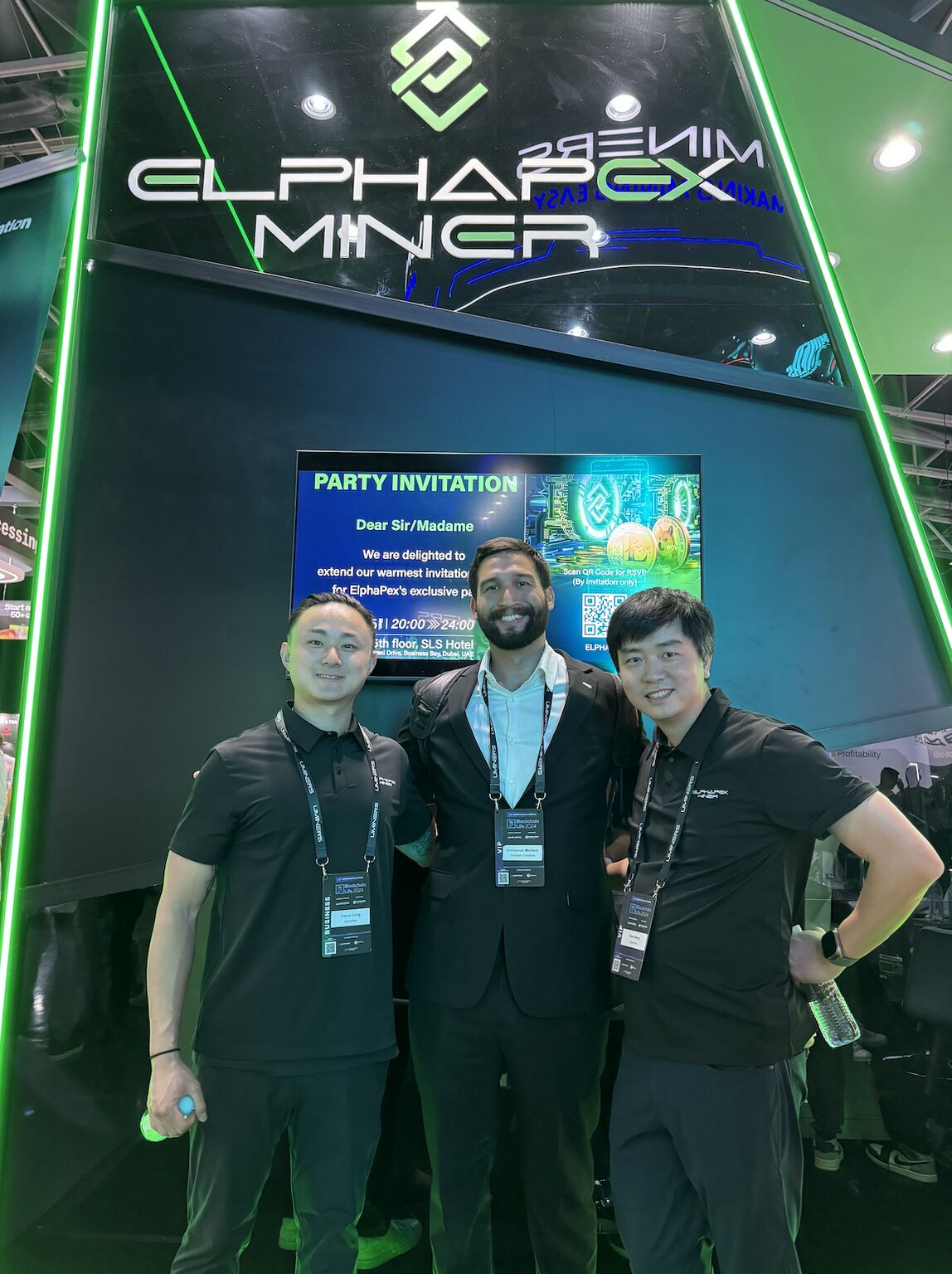
His accompanying account emphasized the conversations. He wrote that speaking with leaders of cryptocurrency companies helped him examine the reasons for their success, with lessons he intended to apply to Terahash’s value, scale and operations. It was a statement about learning how to run the business, with the photograph supplying the less solemn reminder that professional development sometimes comes with neon lighting.
Montero also appeared on the Coin Bureau Podcast in an episode about Bitcoin mining, ASICs and the halving. That appearance offered a public route into the subject he was working on. The episode’s framing puts equipment and mining mechanics at the center. It provides a useful companion to his later financial work: an opportunity to hear him in the context of the underlying industry rather than encounter only the finished product description.
His public presence therefore includes both the operator’s conversation and the executive’s announcement. Those settings ask for different explanations. A prospective hosting customer needs an account of the service. A finance audience needs an account of the instrument. The same industrial activity can occupy both conversations, although the questions around it change considerably.
A different customer, a different instrument
Omnes’s introductory announcement places professional investors at the center of its intended audience. It presents the Mining Note as a way to connect industrial Bitcoin production with a financial structure. For Montero, this is a change in the form of participation he is offering. The customer would hold an instrument linked to production, while the operational work remains behind the arrangement.
The distinction matters to the story. Buying Bitcoin gives someone ownership of Bitcoin. Exposure to mining economics involves the activity that produces it, with a different set of moving parts. Montero’s case for Omnes begins with that difference. The business is seeking to organize production into something an investor can evaluate through financial documentation, governance and reporting.
The March 24, 2026 announcement of a partnership with Apex Group made the intended structure more visible. It described tokenization of the Omnes Mining Note on Base and a Luxembourg secured debt framework. Montero explained the project in terms of turning an operationally intensive process into a financial instrument backed by mining infrastructure. The announcement marked a partnership and a development step; it should not be mistaken for a record of investor results.
There is a pleasing collision of vocabularies here. One side talks about hashrate; the other asks about administration and transfer arrangements. A product has to survive both conversations. The founder’s task is to make the industrial explanation intelligible to the financial audience, then give that audience a structure with responsibilities it can inspect.
“Nearly 2 years in the making”Emmanuel Montero, reflecting on the team’s work toward the Mining Note
The people around the note
Montero is listed as Omnes’s co-founder and chief executive officer. The team also includes co-founder and chief legal officer Panagiotis Dermatis, and chief strategy officer Charles Kanavel. Their titles put legal and strategic work alongside executive leadership. This is a business whose public proposition depends on more than a founder understanding mining.
Omnes describes its wider purpose as building a financial layer for productive compute. Bitcoin mining is its starting point. The company is headquartered in Abu Dhabi, with affiliated entities in Luxembourg and Zug. That geography belongs to the organization; Montero’s own LinkedIn lists the United States. His public career connects those places through work, rather than giving reason to assume a particular present home city.
The professional network also extends to public discussion of fund structures. Renaud Oury’s account of an Apex webinar lists Montero among the participants alongside legal and tokenization specialists. In that setting, the conversation concerns the construction of digital funds. It is another indication of the arena he has entered: product architecture discussed among people responsible for law, technology and administration.
Such connections are useful because a financial instrument contains a chain of responsibilities. The investor may encounter a single product name, but the structure requires several organizations to perform different jobs. For an executive coming from mining services, that is an additional layer of coordination. The equipment still has its demands; so does the arrangement built around its economic output.
The paperwork has a geography
In March 2026, Omnes announced that it had engaged Arendt & Medernach for legal, regulatory and tax advice connected with the Mining Note launch. The announcement gives the legal work a named participant and a defined scope. It also shows why Luxembourg appears repeatedly in this chapter of Montero’s career. Structuring is part of the product’s construction.
The current product description identifies a notional allocation of one petahash per second for each note over a 730-day term. It describes accumulated Bitcoin held for the relevant compartment and a distribution at maturity after costs and tax liabilities. These details are the published design as checked in October 2026, rather than a promise about how much any investor will receive.
Conceptual product flow. Outcomes depend on mining economics and the offering terms.
Eligibility narrows the audience. Omnes’s FAQ specifies professional investors, a minimum investment of US$100,000 and exclusions for US and Canadian persons, among other restrictions. The product is therefore aimed at a particular financial customer. The word “access” has a precise boundary here: participation through a professional investment structure, subject to qualification and jurisdiction.
The company also explains that the issuer’s noteholder register is the definitive ownership record, mirrored onchain. It describes quarterly reporting and audited financial statements once available. These are the less photogenic elements of the proposition. They are also where a reader can see how the company expects an industrial claim to become an administrable investment relationship.
The next issue is still ahead
As of October 8, 2026, Omnes’s website lists a US$50 million first tranche being structured, with an expected first issue on November 1. The number is a proposed tranche size, and the date is an expectation. Neither establishes money already raised. This is the current point in Montero’s story: a product timetable ahead of him, alongside the work already announced.
That distinction keeps the profile grounded. The company’s broader ambition reaches into the compute economy, while its first named product concentrates on Bitcoin mining. The useful test will be what the arrangement delivers in operation: the industrial activity, the reporting and the financial structure functioning together over time. A published design can specify responsibilities; execution has to fulfill them.
Montero’s career has moved from helping customers acquire and host machines to organizing a way for professional investors to hold exposure to their output. The route is unusual, but its progression is understandable. Each stage asks him to explain a complicated activity to someone who wants to participate without taking on every task personally.
The conference photograph preserves an earlier version of that work: a founder with a badge, standing among people who build and sell mining equipment. The current chapter adds lawyers, administrators and investment documentation to the picture. For all the new terminology, the central concern remains recognizable. Somewhere behind the money, work must be done, and someone must answer for it.