A bank can put a bond on a blockchain and still have trouble finding someone to buy it. That awkward gap between recording an asset and creating a market explains R3’s new direction. The company that helped financial institutions build private ledgers is now working to connect their assets with Solana’s public blockchain ecosystem. After years spent making the technology acceptable inside banks, R3 wants to make those banks accessible outside their own networks.
The shift matters because R3 has something more substantial than a demonstration to bring along. Its Corda software sits underneath systems used for interbank reconciliation, collateral management and digital securities. In September 2025, the company reported $17 billion in tokenized real-world assets across its platforms. That is an ecosystem figure, not revenue or money belonging to R3. It nevertheless gives the company a concrete starting point for a much harder proposition: turning separate installations into connected markets.
The back office got there first
R3’s business begins with a familiar financial nuisance. Several institutions participate in the same transaction, but each keeps its own records. They then spend time checking whether those records agree. Differences generate messages, investigations and delays. Corda gives the relevant parties a shared way to represent an agreement and update it under common rules, while restricting who sees the underlying information.
For developers, the work takes the form of applications called CorDapps. Corda’s open-source repository supports smart contracts written in Java and other languages that run on the Java Virtual Machine. That choice fits an enterprise software buying process: build with skills that engineering departments can recognize. A bank does not have to turn its entire technology team into cryptocurrency specialists before it can investigate a shared ledger.
Privacy is central to the design. The parties to a trade need consistent records; they do not necessarily want every other institution to see the terms. R3 built around that distinction. Its customers are typically banks, asset issuers and the operators of financial infrastructure. The person benefiting from the software might be an operations specialist resolving an exception, rather than an investor opening a new app.
Common rules
Controlled visibility
and payment workflows
Simplified workflow, not a diagram of every Corda deployment.
Italy supplied the unglamorous proof
Italy’s Spunta project makes the idea tangible. Developed with ABI Lab, NTT DATA, SIA and R3’s Corda platform, it tackles reconciliation between banks. An October 2020 announcement reported approximately 100 banks using the network. The operating change was specific: shared matching rules, daily reconciliation instead of monthly cycles, and integrated handling of discrepancies.
That is an unusually useful blockchain story because the problem can be described without mentioning a token price. Banks were replacing a slow exchange of calls and messages with a common process. Spunta had processed 204 million transactions by that announcement. Those were reconciliation records, not a claim that Corda had replaced Italy’s entire payment system. The distinction keeps a good example from becoming an inflated one.
Securities provide another test. In October 2023, the World Bank issued €100 million of three-year digitally native notes on Euroclear’s new Digital Financial Market Infrastructure. TD Securities acted as dealer and Citi as issuer and paying agent. The issuer’s case study identifies Corda as the permissioned technology beneath the platform and describes issuance on the same day as pricing.
The connection to existing infrastructure was essential. After primary settlement on the digital platform, the notes became available through Euroclear’s established system for subsequent market activity. Investors could use familiar services. A new ledger did not require everyone else to abandon the machinery they already trusted.
Corporate funding announced in May 2017, covering two Series A tranches.
World Bank bond proceeds on Euroclear’s digital platform, October 2023.
Tokenized assets across R3 platforms, as reported by R3 in September 2025.
The bill was bigger than the code
R3 emerged during the first wave of bank enthusiasm for distributed ledgers. Its current corporate history dates its origins to 2014; the banking consortium launched in September 2015 with nine institutions. Founder David Rutter came from financial markets, while co-founder Todd McDonald had worked in electronic foreign exchange trading at Standard Chartered. Their target was the expensive machinery behind finance.

In May 2017, R3 announced $107 million from more than 40 institutions, including SBI Holdings, Bank of America, HSBC, Intel and Temasek. The consortium had already lost prominent members, among them Goldman Sachs and JPMorgan. An earlier fundraising target had been reduced. The first visible strain was in the coalition and its financing, before the later debate about connecting private networks to public ones.
For buyers, the business model follows enterprise software: licensed products, maintenance, support and professional services. R3 offers help from evaluating a use case through production deployment, with support tiers extending to round-the-clock coverage. Commercial success therefore depends on institutions choosing to build and operate systems, not simply downloading code.
The newer Solana Toolkit advertises no platform license fees. That changes one line of the purchasing calculation. It does not erase application development, custody arrangements, integration or operational work. A sensible implementation budget would price those separately. R3’s collateral case study illustrates the stakes: it cites potential annual savings of €50 million to €100 million for a global bank using HQLAX. Those are estimated benefits, not a quoted software price or independently demonstrated savings for every customer.
A network can work and still run out of money
HQLAX’s approach is to transfer ownership of securities without moving them between custodians. It connects digital records to existing custody arrangements, aiming to reduce the friction of mobilizing collateral. The appeal lies in changing a costly process while retaining useful infrastructure. This is where R3’s experience with financial operations becomes part of the product.
Other Corda projects faced a rougher commercial reality. Trade finance network Marco Polo signed up more than 30 banks but missed an early-2019 production target and a revised 2020 deadline. It eventually went live with two modules in late 2020. In February 2023, it entered insolvency after failing to secure fresh funding, with reported debts of €5.2 million.
Marco Polo was a separate business using Corda. Its collapse does not establish that the underlying software failed. It does show why membership lists are weak substitutes for recurring usage. An infrastructure company needs participants to change their daily work, allocate budgets and keep transacting. A technically functioning network can still lose that argument.
Why R3 opened the door to Solana
R3’s own explanation of its strategic shift is unusually revealing. Writing in May 2025, Richard G. Brown described private networks as a useful starting point with disadvantages: projects could be difficult to finance and isolated systems limited how applications interacted. Meanwhile, stablecoins and decentralized finance had developed outside the banks’ private environments.
“Permissioned networks were the right starting point. But they’re not the finish line.”
Richard G. Brown · May 2025
Brown’s case for moving now rested on improvements in public blockchain infrastructure, programming tools and the regulatory environment. These were R3’s reasons for changing course, rather than proof that every institution faced identical conditions. In May 2025, R3 and the Solana Foundation announced their collaboration. The proposed connection would give private networks access to public-chain transaction confirmation, settlement assets and wider distribution.
R3 then launched R3 Labs in September 2025. The Solana Toolkit addresses controlled issuance, permissioning and connections to wallets and custodians. Its intended buyer is an institution that wants public-chain reach while retaining rules about who can hold and transfer its assets. The strategy depends on combining those demands successfully, rather than assuming public infrastructure makes them disappear.
A second Corda now complicates the vocabulary. In December 2025, R3 announced Corda protocol on behalf of the independent R3 Foundation: a Solana-native system for professionally curated real-world-asset yield vaults. Enterprise Corda remains the ledger-software story; the protocol is a separate product proposition. The announcement targeted the first half of 2026, while the accessed protocol website still invites early access.
In a February 2026 explanation, Brown described investors depositing stablecoins into vaults and receiving tokens representing their positions. Curators would manage asset exposure, inflows and redemptions. The attraction is access to financial returns through products usable within decentralized finance. Whether a particular vault provides suitable liquidity depends on its assets and redemption procedures; putting a position on a blockchain does not make its underlying investment instantly saleable.
The next contest is for working markets
R3 competes in a market with several credible approaches. Canton emphasizes privacy and interoperability for institutional finance. Hyperledger Fabric offers a modular permissioned platform. Public-chain tooling gives issuers another route. R3’s argument rests on financial workflow experience and installed customer systems. Privacy alone is not an exclusive selling point.
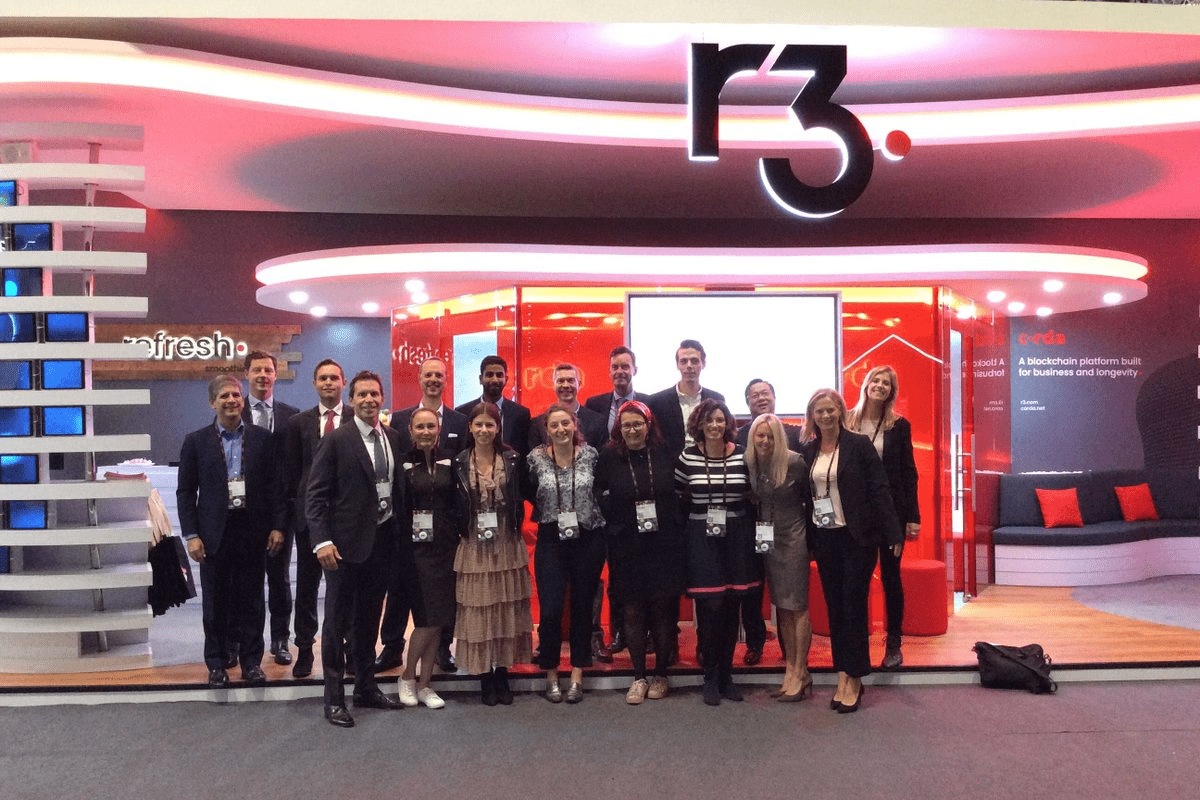
Its hiring gives the transition a human dimension. The careers site lists Solana engineering alongside software testing roles involving Java and enterprise infrastructure. It advertises flexible work and learning leave. Those details describe the organization R3 is recruiting for: one that must understand both established financial systems and public-chain software.
There is a practical lesson here for builders well outside banking. Choose an expensive coordination problem. Identify the organizations that must agree. Design the route into their existing systems, then measure use and reduced work. If one organization already controls the record and its counterparties trust that arrangement, a shared ledger may add complexity without enough benefit. R3’s next test is more demanding still: showing that connecting proven private workflows to public markets brings participants business they actually want.