For four months, Paul Melchiorre and David E. Rutter tried to arrange a meeting. Both were busy. R3 wanted an independent director who understood enterprise software; Melchiorre had that experience. The appointment had all the ingredients of a lengthy corporate courtship. Then they discovered they lived a few blocks apart in New Jersey. Melchiorre got on his bicycle and rode to Rutter’s house.
The interview became an informal conversation between neighbours. Melchiorre later joined R3’s board. A company working on the future of financial infrastructure had made progress with an admirably economical piece of transport.
There is a useful introduction to Rutter in that episode. His businesses concern elaborate networks, but the people inside those networks still have to agree to do something together. Over a career stretching from money markets to blockchain, he has repeatedly worked on that difficult junction between a new system and the institutions expected to use it.
Before the ledger, the board
Rutter graduated from Villanova University in 1984 with a Bachelor of Science in business administration. That year, he began in a money market firm as a “board boy”. It is a pleasantly physical job title for someone whose later work would concern assets that move through computer networks.
His career developed through Prebon Yamane, where he became co-owner and chief executive for the Americas. There were roles in regional management and electronic commerce, followed by responsibility for ICAP’s electronic broking business. At ICAP, his remit included BrokerTec, for fixed income, and EBS, for foreign exchange.
Electronic trading was already part of his working life in 1994, when Chicago Board Brokerage, a joint venture in which he was involved, launched an electronic US Treasury trading platform. Long before blockchain became a conference staple, he was dealing with the practical business of putting markets on screens.
The sequence matters. The founder who eventually pitched distributed ledgers had spent years inside the machinery he wanted to improve. Buyers, sellers, brokers and institutions were familiar working counterparts. His later ventures would ask them to adopt different arrangements for trading, sharing information and recording ownership.
Getting the banks into the room
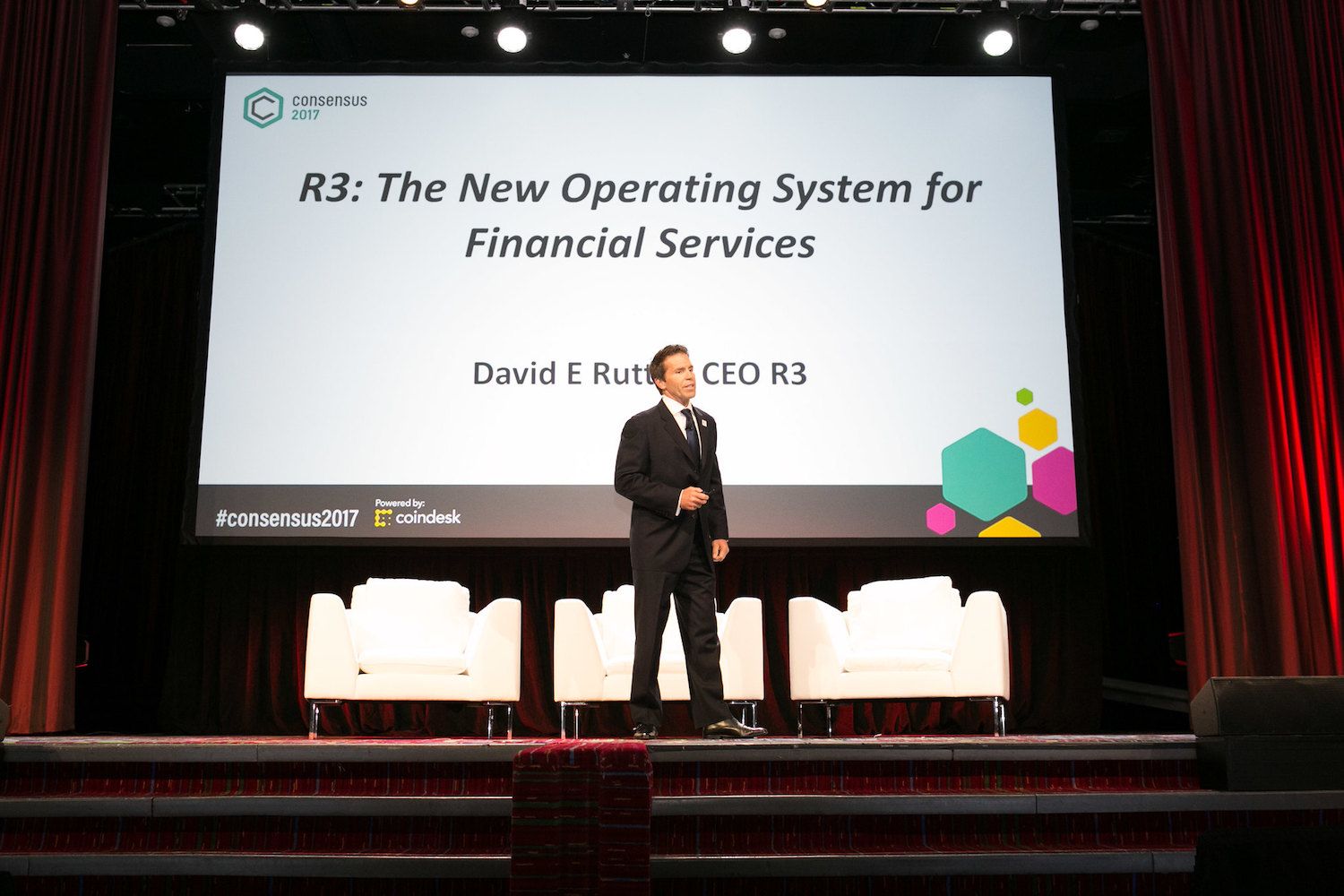
R3 emerged in 2014, with its banking consortium coming into public view in 2015. Nine banks were involved at the start. The proposition gave financial institutions a place to investigate distributed ledger technology together, rather than each paying to discover the same things alone.
By May 2017, R3 had announced $107 million from financial and technology investors in the first two tranches of its Series A. Bank of America, SBI, HSBC, Intel and Temasek were among the backers. This was an unusual guest list for a young software business, and an unusually complicated set of interests to keep aligned.
Some institutions had already left, including Goldman Sachs, Santander, Morgan Stanley and JPMorgan. Rutter’s collaborative model attracted substantial backing while allowing plenty of room for disagreement. In finance, even a shared destination can produce a vigorous dispute over who gets to choose the vehicle.
Melchiorre’s account of joining the board catches another difficulty. R3 had financial expertise in abundance; it also needed people who knew how to build and sell enterprise software. He worked on product strategy, pricing and hiring. The bicycle visit had opened onto a substantial organisational task.
The resulting platform, Corda, centred on transactions between identifiable participants and on control over information. One early project with banks examined shared identity management and customer onboarding. The attraction was concrete: reduce repetitive verification work while allowing customers to retain control of their information. Rutter’s technological ambitions kept finding their way back to administrative chores.
A $150 million answer
While R3 pursued shared infrastructure, LiquidityEdge tackled a specific trading market. Rutter founded the US Treasuries venue in 2015. It let participants choose trading relationships and receive executable prices through customised arrangements, including individual and broader pools of counterparties.
That design made room for differences between customers. A Treasury market may concern the same government’s debt, but its participants need not all want the same trading experience. LiquidityEdge offered anonymous and disclosed price streams, with a personalised order book for each participant.
Approximate consideration for MarketAxess’s acquisition of LiquidityEdge.
By the second quarter of 2019, LiquidityEdge’s average daily volume had reached $14.7 billion. Its 2018 revenue was $9.2 million, compared with $2.3 million the year before. These were business measurements a prospective buyer could examine without attending a symposium on the future.
MarketAxess announced the acquisition in August and completed it on November 1, 2019. The consideration was approximately $150 million, comprising roughly $100 million in cash and 146,450 MarketAxess shares. For Rutter, it was a tangible outcome from a venture launched four years earlier. For MarketAxess, it provided Treasury trading infrastructure and a liquidity network that could support its wider fixed income business.
The customers who almost arrived
LedgerEdge, co-founded in 2020, brought Rutter back to corporate bonds. It used Corda and sought to help traders discover liquidity while controlling sensitive information. Revealing a trading intention can itself carry a cost. The venture was designed around giving participants more say over how their data travelled.
Co-founder David Nicol traced the idea’s development to work on the SIX Digital Exchange in Zurich. Distributed ledger technology offered a way to tackle a familiar problem: valuable information was needed to find a trade, yet exposing it could hurt the party supplying it. This was a market design question with a software component.
LedgerEdge went live in May 2022 as a UK-regulated multilateral trading facility. By the time it closed in 2023, there were 45 firms in its UK facility and 70 globally either trading or being onboarded. That last distinction proved consequential.
The business struggled to turn interest and onboarding into sufficient active use. Rutter stepped in temporarily after Nicol’s departure in December 2022. The following summer, the venture closed and went into administration. Its explanation pointed to difficult funding conditions despite improved traction.
Rutter’s record contains both the completed LiquidityEdge sale and this unfinished promise. Put beside one another, they show how much depends on participation. A financial marketplace needs enough customers using it, with enough regularity, while the business still has money to operate. Supportive conversations do not pay the hosting bill indefinitely.
The public-chain turn
Rutter’s approach to decentralised finance has included conspicuous caution. In 2022, he argued that institutional adoption would require the regulatory protections developed by traditional finance. He was interested in the technology, but he objected to treating existing safeguards as disposable furniture.
Three years later, R3 announced a strategic collaboration with the Solana Foundation. The May 2025 plan sought to connect regulated institutions and their assets to a public blockchain, bringing Corda’s controls into contact with a wider network. Solana Foundation president Lily Liu was invited to R3’s board.
“We’ve never pursued blockchain for its own sake”
David E. Rutter · May 2025
The shift had a clear commercial argument. Institutions wanted broader distribution and liquidity for tokenised assets. Public networks offered access to a different population of participants. R3 said its collaboration would preserve privacy, compliance and institutional control while connecting the systems. The practical details would determine how much of that ambition could be delivered.
In September 2025, R3 launched R3 Labs, led by Richard G. Brown, and reported $17 billion in tokenised real-world assets across its platforms. Rutter described an ambition to help bring the next trillion dollars of institutional assets onto public blockchains. The $17 billion was a company-reported platform figure; the trillion dollars was a destination.
December brought an announcement for Corda protocol on behalf of the independent R3 Foundation, formed that summer. The proposed Solana-based yield vaults extended the move towards distributing institutional assets through public infrastructure. For Rutter’s story, the significance is the direction of travel: a business associated with private networks was reaching beyond them.
Back to the bond desk
Rutter’s present roles keep him close to familiar problems. R3 now lists him as founder and Richard G. Brown as chief executive. At AIQ Markets, he is board chair. The company builds intelligence tools for US corporate bonds, with Kevin Rutter as CEO and Brandon Stiles as CTO.
AIQ’s proposition addresses fragmented data and the time it takes a trading desk to obtain useful answers. Its advisers include people with experience at R3, LedgerEdge and MarketAxess. Across Rutter’s ventures, institutions and colleagues reappear, bringing knowledge accumulated through earlier attempts.
His LinkedIn profile also describes support for charity: water, including membership of its operating-cost funding community after a trip to Ethiopia. It is a glimpse of a life outside trading infrastructure, recorded in the same practical language of backing an organisation’s work.
From the board boy’s first job to a chair at an AI company, the tools have changed considerably. The recurring challenge has been persuading people with established routines to take a chance on a different arrangement. Rutter has a sale, a closure and an evolving software company to show how uneven that process can be.
The bicycle meeting offers a fitting place to leave him. Months of scheduling became a conversation once two people realised how close they already were. Financial markets require rather more engineering. Still, a connection only becomes useful when somebody actually makes the journey.