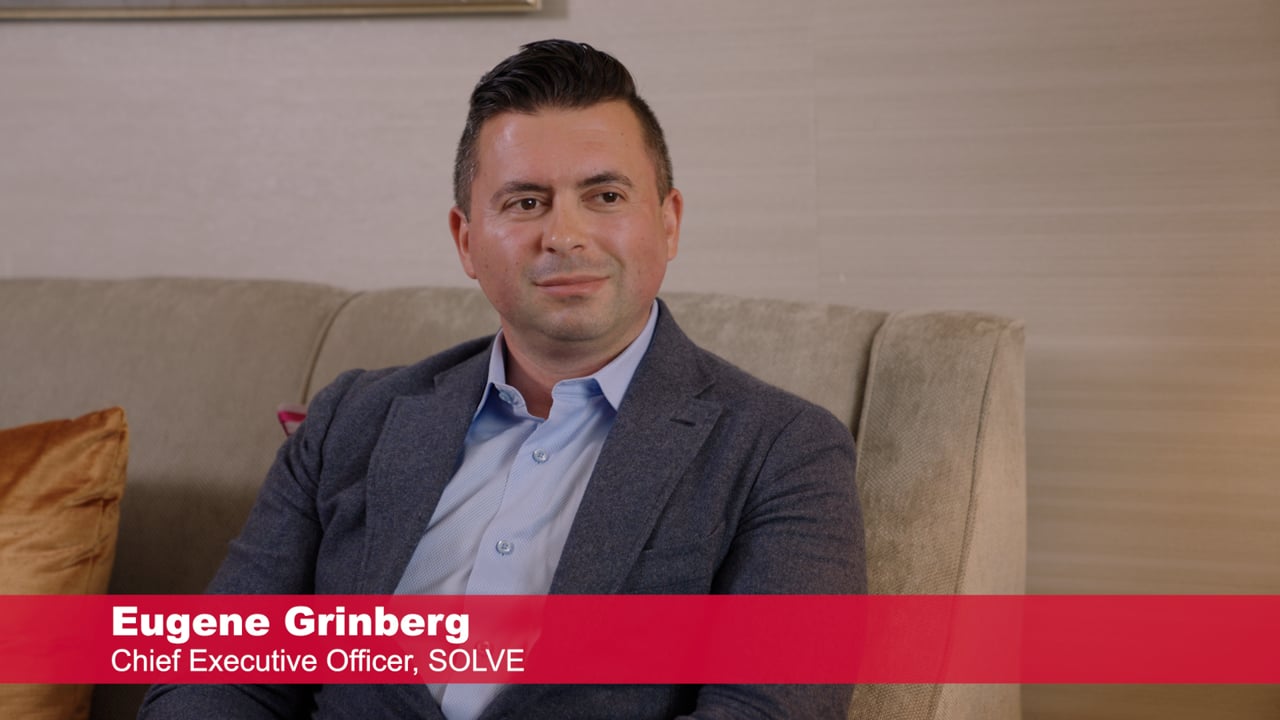
Eugene Grinberg remembers the date: May 17, 2012. SOLVE had its first paying customer. For a founder trying to sell a way of understanding prices, the payment supplied a particularly persuasive piece of evidence.
He and Gerard Nealon had previously tried to sell pricing models at Red Pine Advisors. Those conversations revealed a different problem: customers struggled to discover prices and trust the information behind them. The pair founded SOLVE in 2011. Their eventual business grew around reading the market’s scattered messages.
There is a pleasing indignity to this beginning. Finance can make a roomful of people sound fluent in uncertainty. Getting someone to pay an invoice is a less elegant examination. Grinberg’s remembered date gives the story a human scale: somebody decided that what these two programmers had built was useful enough to buy.
An engineer learns the language of bonds
Grinberg’s education sits a little sideways to the usual image of a financial executive. He earned both bachelor’s and master’s degrees in Electrical Engineering at Cooper Union. He is also a CFA charterholder. The combination puts systems and securities on the same résumé, with plenty of room for awkward problems between them.
His professional apprenticeship was in securities that resisted easy valuation. At ACA Capital, his responsibilities included information services and structured credit. At Duff & Phelps, he worked as vice president of financial engineering. At Houlihan Lokey, through Red Pine Advisors, he was vice president and co-head of analytics, conducting valuations and developing analytical tools for complex, illiquid securities.
That is a useful place to acquire respect for detail. A model has to accommodate the security in front of it. A valuation has to mean something beyond the person who produced it. By the time Grinberg became a founder, he had worked on the machinery behind those answers as well as the answers themselves.
The programming began earlier. After his family moved from Ukraine to Brooklyn in 1992, his father’s programming books helped him learn the craft. They later worked together on consulting and teaching programming. Before software became a company, it was something they could do together.
A bigger company, a more specific problem
The market problem Grinberg discusses is easy to recognize even without a trading desk. Information arrives in conversational form. A message contains a price; another carries a useful update. The facts exist, but they do not arrive as a clean, orderly database. In his 2025 TraderTV interview, he described how fragmented chat-based pricing information leaves participants with uneven views of the market.
SOLVE’s original technical task was to extract information from that traffic. Natural language processing and machine learning turned unstructured messages into data that users could search and analyze. The company’s quote platform made room for dealer inventories, competing bids and indications of where a security might trade. An inbox could begin to behave like a working record.
- 01ReadMessages & quotes
- 02OrganizeComparable market data
- 03EvaluatePrices & peer groups
Institutional capital gave the founders room to extend the business. Credit Suisse Asset Management’s NEXT Investors invested in 2019. In February 2022, SOLVE announced investment of more than $80 million from Charlesbank’s Technology Opportunities Fund. The stated purposes included product development, acquisitions and geographic expansion. This was funding for a company with a working product and a longer list of things to build.
The acquisitions added particular kinds of knowledge. Advantage Data and Best Credit Data joined in March 2022, bringing credit information, analytics and pricing capabilities. Lumesis followed that September, adding its DIVER municipal-bond tools. Its co-founders, Gregg Bienstock and Tim Stevens, joined SOLVE with their colleagues. Growth meant bringing in people who already knew the difficult corners of another market.
In October 2025, SOLVE acquired MBS Source, founded by Mihai Szabo. The addition brought specialized mortgage- and asset-backed securities data and trading tools, including predictive pricing for agencies and prepayment analytics. For Grinberg, whose earlier career involved difficult securities, the expansion returned to familiar technical territory with a broader set of tools.
Grinberg also takes the work into conversations with other specialists. In July 2023, he appeared with Moody’s Analytics colleagues William Tso and Arthur Krivoruk for a webinar on real-time pricing and liquidity monitoring. The session brought SOLVE Quotes into the Structured Finance Portal, covering inventories, comparative analysis and charts. That setting captures another aspect of his career: technical tools have to be explained, demonstrated and connected to someone else’s way of working. The diagram may be tidy. The professional using it brings a particular portfolio, a particular question and a limited amount of time.
How much faith belongs in a number?
As the business expanded, its question became more immediate. A trader needs a view of where a bond could trade now. SOLVE Px was built for that front-office problem. Its models are trained on actual trades, with predictions checked against trading outcomes. The intended use is practical: give the person making a decision a timely benchmark alongside their own judgment.
Grinberg discussed that approach on Bloomberg Intelligence’s FICC Focus podcast in 2025. Conversational quotes supply live inputs; aggregation provides a wider view. The interesting engineering problem is what happens between those two things. Data gathered from a market has to become an estimate that still makes sense when conditions move.
A number on a screen can have impeccable posture. It can stand there with several decimal places and reveal very little about how much trust it deserves. This is where the next part of Grinberg’s product agenda becomes revealing. Alongside a predicted price, SOLVE began giving users an explicit measure of uncertainty.
Higher scores indicate greater model confidence in the predicted price. The score describes uncertainty; it is not a return forecast.
When Confidence Score reached corporate bonds in February 2026, it used a scale from one to ten. The company grouped the scores into low, medium and high confidence and made them available across its delivery methods. A trader could look at a proposed price with some indication of how strongly the model supported it. The distinction matters most when the evidence is uneven.
In March, another change addressed a quieter frustration. Augmented Quote data applied a consistent methodology to price, yield and spread calculations for municipal and corporate bonds. Before comparing two answers, it helps to know they have been calculated on comparable terms. Grinberg framed the update around clients asking for greater consistency.
“Our clients asked for greater consistency”
Eugene Grinberg · March 2026
The comparison before the trade
By June 2026, SOLVE’s work had moved further into the question of relative value. A bond might look attractive beside one security and ordinary beside a more suitable group. The company introduced cohort-based analysis, letting users compare a bond with a configurable set of peers or compare one market segment with another.
The difference is in who defines the company a bond keeps. Portfolio managers can create groups that reflect the question they are investigating. SOLVE also added a natural-language interface for defining segments. The underlying idea is concrete: make it easier to move from a broad suspicion about a sector to a comparison grounded in information.
In September, the company connected more of those analytical steps with the desk’s daily work. Its TRACE suite put reported trades beside security-level context. An updated BWIC Monitor helped teams coordinate bids wanted in competition, including shared statuses showing whether a security was being passed on, bid on, won or lost. Those are ordinary verbs carrying expensive responsibilities.
These details make the present chapter of Grinberg’s story more interesting than a simple account of adding AI. A shared status can stop two colleagues duplicating work. A trade shown with its history can be easier to interpret. The ambition is expressed through small decisions about what a working person needs to see next.
The founder’s work moves with the company
The people around Grinberg now reflect the company’s wider responsibilities. In April 2026, SOLVE promoted Michael Pellerito to senior vice president of innovation, giving him responsibility for advancing AI-driven products. Grinberg singled out his role in building the models behind the platform. Technical leadership had become something to distribute across an organization.
In August, Doug Meads became chief revenue officer, reporting to Grinberg and leading sales and account management. Building the commercial organization sits alongside building the technology. The appointment gave a specific executive responsibility for connecting SOLVE’s expanding products with clients and prospects. A founder’s calendar has a way of filling with the consequences of the product working.
Access is another part of that work. The November 2025 partnership with Charles River Development set out to bring SOLVE’s market data and predictive pricing into Charles River IMS. Traders and portfolio managers would be able to use that information within an existing workflow. Useful data has a better chance of being used when it arrives where the decision is already happening.
Grinberg’s public outlook has increasingly centered on that connection. In his year-end 2025 writing, he argued that real-time information and automation were becoming fundamental to fixed income. In 2026, he returned to the ability to turn fragmented information into repeatable decisions. The challenge he describes extends beyond acquiring another dataset.
There is continuity here with the beginning. The early sales conversations exposed a question customers needed answered. The later products keep approaching that question from different directions: a comparable quote, a confidence measure, a useful peer group, a shared view of a live bid. Grinberg’s work keeps returning to the same practical test. Someone has information. Can they use it?
More conversations, fewer mysteries
Follow the work and hear Grinberg explain it in his own words.