Somewhere on a bond desk, a trader opens an inbox and meets a small blizzard: dealer runs, bids, offers, lists of securities, price talk, inventory and shorthand composed for humans who already know the dialect. The messages contain a live picture of the market. They are also too numerous, too inconsistent and too perishable for any one human to assemble. SOLVE's business begins inside that contradiction.
Founded in 2011 by Eugene Grinberg and Gerard Nealon, the Stamford-based company takes the market color institutions already receive and turns it into structured data. Its natural-language systems parse messages; its platform combines those quotes with trades and reference information; its tools let fixed-income professionals search, compare, price and monitor securities. More recently, SOLVE has trained models to predict the next trade level. It does not execute the bond. It tries to make the moment before execution less blind.
Its moat arrives one badly formatted message at a time
The obvious description of SOLVE is “AI-powered fixed-income data.” It is accurate and incomplete. The more interesting asset is permissioned access to a stream of information that generic models do not possess. A buy-side desk can receive thousands - sometimes hundreds of thousands - of market messages in a day. A sell-side desk is expected to provide color while seeing only part of what the street is doing. SOLVE structures a client's own flow and also offers aggregated color from a network of contributing institutions.
That creates a practical data flywheel. More usable quotes improve the picture of liquidity and price. A better picture gives institutions a reason to participate and keep the product open. The customer does not need a philosophical lecture about data network effects; the return can be immediate. One bank quoted in SOLVE material said it went from bidding five municipal deals to fifteen in the same amount of time.
“We used to bid 5 deals - now we can bid 15 in the same time.”
The audience is broader than the trader staring at a Bloomberg screen. Portfolio managers look for relative value. Sales desks want useful color while moving inventory. Valuation teams need evidence for a mark. Banks and underwriters need comparables for new issues. Municipal advisers and compliance teams use DIVER tools for diligence, monitoring and regulatory workflows. Private-credit analysts examine BDC holdings. Quants pull data through feeds and APIs. The product is sold as enterprise software and data access - workstations, integrations, Excel functions, APIs and files - with pricing negotiated privately rather than posted like a consumer subscription.
An $80 million check bought breadth - and a branding headache
SOLVE spent its first years as a focused price-transparency company. Credit Suisse Asset Management's NEXT Investors backed it in 2019 with an undisclosed investment. Then came the accelerant: in February 2022, Charlesbank's Technology Opportunities Fund invested more than $80 million for product development, acquisitions and global expansion. SOLVE acquired Advantage Data and Best Credit Data in March, adding credit, municipal, private-credit and workflow datasets. In September it acquired Lumesis, whose DIVER suite brought municipal new-issue pricing, monitoring and regulatory tools used by thousands.
The acquisition prices were not announced, so the public cost of the strategy stops at the Charlesbank commitment. The shape of the strategy is clearer. SOLVE was assembling the fixed-income stack around its quote engine: observable market color, security and issuer data, valuation, compliance, primary-market workflows and portfolio analysis. In 2025 it added MBS Source, a roughly 30-person specialist in mortgage- and asset-backed securities with prepayment models, new-issue data and structured-product analytics.
Grinberg and Nealon start with fragmented pre-trade data and illiquid securities.
Credit Suisse NEXT funds expansion in product, sales and marketing.
Charlesbank invests $80M+; Advantage Data, Best Credit Data and Lumesis join SOLVE.
SOLVE Px expands from munis to corporates, then gains confidence scores and cohort analytics.
What failed first was not the technology but the explanation. By 2025, SOLVE said its brand had become disjointed and too product-oriented after a decade of organic growth and acquisitions. Customers could reasonably ask whether this was a data vendor, a municipal workflow suite or an AI-pricing company. Management's answer was to stop making the catalog the story. A new identity organized the pieces around one promise: clarity in opaque markets. It was a marketing correction with operational meaning - the products increasingly had to work as one platform.
Nearly a million quiet bonds, each waiting for a next price
Municipal bonds made a revealing test case. The market contains around a million live securities, many of them infrequently traded, and retail investors hold much of the asset class. A last trade can be an old photograph. SOLVE Px, launched commercially in 2024, used the company's quote database, trades, reference data and nearly 300 feature inputs to produce real-time next-trade predictions for more than 900,000 municipal bonds. The model was retrained daily. In 2025, SOLVE extended Px to more than 250,000 corporate bonds using more than 300 reference features alongside proprietary quotes and activity.
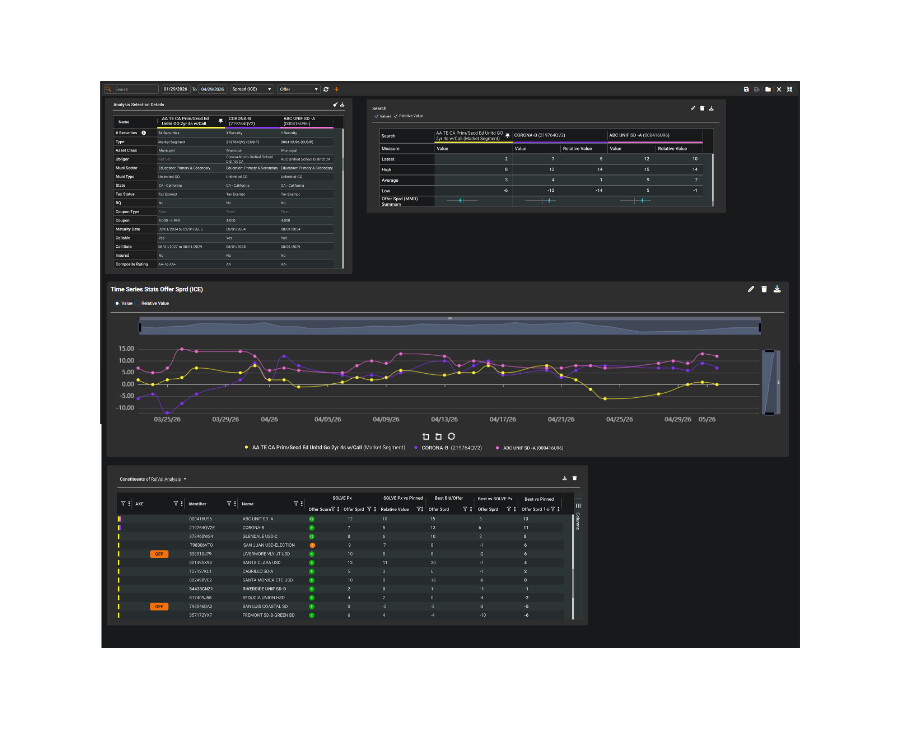
The newer products move beyond returning a number. A 1-to-10 Confidence Score tells corporate-bond users how much faith the model places in each predicted bid, mid or offer. Augmented Quotes apply consistent yield and spread calculations to municipal and corporate quotes. In June 2026, Relative Value Analysis added bond-versus-cohort and cohort-versus-cohort comparisons. A portfolio manager can define a segment - airports against railroads, for example - with a natural-language interface, compare predictive prices, and check whether attractive-looking bonds have live bids or offers.
This is SOLVE's competitive argument against Bloomberg, ICE, LSEG, S&P Global, MarketAxess, Tradeweb, BondCliQ and homegrown systems. It is not that those firms lack fixed-income data. It is that SOLVE concentrates on the pre-trade exhaust others may leave fragmented: parsed messages, contributor color and the long tail of illiquid securities. Nor does it insist on becoming another destination screen. Partnerships push its data into Charles River IMS, FlexTrade's FlexFI execution workflow and INTEXcalc. The closer a prediction sits to an existing decision, the less likely a trader is to ignore it.
Do not begin with the model. Begin with the neglected workflow
There is a clean lesson here for founders outside finance. Find an expensive decision surrounded by high-value information that arrives in an unusable form. Structure the exhaust. Give the contributor value before asking for more. Build an interface around the existing job. Only then use prediction to compound the dataset. SOLVE's order of operations matters: quote parsing came long before the fashionable generative-AI layer. Its founders paired market knowledge with engineering - Grinberg had spent decades modeling complex securities; Nealon brought systems architecture, analytical tooling and a graduate background in cryptography.
There is another lesson in the rebrand. Acquisitions can widen a moat while making a company harder to understand. Buying adjacent datasets is not enough; identity, navigation and workflows must make the combination legible. SOLVE changed its message when the old product-by-product story no longer described what customers were buying. The company now sells a connected progression: observe the market, predict a price, compare the bond, act in the system where you already work.
A predicted price is still a prediction
The approach is strongest when fresh quotes, representative trades and stable reference features overlap. It weakens in sparse data, sudden regime changes or markets whose participants do not contribute enough color. Privacy and governance are prerequisites, not garnish. SOLVE says its outputs are decision support rather than investment advice - a necessary distinction when the model's tidy number meets a bond that has not traded in months.
That limitation also explains the confidence score. In an opaque market, honesty about uncertainty can be a product feature. A trader does not need software to pretend every estimate is equally solid; the trader needs to know when the evidence thins out. SOLVE's opportunity is to make that evidence broad enough, current enough and close enough to execution that its view becomes difficult to work without.
Fifteen years after launch, the company has roughly 180 employees by industry estimates, seven global offices by its own account, four acquisitions and a platform spanning corporates, munis, syndicated loans, structured products, private credit, CDS, convertibles and indices. The scale is substantial. The animating idea remains pleasantly small: a market is already telling you what it knows. First, teach the computer to read the messages.