A credit rating is a remarkably small container for a remarkably large decision. A few letters sit beside a bond. Behind them are assumptions about cash flows, collateral, management and what might happen when conditions turn ugly. KBRA was founded in 2010, when investors had recently learned how much trouble could fit inside those letters.
- KBRA rates borrowers and debt; its separate analytics business sells data and research.
- Its useful territory includes structured finance, private credit and the loans behind commercial property.
- The product is an informed opinion, followed by the work of checking whether it still holds.
The company’s origin belongs to the aftermath of the financial crisis. Highly rated mortgage securities had produced losses that made familiar assurances look ridiculous. Jules Kroll and Jim Nadler entered a market dominated by established names with an apparently simple proposition: investors could use another informed voice. Getting that voice heard would be the harder part.
01 / A familiar name is a formidable moat
Ratings work because other people recognize them. An issuer wants an opinion investors accept. Investors want analysis they can compare. A new agency therefore faces an awkward circular problem: being useful helps it become accepted, while acceptance helps make it useful. Hiring analysts is only one part of entering the business.
Nadler understood the machinery. Before KBRA, his career included S&P and a substantial role building Fitch’s structured finance business. Today, KBRA covers corporate borrowers, financial institutions, insurance, public finance, infrastructure and several forms of securitized debt. Its regulatory footprint includes U.S. registration and registered European and UK affiliates. Acceptance still depends on the jurisdiction and the transaction.

KBRA’s competitive pitch rests on detailed analysis, transparency and investor engagement. That is a claim about how it works, rather than proof that its judgments always beat those of Moody’s, S&P or Fitch. For a reader comparing agencies, the revealing questions concern assumptions, sector expertise and the willingness to explain a conclusion.
02 / The borrower pays. Someone else relies.
Here is the business’s central complication. Issuers and other transaction participants can pay for ratings that investors use. KBRA also earns money from surveillance and, through its analytics affiliate, subscriptions. An initial borrowing event creates work; keeping the opinion current creates more. A rating is a product with a maintenance obligation.
The conflict inherent in issuer-paid ratings does not disappear because an agency arrived after a crisis. KBRA’s published conduct rules restrict ratings employees from negotiating fees and from having their compensation tied to revenue from an entity they rate. Those rules matter because independence needs operating procedures as well as good intentions.
“It’s really listening to what investors want that has helped us grow so much.”Jim Nadler, December 2021
Parthenon Capital’s majority acquisition, announced in December 2021, put a reported $900 million enterprise value on KBRA, including debt. That figure measures an ownership transaction. Customers buy individual rating engagements or analytics subscriptions, with scope and access determining what they need. Comparing the services requires comparing the deliverables, too.
03 / Your borrower needs neighbors
Private credit makes the information problem particularly interesting. A lender may know a borrower closely while having less visibility into comparable companies financed elsewhere. A leverage ratio becomes more useful when the earnings beneath it have been calculated consistently. Otherwise, the apparent comparison can conceal different accounting adjustments.
In March 2026, KBRA Analytics announced Private Credit Benchmarking within Credit Intelligence. It uses analyst-adjusted financial information to compare middle-market borrowers. Its product page reports more than 4,000 borrowers and over $1.3 trillion of represented private credit exposure. These are coverage figures supplied by the company, rather than a measurement of the entire market.
For an investment team, the practical use is straightforward: compare leverage, interest coverage and liquidity with a relevant peer group, then investigate the differences. A fund manager can also organize exposures into portfolios and prepare reporting. The analyst still has to decide whether the selected peers actually resemble the borrower.
04 / Put the answer where the work happens
The wider product family follows specific professional tasks. Direct Lending Deals tracks private loan transactions, terms and market developments. Credit Profile examines commercial mortgage-backed securities and CRE CLOs, including property valuations and alternative loss scenarios. Financial Intelligence supplies bank and credit union data, peer comparisons and proprietary scores.
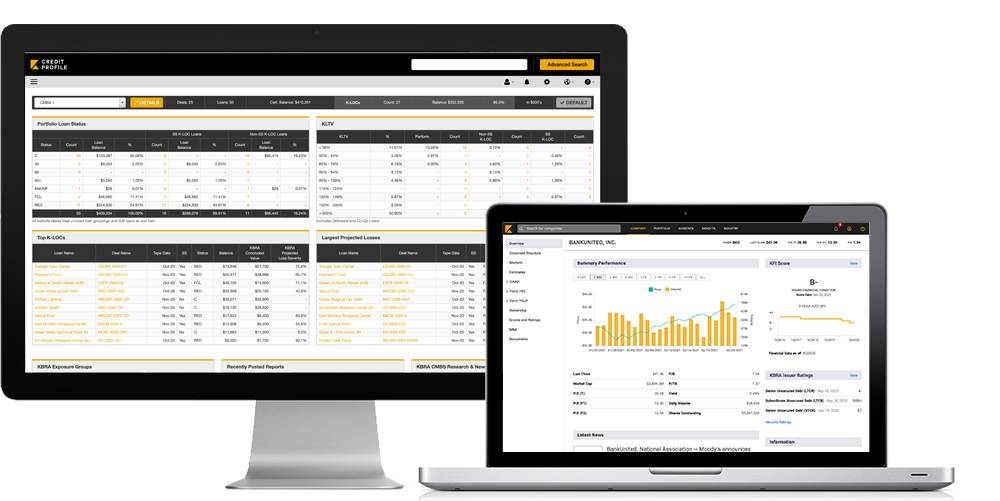
Delivery is part of the strategy. KFI offers an Excel add-in; KCP lists integrations with Bloomberg, Intex and Trepp. These connections put analysis closer to existing decisions. A treasury team assessing bank relationships has a different problem from a trader modeling a property-backed bond. KBRA sells tools shaped around both.
One distinction deserves attention: KBRA Analytics is a separate business and is not a credit rating agency. An analytics score, a confidential credit assessment and a surveilled credit rating have different meanings. Buyers need to understand the output before using it in a mandate, a risk model or an investment committee presentation.
Consider a property-backed loan. A change in rental income can alter a building’s estimated value, which can alter the expected recovery if the borrower defaults. KCP’s multiple loss scenarios let investors examine different outcomes rather than treat one forecast as inevitable. That makes the reasoning inspectable. A model cannot make the building’s tenants pay their rent, but it can help reveal which assumptions carry the decision.
05 / The opinion has to survive tomorrow
KBRA’s careers materials emphasize collaboration, integrity and professional development, including tuition reimbursement. Those commitments fit a business whose output depends on specialist judgment. On October 15, 2026, its homepage highlighted an AI Ecosystem hub covering the financing behind data centers and related infrastructure. New assets create new questions about familiar things: tenants, power, leases and repayment.
The useful lesson for other businesses is to find an information gap, make the inputs comparable and fit the answer into a customer’s routine. The limits remain stubbornly human. Incomplete information, unsuitable comparisons or a mistaken assumption can weaken the conclusion. A second opinion earns its place when the reader can examine the reasoning and decide what to do next.