Private markets have an awkward habit: the money can be enormous while the information remains maddeningly difficult to compare. A fund manager has a performance record. An investor has a pension to pay. Somewhere between the pitch and the cheque sits the question that made Preqin valuable: compared with what?
BlackRock put a price on that question when it bought the London data company. The transaction closed in March 2025; a subsequent securities filing describes roughly £2.5 billion in cash. Preqin had spent more than two decades collecting information about funds, their managers, their investors and their results. Its new owner wanted those numbers closer to the machinery of investing.
The view was worth £2.5 billion
Preqin sells financial information and the tools to interrogate it. Its territory includes private equity, venture capital, private debt, real estate, infrastructure, natural resources and hedge funds. Customers use it to find investors, investigate managers, compare performance and understand fundraising markets. A large part of its appeal is making separate pieces of an investment story searchable together.
The economics attracted BlackRock before the deal closed. At the June 2024 announcement, the buyer forecast approximately $240 million in Preqin revenue that year and described it as highly recurring. That was a forecast, not a final audited result. More than 4,000 client relationships and 200,000 users were part of the acquisition pitch. The revenue model was subscriptions and information sold repeatedly to professional customers.
Cash acquisition consideration reported in BlackRock’s subsequent SEC filing. An ownership change, not a venture funding round.
BlackRock had been a customer. Owning Preqin offered a way to bring outside-market intelligence into Aladdin and its private-markets platform, eFront. The purchase also brought an established audience for data products. The strategic attraction is easy to see: information becomes more useful when it appears where a customer is already making a decision.
A founder who had already paid for ignorance
Mark O’Hare and Nick Arnott launched the business in 2003 as Private Equity Intelligence. Preqin’s twentieth-anniversary account describes a starting team of five and two priorities: data quality and attention to customers. The original name was almost aggressively literal. Nobody needed a branding consultant to explain the intended subject matter.
O’Hare’s own history supplies a useful complication. In a 2023 interview, he pushed back when the interviewer framed his career as three consecutive successes. He had failures too. After selling Citywatch, an equity-ownership database, in 1998, he invested in a dot-com venture promising three-dimensional room imagery for architects and interior designers.
He did not understand how it would earn revenue. The venture went broke after the boom ended. His lesson was plain: “only invest in businesses you understand.” This was a personal investment failure, separate from Preqin. It also makes a more revealing origin detail than the usual founder mythology: a man selling better information had experienced the cost of ignoring its absence.

The database earns its keep before the meeting
Consider two customers approaching the same market from opposite directions. A pension investor wants a shortlist of managers that fit its strategy. A manager raising a new fund wants institutions likely to commit capital. Preqin Pro gives each a starting point: searchable profiles, investment preferences, fundraising information and performance tools. The product serves both sides of the conversation.
The practical sequence matters more than the catalogue. An analyst can narrow a universe, inspect individual records, build a list and monitor changes. A business-development team can research investors before making contact. A consultant can place a manager’s record beside comparable funds. These are recurring jobs, which helps explain why a database can support a recurring bill.
Amundi’s 2021 client account makes the use concrete. Its private-markets multi-management team used Preqin daily for screening funds and monitoring portfolios. Research and marketing colleagues used the information too, including to explain private markets to clients. Preqin helped organize the information around investment decisions; the account does not establish that the database caused Amundi’s investment returns or asset growth.
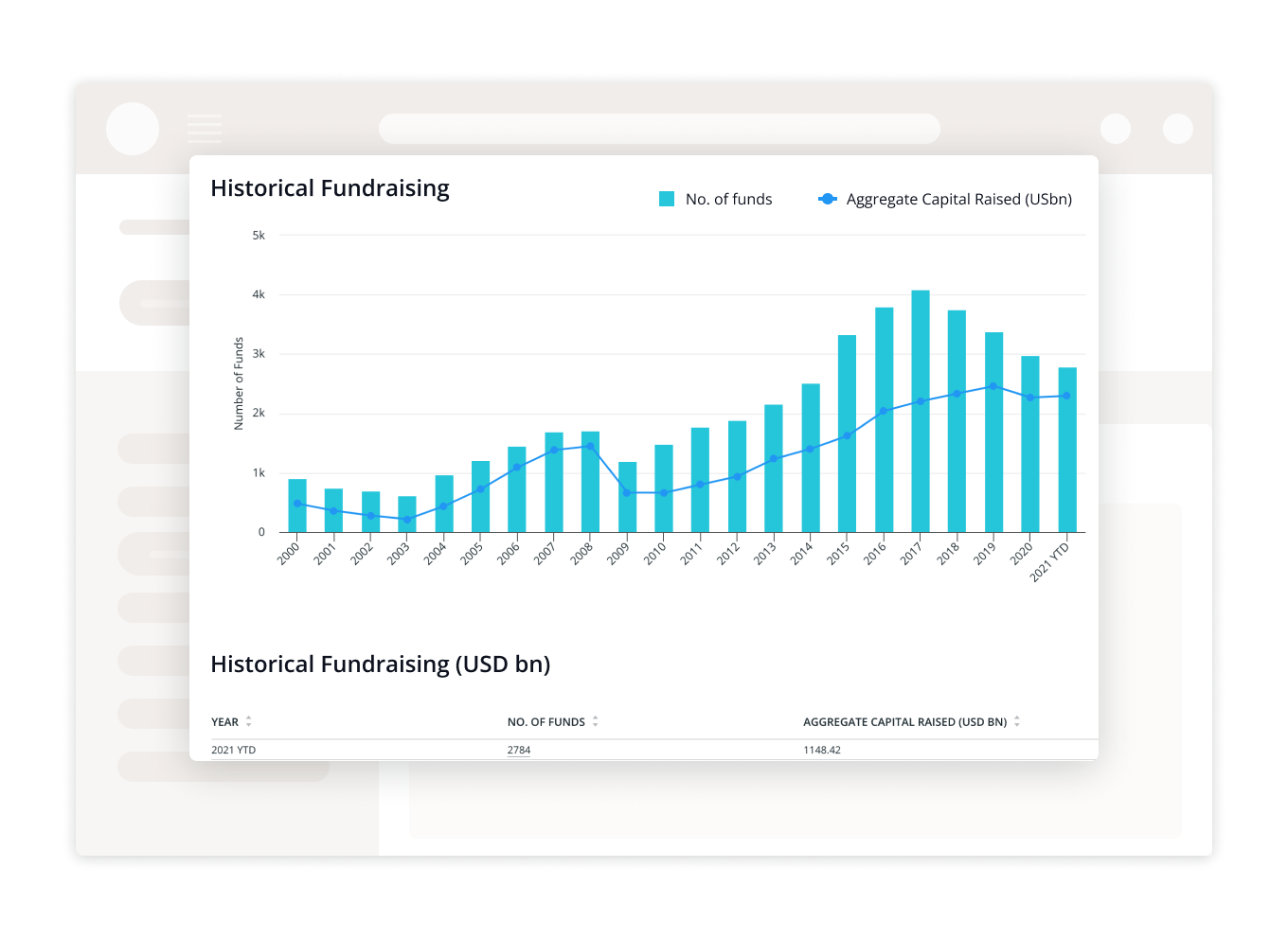
Other published customer stories feature Investec, Natixis Investment Managers and investment consultant Objective. The variety is instructive. Preqin sits in a professional information market serving institutions with different mandates, rather than a single category of investor. A useful answer for a lender can be a useful starting point for an allocator, even when the eventual decisions differ.
The unglamorous work behind a useful number
Preqin’s expertise starts before the dashboard. Its performance-data guide describes gathering institutional-investor figures through freedom-of-information requests, alongside other collection methods. Its contribution portal lets firms submit and review information about their profiles, fundraising, performance and deals. Data collection here includes asking, checking, updating and giving the subjects a route to correct the record.
That is a labour-intensive proposition. A January 2024 coverage update said the research department had reached nearly 500 people during 2023. A polished chart conceals the work required to make its inputs usable. The company also publishes research that interprets those inputs, giving customers a route from individual records to a wider view of a market.
The scale should be dated honestly. Preqin reported 1,500 people across 16 offices in its 2023 anniversary account. Those figures describe that moment, rather than a verified standalone workforce after the acquisition. Its 2024 King’s Award for Enterprise in International Trade offers another marker of the business it had built before joining BlackRock.
“only invest in businesses you understand”
Mark O’Hare · Founder interview, 2023
Compared with which funds, exactly?
A benchmark earns its name only if the comparison makes sense. Preqin’s custom-benchmark tools let users assemble their own peer groups, including by selecting funds from search results or adjusting a market benchmark. That gives an investor room to ask a more precise question than whether a manager beat an undifferentiated industry average.
It also creates responsibility. In practical terms, an analyst needs to examine the strategy, vintage and geography represented, as well as the dates and completeness of the records. A narrowly tailored group may answer a specific question while saying little about the wider market. Customization can improve relevance; it cannot settle whether the chosen peers are fair.
- 01Define the mandateWhat are you trying to own?
- 02Choose the peersWhich funds belong together?
- 03Inspect the evidenceDates, coverage, cash flows.
- 04Keep checkingThe comparison changes.
Illustrative workflow, not a prediction of investment results.
Preqin operates in a competitive market. PitchBook also offers investor research, fundraising intelligence and peer comparisons. MSCI Private i addresses private-capital performance, cash flows and portfolio analysis. Preqin’s distinctive position now combines its alternatives database with distribution through BlackRock’s investment technology. Buyers still have to test the records and tools that matter to their work.
From a browser tab to the investment system
The integration became tangible in February 2026, when BlackRock announced that Preqin data and technology had entered eFront. The stated aim was to connect research and due diligence with portfolio monitoring. That brings information used before a commitment closer to the information used after it, when the investor needs to track performance and cash flows.
May brought a more granular example. Preqin Private Credit introduced tools for examining business development company holdings, comparing exposures and investigating how different holders mark an issuer. Its transaction intelligence covered more than 47,000 instruments and $1.3 trillion of invested capital as of April 2026. These are dataset-coverage figures, not assets managed by Preqin.
The interesting question underneath is wonderfully specific: do two apparently different funds own the same borrowers? Holdings-level information lets an investor investigate overlap that fund labels alone cannot reveal. Preqin also describes AI-assisted research for creating dashboards and examining valuation differences. The underlying records and their interpretation remain central to the usefulness of the answer.
In July 2026, BlackRock expanded Preqin’s benchmark and index offering across Preqin Pro, Aladdin, eFront and Aladdin Wealth. The announcement described more than 140,000 peer benchmarks, alongside closed-end indices covering over 10,000 funds. The commercial direction is consistent: put comparable numbers into more of the places where investment professionals already work.
The lesson hiding in the subscription
There is a less dramatic version of that strategy outside the acquisition. Preqin distributes datasets through Snowflake Data Marketplace and AWS Data Exchange, letting customers combine external information with their own systems. The benefit is practical: fewer manual transfers and another route to analysis without repeatedly exporting files from a browser.
For a prospective buyer, the sensible test is a real assignment. Bring a shortlist to a demonstration, check the records, build the intended comparison and try the output where it will actually be used. Paid access is sold through sales conversations; selected content and tools are available through free accounts. The relevant cost includes the team’s time as well as its subscription.
The business lesson is an editorial inference, but a copyable one: find information that customers repeatedly struggle to compare, make it consistent, then deliver it inside their existing work. That approach needs dependable coverage and a task valuable enough to justify continuing payment. A one-off curiosity, an incomplete peer group or a need for live executable prices asks something different.
Preqin’s story ends up being about a modest-sounding advantage: helping someone arrive at a meeting better prepared. BlackRock’s purchase attaches a large price to that advantage. The next test is whether the combined products make the everyday questions easier to answer, while leaving investors sufficiently curious to challenge the answers.
Open the database. Watch it work.
Preqin website · Preqin Pro demonstration · Snowflake workshop replay · CNBC: the BlackRock acquisition · Research and Insights
LinkedIn · Twitter / X · Instagram · Facebook · YouTube