The trouble began with a good idea: charge a small fee. Uniswap Labs introduced interface fees in 2023, adding a revenue stream to its business. Then the receipts arrived. There were millions of them, scattered across tokens and blockchains. A commercial success had acquired an uninvited guest: an accounting workload with no sense of proportion.
- Cryptio translates digital asset activity into accounting records and financial controls.
- Its customers include Circle, Uniswap Labs and Securitize.
- Its wager: institutional crypto needs a back office that can explain every number.
The fee that overwhelmed the books
In Cryptio’s account of the project, Uniswap Labs’ finance operation went from tracking 12 tokens to more than 5,000 across nine blockchains. Monthly transactions climbed from roughly 200,000 to almost four million. Spreadsheets became unsustainable; internal automation also struggled. The revenue model worked. The unit of accounting work needed to change.
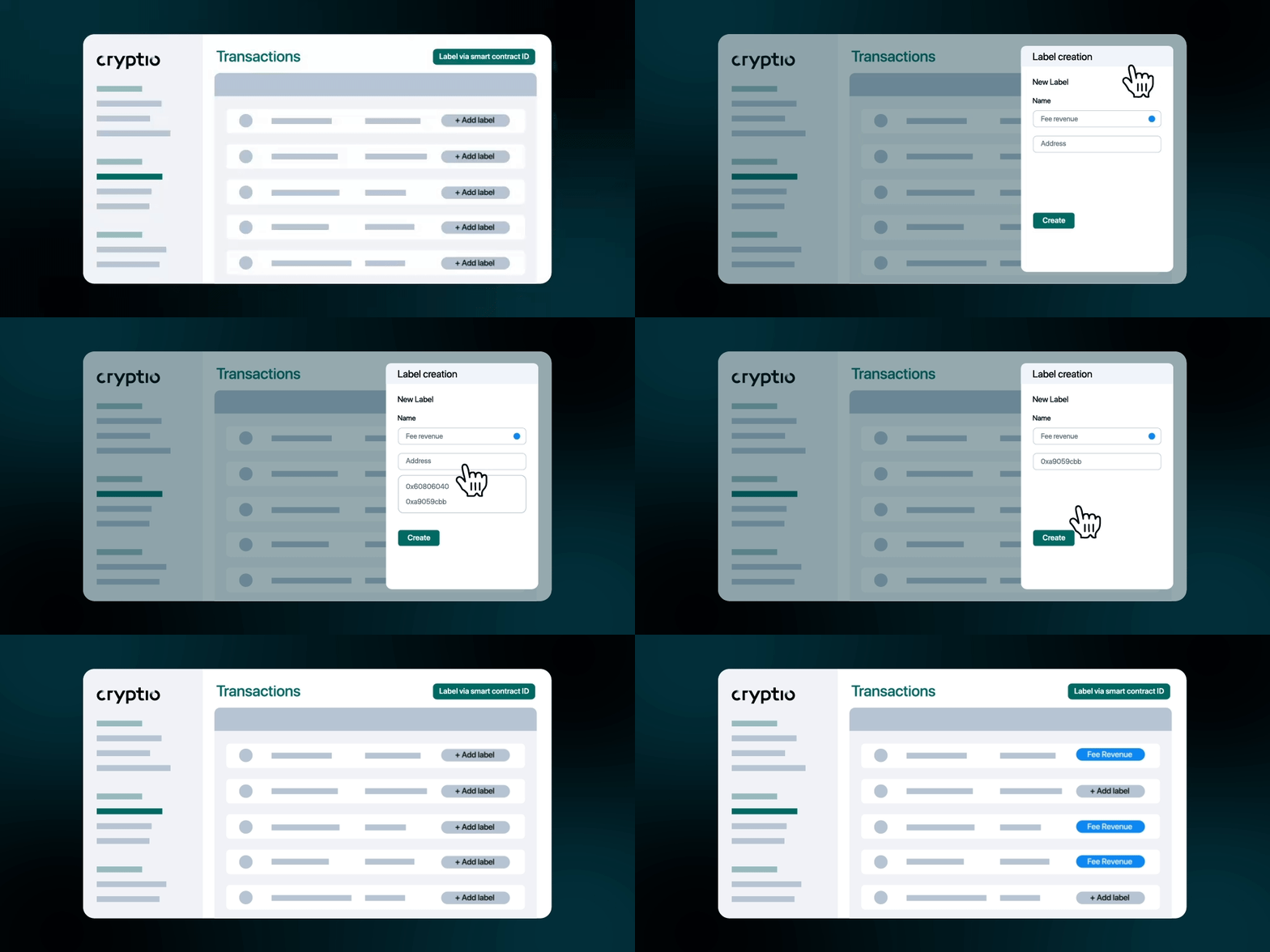
Cryptio worked with Uniswap Labs as a test partner for its Batching Engine. Similar transactions could be grouped over a chosen interval, usually a day. The accountant could examine a consolidated record and still inspect the individual activity underneath. Think of a restaurant adding up the day’s receipts while keeping every bill in the drawer.
The reported reduction was about 90%. That figure measures the transactions requiring accounting analysis, not a reduction in business activity or a promise that every customer will save 90% of its time. It is nevertheless a revealing result: the solution made the workload smaller without making the evidence disappear.
“It retains the original level of data”Justin Wong, Uniswap Labs · Cryptio’s Bedrock keynote recap
A transaction needs a meaning
A blockchain can tell you that something moved. A finance team must establish whose asset moved, why it moved, what it was worth and where it belongs in the accounts. A transfer may represent revenue, collateral or movement between a company’s own wallets. The visible event is only the beginning of the explanation.
Cryptio occupies that awkward space between blockchain activity and the general ledger. It gathers data from wallets, exchanges, custodians and internal systems, normalizes it, checks balances and provides accounting workflows. Teams can classify activity, calculate cost basis and prepare records for reporting. Existing systems such as NetSuite, QuickBooks and Xero remain part of the arrangement.
The company’s beginning was more modest. In his 2018 launch post, Antoine Scalia described a cross-exchange accounting tool for crypto investors, launched with Alexandre Bourgeus after the HEC/42 Startup Launchpad. It consolidated transactions and helped with gains, losses and tax declarations. More than 200 accounts opened in the first week, he wrote. Even then, the problem was fragmentation.
Today’s buyer has more systems, more counterparties and more people asking for explanations. Cryptio’s expertise combines blockchain data engineering with the bookkeeping questions that follow the data home. Its product is useful precisely because a ledger entry needs business context that a transaction feed does not automatically provide.
Three versions of the same money
Tokenization makes the reconciliation problem particularly vivid. An issuer has tokens on a blockchain, issuance records in its own systems and assets backing those obligations. Three records describe related things. They must agree for reasons stronger than optimism. Cryptio’s tokenization product compares them and tracks minting, burning and wallet movements.
supply
records
assets
One question: do the records agree?
The same data foundation supports lending. Cryptio’s Loan Management System follows loans through their lifecycle, monitors collateral and produces accounting information for interest and other events. Its November 2025 keynote presented accounting, tokenization compliance and lending as applications on a common data layer. By March 2026, treasury management was also part of the expansion.
The website now advertises an Intelligence Suite with automated close workflows and regulatory tools. The appeal is obvious: less repetitive work. The product’s stated emphasis on auditable, verifiable data matters here. A faster financial statement is useful only if the people reviewing it can understand how its numbers were assembled.
Selling to the people who sign
In March 2026, Cryptio reported more than 400 enterprise customers in over 30 countries. Its named clients range from crypto-native businesses to institutions such as Laser Digital. The buying audience includes controllers, accountants and finance leaders managing activity that has outgrown a tidy export file.
It sells software subscriptions through customized quotes and modular solutions. Prospective customers are invited to map their flow of funds during a consultation; enterprise buyers can discuss a proof of concept. That makes purchasing an exercise in operational fit. Which sources connect? Which entities need records? Which reporting workflows must survive the month-end close?
KPMG’s July 2024 alliance with Cryptio pairs its technology with professional expertise in accounting and internal controls. Cryptio also says PwC audits its SOC controls. Neither relationship makes a customer’s books correct by magic. They illustrate the seriousness of the audience: people who need evidence, established processes and someone accountable for the result.

Investors have funded that direction. A $10 million Series A in 2022 was followed by a $15 million extension in January 2025. The $45 million Series B, announced in March 2026, was co-led by BlackFin Capital Partners and Sentinel Global. The company described the latest round as support for a broader financial operations platform.
Keep the evidence, shrink the task
Bitwave, Ledgible and other providers compete in enterprise crypto accounting. Cryptio’s distinctive pitch combines its own data infrastructure with reconciliation and operational applications. Its most instructive customer example offers a practical test for any alternative: can you simplify the accountant’s view and still trace the number back to its origin?
Batching is most useful for repetitive activity that can sensibly be grouped. Bespoke transactions still need individual judgment. Missing sources, poor classifications and unreconciled records require attention before automation can help. The transferable lesson is pleasingly ordinary: organize the work around what people need to decide, and keep enough detail to defend the decision.