The most expensive mistake in Bitcoin can be a very ordinary one. A phone disappears. A password is forgotten. The note with the recovery words goes through the wash. In conventional finance, a support desk can usually repair the damage. In a wallet controlled by one private key, the same mistake can become final. Conio began with that awkward mismatch between digital money and human memory.
- Conio's on-chain Bitcoin Wallet uses three keys; two signatures are needed to move funds.
- Its consumer app lets people buy, sell and hold crypto; its bank products put similar services inside partners' apps.
- Hype and Banca Generali brought the technology into banking. Enel's ebitts took it into renewable-energy tokens.
- Conio reports more than 450,000 retail customers and gained MiCAR crypto-service authorization in 2026.
A spare key with strict manners
Christian Miccoli and Vincenzo Di Nicola founded Conio in San Francisco in 2015. Miccoli had worked in online banking; Di Nicola brought a technology background. Their first public answer to the custody problem was a smartphone Bitcoin wallet for Italy. It arrived in 2017 with a patented 2-of-3 signature design, an idea that reads almost comically plain once explained: make three keys, but require only two.

The customer holds one key. Conio holds another. An independent third party stores the recovery key offline. In normal use, customer and company sign together. If the customer loses access, the company and the recovery holder can help restore it. Conio cannot move the customer's Bitcoin with its key alone. The system gives someone a route back without making one custodian the sole gatekeeper.
Any two can authorize a transaction. The third is a recovery path, not a promise that market losses or every form of fraud can be reversed.
There is an important boundary. Conio's app also has an Assets section, where cryptocurrencies are held in aggregated custody wallets and recorded for each customer. Bitcoin moved into the separate on-chain Bitcoin Wallet uses the three-key setup. It is worth knowing which screen holds your coins before assuming that every balance has the same plumbing.

The bank arrived before the bill
A good wallet solves a customer's problem. A bank integration solves a second one: how to offer crypto without forcing every bank to become a wallet laboratory. Hype launched a Conio-powered service in 2020 that let customers buy, sell, send and receive digital assets inside its own app. Conio also supplied monitoring and reporting tools for suspicious activity. That combination of product and compliance is much closer to banking infrastructure than to a stand-alone crypto download.
The same year, Banca Generali led a $14 million financing and signed a commercial agreement. Its client offering went live in 2021. Conio's own materials describe different custody arrangements for Hype and Banca Generali, reflecting the banks' different customer needs. The lesson for a company selling into institutions is practical: the useful unit is the integration, including reporting and controls, not merely the wallet code.
Conio now sells integrated custody, trading and tokenization technology to banks and businesses. It offers a consumer app as well. The app is free to download and holding crypto carries no stated custody charge; buying, selling and converting each have a published 0.99% fee. Cash top-ups and withdrawals may carry fees, and a trade price can include a spread. Conio says it trades directly with the customer rather than operating an exchange order book. That distinction matters when comparing a quoted app price with a market chart.
The high-value Conio Prime channel adds direct contact through WhatsApp. For a retail customer this may sound like a return to an old-fashioned broker; for Conio it is another way to make an unfamiliar asset feel less solitary. The public fee sheet is the more useful document than the marketing line. A buyer should check the final quoted price, the funding route and the spread before confirming.
The useful crypto feature is often the one you notice only when something has gone wrong.What Conio's custody design makes visible
From coins to kilowatts
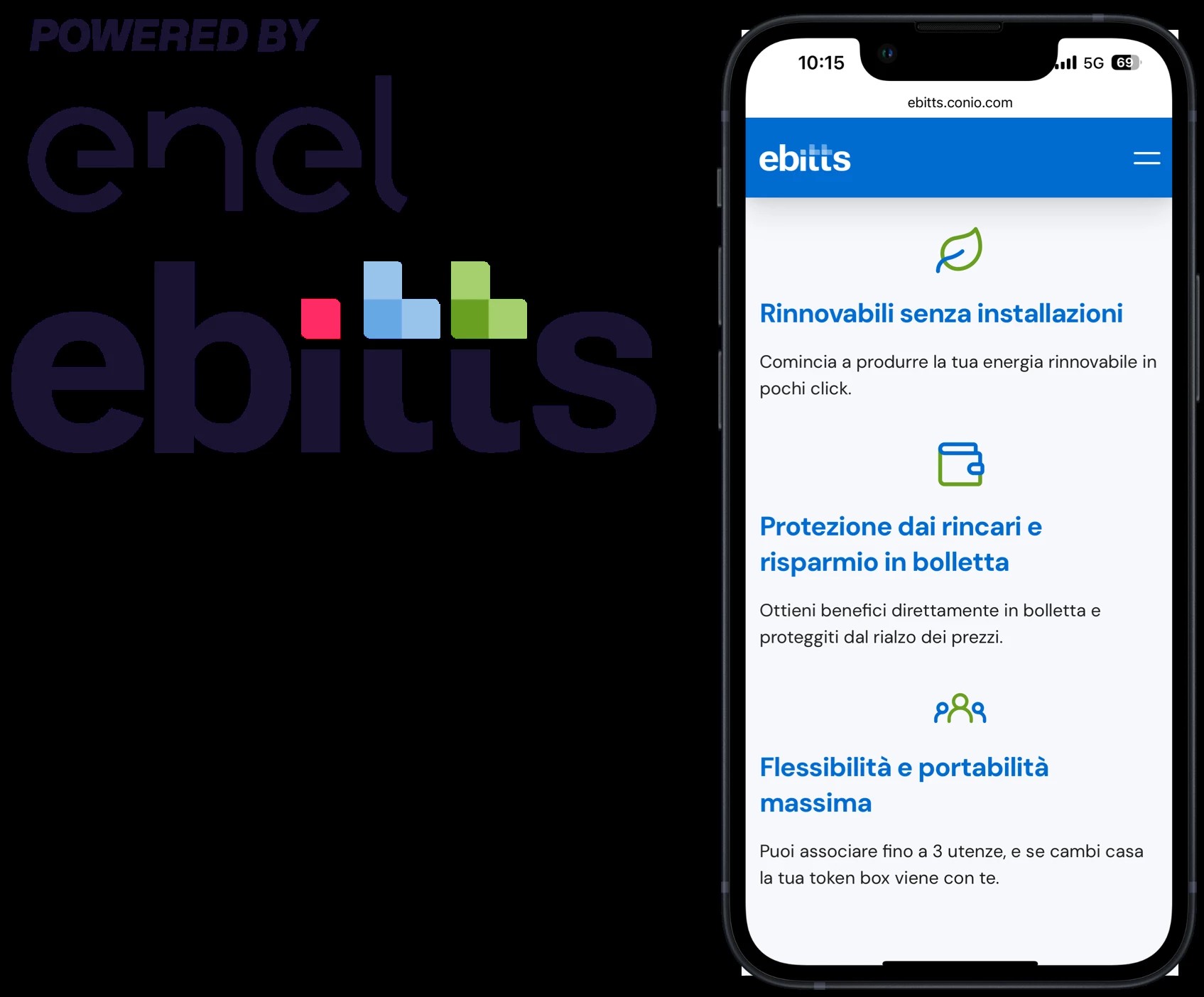
The more surprising extension of Conio's business is a power bill. With Enel, it developed ebitts, a token-box product connected to portions of renewable-energy plants. Customers who cannot put panels on a roof can buy a digital entitlement whose energy benefit is applied to an eligible electricity bill. Conio handles token creation, distribution and custody. It is a narrow, concrete use for tokenization: a right that must be tracked and delivered, rather than a token issued for its own sake.
In 2025 Conio also announced work with Ferrari. The planned project would place a Conio wallet in MyFerrari and give Hyperclub members a digital token linked to exclusive opportunities, including an auction for a Ferrari 499P. Conio says the project is scheduled to go live with the 2027 endurance-racing season. The car is the attention magnet; the less theatrical problem is familiar to any asset platform: who can hold a right, transfer it, verify it and recover access to it?

The point of the third key
Conio's market position sits between two familiar answers to crypto custody. A self-managed wallet gives the owner responsibility for every key. A fully custodial service handles the keys for them. Conio's original Bitcoin Wallet splits the responsibility, then builds service and recovery around that split. It is a specific design choice, not a magic shield. It helps with lost access; it does not remove price risk, mistaken payments or the need to understand the asset you are buying.
Nor does the model travel everywhere unchanged. The app's pooled Assets custody already shows that different products need different arrangements. A bank may want a closed-loop service; another partner may need customers to send coins out. A renewable-energy token only succeeds if the underlying energy benefit can be measured and applied. Ferrari's token has to confer a genuine, clearly defined right. The wallet can secure the record, but it cannot make the underlying promise valuable.
What can another company borrow? Start with the failure that a real customer fears, and design the recovery path before the celebratory launch. Then spell out who holds each key, who can act alone and what happens if a partner disappears. Conio's path from a Bitcoin app to institutional technology suggests a second rule: solve the mundane work around the asset - custody, reporting, pricing and support - and the more glamorous use cases may follow.