The most important crypto company you've never clicked on
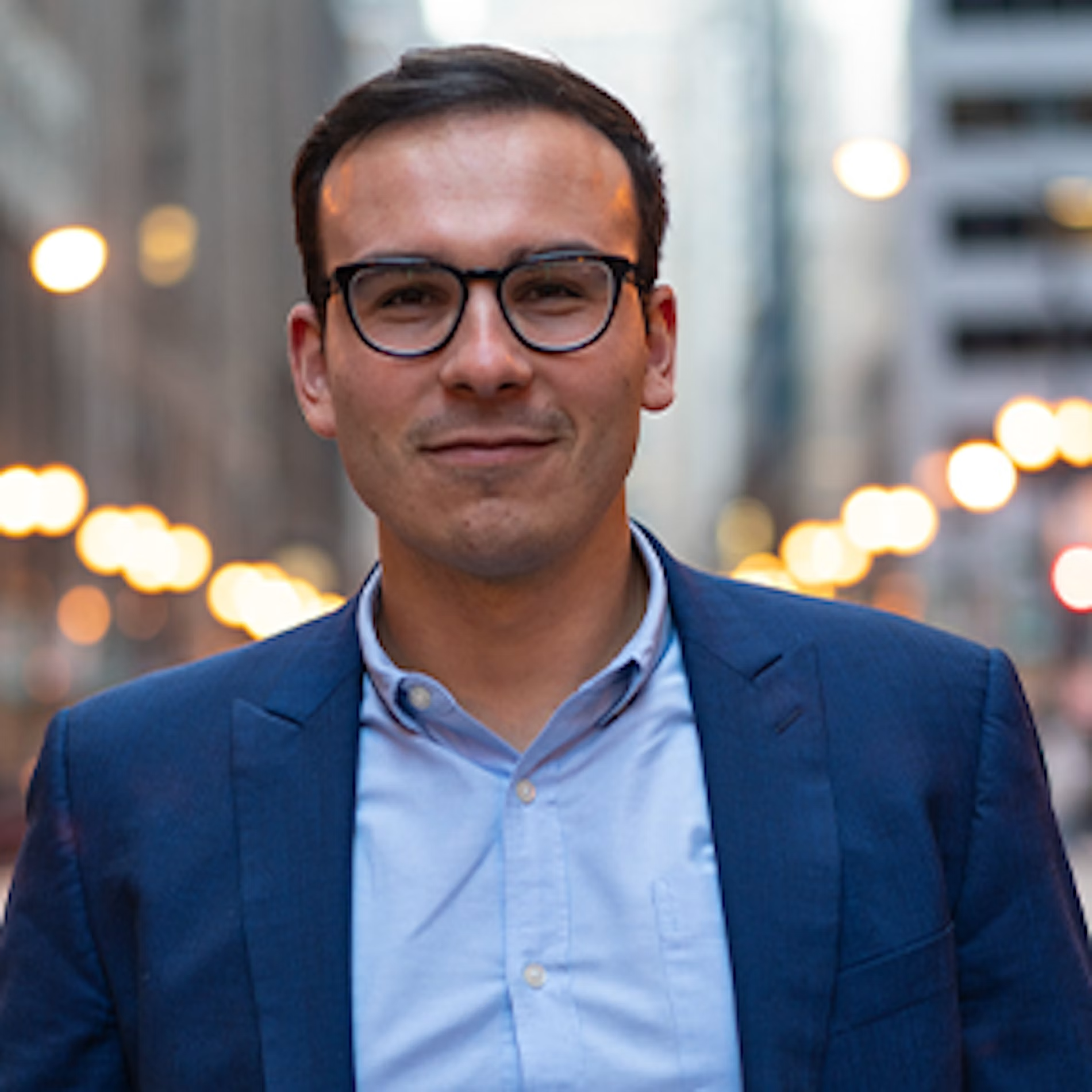
Open the Stripe dashboard and buy a stablecoin. Use Interactive Brokers to dip a toe into Bitcoin. Watch BlackRock tokenize a money market fund. In each case, somewhere underneath the polished button you tapped, there is a layer of regulated machinery doing the unglamorous work of custody, settlement and compliance. That layer is Zero Hash. The person who built it is Edward Woodford.
Woodford is the co-founder and CEO of Zero Hash, a Chicago company that sells "crypto-as-a-service." The pitch is deliberately boring: instead of every bank, brokerage and fintech building their own crypto stack from scratch - and wrestling with money transmission licenses in fifty states - they plug into Woodford's. He handles the regulation, the wallets, the on-and-off ramps, the stablecoin rails. His clients keep their brand on the front. Customers never see Zero Hash at all. That invisibility is the entire point.
In September 2025, that invisible business put a very visible number on the board. Zero Hash raised $104 million and crossed a $1 billion valuation, a jump from roughly $340 million three years earlier. The round was led by Interactive Brokers, with Morgan Stanley, Apollo Global Management, SoFi and Jump Trading's crypto arm joining in. These are not crypto-native gamblers. They are the establishment. And they were writing checks to a company most retail investors could not pick out of a lineup.
It's not just that we're a survivor. We've actually thrived in that market.
From an ATM in Cambridge to a billion-dollar idea
The origin is almost too tidy. As a graduate student at MIT, finishing a Master's in Finance in 2015, Woodford walked up to a crypto ATM and bought his first Bitcoin. Before that he had studied Politics, Philosophy and Economics at the University of Warwick - not computer science, not engineering. He came to crypto through markets and ideas, not code. That framing stuck. He has always treated digital assets as a financial-plumbing problem dressed up as a technology one.
His training ground was Goldman Sachs, where he worked in commodity derivatives and macro research. It was a front-row seat to how real money moves: the risk, the clearing, the regulators who decide what is and is not allowed. When he left to build his own thing, he did not build a flashy exchange chasing retail traders. He built Seed CX, a regulated venue for derivatives and alternative commodities. It became one of the first crypto-era platforms to hold both a CFTC-regulated swap execution facility license and a FinCEN-registered money services business designation. In 2017 he sold a commodities swaps platform to Tastytrade. The license-first instinct never left.
Seed CX eventually became Zero Hash. The handle on his old Twitter account still reads "seedcx," a small fossil from the first chapter. The lesson he carried forward was simple and unfashionable for crypto in the mid-2010s: regulation is not the enemy of the business, it is the business. While competitors raced to launch tokens and dodge oversight, Woodford collected licenses and built the dull, defensible infrastructure that institutions would eventually need.
Surviving the winter that killed everyone else
Then came 2022. Luna collapsed. Celsius froze. FTX imploded in a fraud that vaporized billions and dragged the entire sector into a two-year deep freeze. Funding dried up. Headlines turned poisonous. Plenty of crypto companies simply stopped existing.
Zero Hash grew revenue every single year through the downturn. There were no consumer deposits to run on, no proprietary token to crater, no leverage to unwind. Woodford was selling picks and shovels to companies that still needed them, and demand from serious institutions kept climbing even as the price charts bled red. By the time sentiment turned in 2025, he was not scrambling to rebuild trust. He was already there, regulated and operating, waiting for the tide.
Crypto now is not a debated issue at this point at large institutional banks.
Three businesses hiding inside one
Zero Hash is really three companies wearing a single name. The first is a white-labeled crypto brokerage that powers buy-and-sell features for partners like Interactive Brokers. The second is a set of tokenization APIs - the kind BlackRock taps to put money market funds on-chain. The third, and increasingly the loudest, is stablecoin networks, with Stripe among the clients moving dollars across them.
That third leg is where the story is heading. Woodford has said stablecoins now make up roughly half of Zero Hash's volume. The narrative has quietly shifted from "speculative crypto" to "programmable dollars" - boring, useful, and exactly the kind of regulated rail an infrastructure company is built to carry. To lean further in, Zero Hash has moved to apply for a U.S. national trust bank charter, which would push it deeper into the regulated core of the financial system rather than the wild edges of it.
Crypto is not a debated issue at large institutional banks anymore.
We didn't just survive the winter. We thrived in it.
Imagine what it looks like with tailwinds.
A leader skeptical of his own power
Ask Woodford about leadership and he turns the conventional script inside out. He talks about influence over authority, and argues the best leaders stay skeptical of their own power. He distributes ownership through the company so that employees share meaningfully in the outcome. His most striking management ritual is asking his team to "write the obituary for your own company" - to imagine, in detail, exactly how Zero Hash could die. It is a strange exercise for a founder who just minted a unicorn. It is also why he is still standing while flashier rivals are not. The person who has already rehearsed the failure is hardest to surprise with it.
The recognition has followed quietly, the way he seems to prefer. Goldman Sachs named him one of its Most Exceptional Entrepreneurs of 2023. In 2025 he was named a Titan 100, one of Chicago's top CEOs and C-level executives. He writes for the World Economic Forum's agenda. He shows up on fintech stages and podcasts - and then goes back to building the rails almost nobody notices they are riding.
There is a particular kind of ambition in choosing to be infrastructure. You give up the logo on the app, the name recognition, the consumer love. In exchange you become the thing everyone else depends on. Woodford made that trade on purpose, more than a decade ago, with a single Bitcoin from an ATM. The billion-dollar valuation is just the receipt.