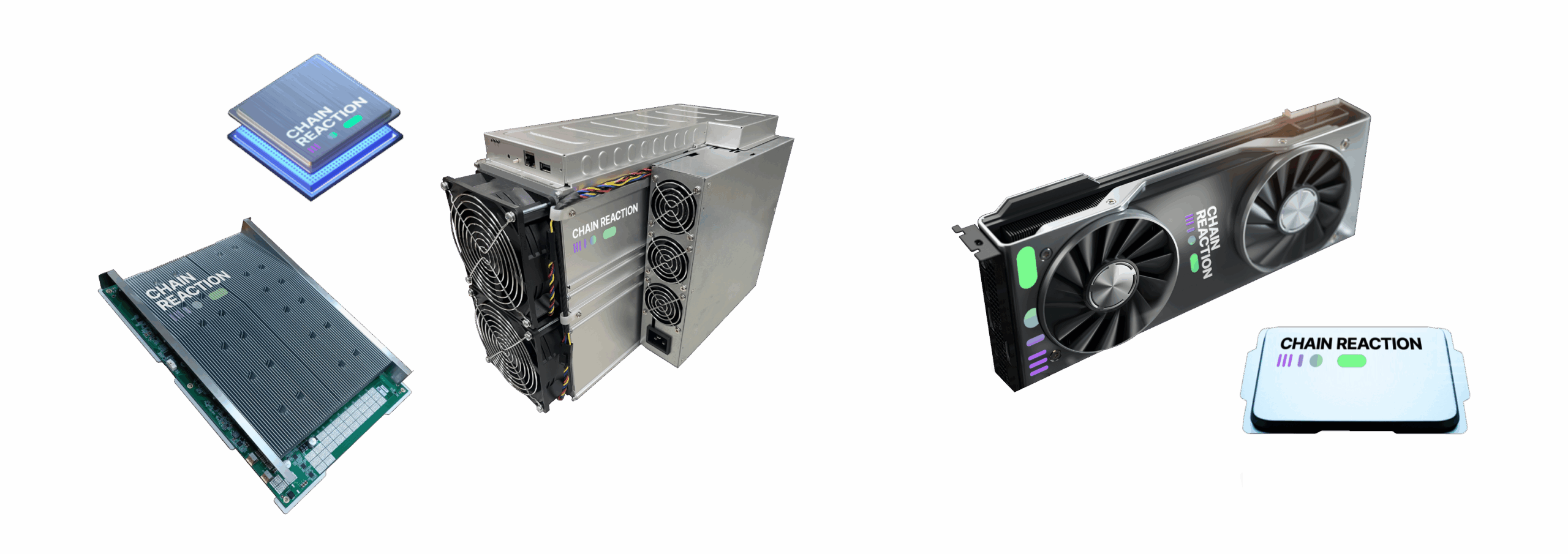
It is May 2026, and somewhere in a windowless data hall in Texas, a stack of mining rigs is humming through Bitcoin's relentless math. The chips inside were taped out in Yokneam, packaged in Hsinchu, and tuned in San Jose. They belong to Chain Reaction, a company that most people outside of two industries have never heard of, and that both industries are starting to take very seriously.
The first industry is Bitcoin mining, which lives and dies by joules per terahash. The second is privacy-preserving computation - the small, stubborn corner of cryptography that promised, twenty years ago, that you could run a calculation on encrypted data without ever opening it. The promise was beautiful. The performance was terrible. Chain Reaction's whole reason for existing is to fix the second part.
I. Who they are nowA semiconductor company in a hoodie
Chain Reaction does not look like a typical chip company. It has four offices - San Jose, Tel Aviv, Yokneam Illit and Hsinchu - and a headcount of roughly 110, which in semiconductor terms is small enough to fit in a single Intel cafeteria. It has raised $160 million from investors including BlackRock, Morgan Creek Digital, Exor, Hanaco and Atreides. And it has two product lines whose names sound suspiciously like a band and a math textbook: EL3CTRUM and 3PU.
EL3CTRUM is the mining business. The flagship - EL3CTRUM E31 - is a 3 nm Bitcoin mining platform that ships in three flavors of cooling: air, hydro, and immersion. (A small irony: the company decided to mis-spell “Electrum” with a 3 because a Bitcoin wallet had already taken the obvious version. Branding is hard when your industry is fifteen years old.)
3PU is the more ambitious bet. It is a custom processor designed to accelerate Fully Homomorphic Encryption - the cryptographic trick where you can add and multiply numbers that are still scrambled. The math has existed since 2009. What did not exist was hardware fast enough to make it practical.
Privacy used to be a policy. Chain Reaction is trying to make it silicon. - The thesis, in one line
II. The problem they sawThe cloud has a confession problem
If you run a bank, a hospital, or a defense agency, you have a familiar dilemma. The cloud is cheaper, faster, and more scalable than anything you can build in-house. It is also a place where your most sensitive data has to be decrypted before it can be used. AWS does not read your customer files. But, technically, it could.
For most workloads, this trade-off is acceptable. For the workloads that actually move markets - patient genomes, transaction records, classified models - it is not. The result is a tier of computing that has stayed in private data centers, paying a tax for the privilege of not being in the cloud at all.
Software FHE on a general-purpose CPU is somewhere between thousand-fold and million-fold slower than computing on plaintext. That is not a productivity problem. It is a deal-breaker. Chain Reaction's bet is that the only way out is down - down into silicon designed from the polynomial up to handle encrypted operations natively. That is what a 3PU is.
III. The founders' betA Mellanox veteran and a national-security technologist walk into a fab
Alon Webman is one of the co-founders of Mellanox, the networking-chip company that Nvidia bought in 2019 for close to $7 billion. After that exit, founders typically do one of two things: invest, or repeat themselves on a smaller scale. Webman chose neither. He picked a market that did not really exist yet - dedicated silicon for encrypted compute - and started over.
His co-founder, Oren Yokev, spent years inside the Israeli Prime Minister's office, eventually running the technology division there. It is an unusual training ground for a chip company. It is, however, an excellent one for a privacy-compute startup, because Yokev spent two decades watching what governments and enterprises actually need when the data is sensitive enough to keep the lights on at 2 a.m.
Webman built the chips that connected the cloud. Now he is building the chips that hide inside it. - Reading between the resumes
The plan was to fund the long, slow work on FHE silicon with a faster, more obviously monetizable line of business. That faster line was Bitcoin mining ASICs. EL3CTRUM was, in effect, the cash-flow ballast for 3PU's research bill. It is also, increasingly, a serious product in its own right.
IV. The productTwo chips, one workshop
The EL3CTRUM E31 is the company's most public artifact. It is a 3 nm Bitcoin mining platform, designed to compete head-on with Bitmain's S-series and MicroBT's WhatsMiner family. The published target is sub-10 joules per terahash, which would put it at the front of the efficiency curve when volume shipments begin. Samples are scheduled for May 2026; volume for Q3.
The 3PU is harder to summarize because it lives one step deeper in the stack. It is engineered around the operations that matter for homomorphic encryption: number-theoretic transforms, polynomial multiplications, key switching, and the bookkeeping that keeps ciphertexts manageable. Run those operations on a CPU and you get tomorrow's answer. Run them on a 3PU and Chain Reaction's pitch is: you get today's.
A short, opinionated timeline
V. The proofCap tables, customers and a number to beat
Believing a deep-tech story is mostly about believing the people behind it. The cap table helps. BlackRock is not the most obvious name on a hardware Series C, and Morgan Creek is. Together they signal something useful: this is a bet that crosses categories. Bitcoin-flavored on one side, enterprise-flavored on the other. Chain Reaction is the rare semiconductor company whose investor letter has to explain both.
Funding, stacked
On the customer side, the loudest data point is the partnership with BIT Mining, a publicly listed miner that has agreed to co-develop next-generation systems on Chain Reaction's silicon. That is the kind of deal that turns a chip from a roadmap into a purchase order. On the 3PU side, the public list is shorter, because most of the conversations are still happening under NDA with cloud providers and large regulated enterprises. The product category is younger than the customers' procurement cycles.
The cap table reads like an argument: Bitcoin will keep mattering, and privacy will keep getting worse. - A reasonable reading
VI. The missionHardware as policy
It is easy to make privacy a policy problem - write a stricter regulation, sign a tougher contract, train the staff. It is harder to make it a physics problem. Chain Reaction's mission, distilled, is that policy alone has lost. The data has gotten too big, the models too greedy, the attackers too patient. The only durable answer is hardware that makes the wrong action impossible, not just illegal.
That is the throughline that connects EL3CTRUM and 3PU. One secures a public ledger with proof-of-work; the other secures a private workload with cryptography. Both bet that the right place to enforce trust is in silicon.
VII. Why it matters tomorrowThe cloud, after consent
If 3PU works at the performance Chain Reaction is targeting, the boring change is that some regulated workloads that used to live in private data centers will move to the cloud. The less boring change is that entirely new workloads become possible - cross-institution machine learning on patient records, multi-bank fraud detection that does not pool customer data, defense analytics that survive the contractor down the hall. None of these are science fiction. They are just slow.
On the mining side, the implication is narrower and clearer. If the efficiency targets land, EL3CTRUM gets a meaningful share of a brutally competitive market, and a second public source of revenue and credibility for the company's longer bet.
Back, then, to the data hall in Texas. The rigs are still humming, the chips are still solving SHA-256 puzzles, and somewhere in a different rack - one with rather less industrial cooling - a 3PU prototype is running an encrypted inference job that, two years ago, would have taken a week. It returns an answer in seconds. Nobody in the room can read what it computed on. That, in one sentence, is what Chain Reaction is for.