Ariel Kelman’s route into marketing began with an error of youthful confidence. In 1998, he and a friend left their jobs as sales engineers at MicroStrategy to build software. Their idea came directly from the chores on their desks: help salespeople prepare for deals, customize proposals, and assemble presentations. Automate the grind, they thought, and a business might appear.
The company became Ventaso. Kelman began around product management, then moved into marketing after the startup hired what he later called a “real CTO” who could build the product. Marketing had found him by practical necessity. The business endured five rounds of layoffs before shutting down. Kelman does not varnish that chapter. He calls it an educational experience.
There was a sharper lesson inside the wreckage. Ventaso had built software to automate a business process that did not properly exist. The product worked when its own people operated it for customers. It faltered when product marketers were asked to redesign how they worked and carry the system themselves. A machine can accelerate a habit. It cannot always invent one.
The accidental translator
Kelman arrived at the startup with an unusually useful split screen. At the University of California, Berkeley, he studied economics and computer science. He had once believed the obvious post-college destination was a two-year investment-banking analyst program. Instead, he became a translator between the people who make technology and the people expected to buy it.
Salesforce gave that role scale. From 2005 to 2011, he worked across product marketing, eventually becoming vice president of platform product marketing. In those years, selling software as a service to an IT department was still a conversation that needed explaining. Today the cloud feels like weather. Then it felt like an argument.
In 2011, Kelman left Salesforce for Amazon Web Services. He remembers joining a marketing team of perhaps 20 or 30 people. The assignment contained exactly the kind of perception gap he likes. Startups rented infrastructure from Amazon, but many enterprise buyers greeted the proposition with a version of: Amazon, for serious corporate IT?
Kelman stayed for about eight and a half years as AWS grew. His work was not to make servers thrilling. It was to make a consequential change in computing understandable, credible, and easy to evaluate. The distinction matters. In his telling, good technology marketing starts with the customer’s complicated architecture and asks a plain question: where do we fit, today?
The dashboard has limits
Kelman is an executive of the digital-marketing era who remains politely suspicious of digital certainty. He does not dismiss attribution models or the reports glowing inside them. He asks whether the apparent precision exceeds the quality of the underlying data.
Consider a website that recognizes only part of its audience, then loses another portion to privacy filters and ad blockers. A gorgeous report can still produce conclusions finer than its evidence allows. Kelman’s remedy is almost comic in its availability. Interview 20 customers. Ask whether the conference changed a decision. Ask whether the white paper clarified the difference between products. Listen for an answer that arrives in words rather than cells.
This is his recurring combination: use the machinery, then walk around it. Count the attendees and correlate the opportunities, but also place customers in a room where they can talk to other customers without a salesperson narrating every breath. A good product benefits from that exposure. A weak product, he has noted, can look worse.
After AWS came Oracle in 2020. Again, the appeal was a mismatch between engineering and perception. Kelman said he found cloud technology that was ahead of what the market understood, inside a company whose marketing had been decentralized. He joined to build a more cohesive organization and translate product capability into a cloud story.
Even Oracle’s sports deals followed that logic. Kelman drew a line between sponsorship and partnership. A logo beside a racetrack was not enough; a technology project, such as analytics embedded in a broadcast, could demonstrate the product while the sport supplied the audience. It was enterprise marketing wearing team colors, but the proof still had to work.
The boomerang and the machine
Kelman left Oracle in 2022, briefly joined digital-asset infrastructure company Fireblocks, and then received a call from Salesforce co-founder Marc Benioff. He had been itching to return from startup life to a large company. Salesforce needed a CMO. Sometimes, Kelman said, the stars align.
The return in 2023 made him a corporate boomerang, but not a nostalgic one. Salesforce was far larger than the company he had left twelve years earlier, with a broader portfolio and a new AI argument to make. The persistent part was its founder-led culture and emphasis on customer success. The new problem was explaining generative AI while nearly every technology company reached for the same vocabulary.
Kelman’s answer was specificity. AI marketing should begin with a use case. At Salesforce, that meant showing marketers how agents could help create campaigns, find analytical patterns, qualify leads, or turn static websites into two-way conversations. His team used its own tools. Beautiful storyboards, he observed, could be generated from copy in a small fraction of the old production time.
He also widened the definition of marketing itself. Brand once traveled mainly through television, print, and outdoor advertising. Digital systems turned every useful interaction into part of the customer experience. A pricing-page visit can alert a salesperson. A service conversation can reveal that a customer needs a different product. An event can become a place where product teams hear friction without the polite filtering of a survey.
That makes the CMO’s job less like guarding a communications department and more like designing a connected experience across an organization. It also raises the standard. When a website invites a real conversation, its automated agent cannot answer a simple product question with a shrug or a policy warning. The promise of listening creates an obligation to be helpful.
Yet his view of automation still carries the scar from Ventaso. Framing the choice as people or AI misses the useful question. The machine can summarize documents, test copy, generate design options, and make a person more productive. Judgment remains with the person in the loop. The software may be new; the need to design a workable human process is not.
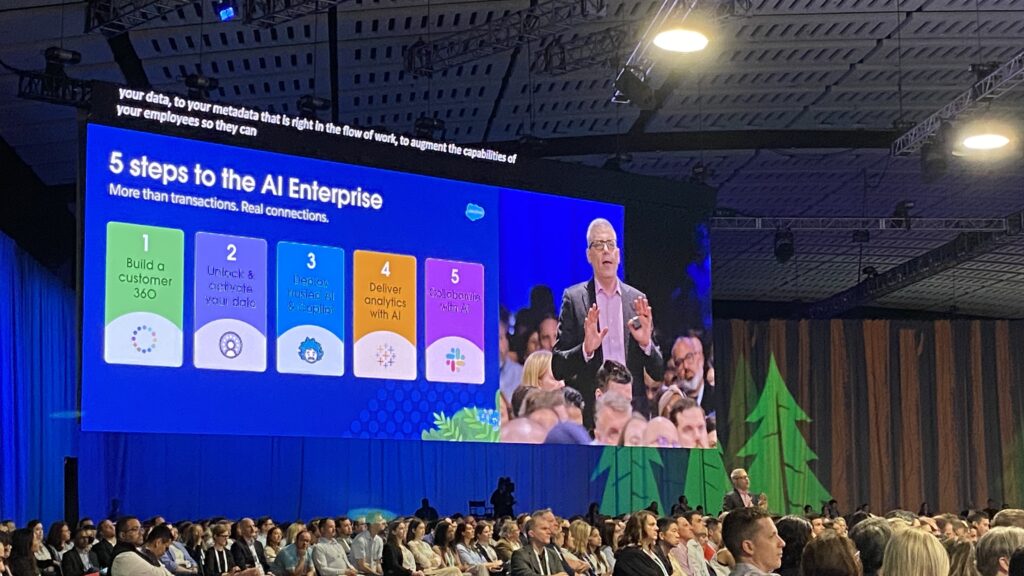
Kelman’s practical sequence starts before the prompt. Organize the customer data. Try the AI features already present in the software the team uses. Choose a task whose result can be inspected. Keep a human responsible for taste, accuracy, and the awkward last few percent where trust lives. This is slower to describe than “AI changes everything,” but considerably easier to put to work on Monday morning.
Explain the difference
If a buyer cannot repeat why a product matters, technical sophistication has become camouflage.
Show, then listen
Hands-on evaluation and candid customer conversations expose value faster than a polished monologue.
Measure in two languages
Pair quantitative reporting with qualitative accounts of what changed a real decision.
Give AI a job
Begin with a concrete use case, sound data, and a person responsible for judgment.
Now the story reaches the chip
In February 2026, AMD appointed Kelman senior vice president and chief marketing officer. His brief spans brand, communications, events, developer relations, and go-to-market strategy. He reports to chief administrative officer Ruth Cotter and works with an executive team competing across data centers, embedded systems, personal computers, gaming, and AI.
The move puts Kelman closer to the physical substrate of the stories he has long told. CPUs and GPUs are tangible. Their value is not automatically obvious. Performance per watt, software compatibility, developer tooling, total cost, and workload behavior quickly become a thicket. AMD does not lack engineering material. It needs the material arranged around decisions customers recognize.
The audience is unusually broad. A cloud operator evaluating an accelerator, a developer checking software support, a PC buyer comparing processors, and a gamer studying frame rates may all encounter the same three letters, AMD, while asking entirely different questions. Kelman’s remit includes developer relations as well as brand and communications, an acknowledgment that credibility is earned in documentation, events, code, and direct technical experience as much as in an advertisement.
His stated ambition is to elevate the AMD brand, deepen engagement with customers and partners, and pursue the AI data-center opportunity enabled by its products. The language is corporate because the job is corporate. Underneath it sits the same attraction that pulled him toward AWS and Oracle: important technology whose public perception has room to catch up.
There is a pleasing loop to the appointment. The young founder tried to automate product marketing before the process was ready. The veteran marketer now joins a company building processors for the AI systems automating everyone else’s work. Between those moments lies a quarter-century reminder that adoption is not a benchmark chart. It is a person deciding that a complicated thing finally makes sense.