A shopping basket looks harmless until half the country wants to fill one at the same time. In 2020, Alibaba’s Double 11 festival reached a reported peak of 583,000 transactions per second. For the shopper, the desired experience was almost aggressively ordinary: tap, pay, carry on. Behind the screen, ordinary required a remarkable amount of coordination.
- Rent the computing, storage and databases behind an application.
- Look closely if your customers are in China or Southeast Asia.
- Use Qwen models through hosted APIs or explore open releases.
- Budget for usage, migration and recovery - not just server rent.
A checkout queue becomes an education
Alibaba Cloud began in September 2009, the same year as the first Double 11. Its founder, Wang Jian, had worked at Microsoft Research Asia and previously headed a university psychology department. That is an unusual apprenticeship for someone building computing infrastructure. It also makes the business’s central problem rather pleasing: how do you make a complicated system behave predictably when people do not?
Alibaba supplied a demanding customer inside its own house. Shopping creates abrupt traffic peaks, fast-changing inventories and transactions that must remain consistent. The resulting expertise became something other organizations could buy. The parent’s commerce platforms supplied both the need and a place to test the answer.
By March 2023, Alibaba reported more than four million global cloud customers. Its customer stories span airlines, retailers, media companies and financial businesses. The number has a date attached; it should not masquerade as today’s headcount. The breadth matters because the service now has to work beyond the habits of its original customer.
The cloud, in plain parts
The catalogue is easier to understand if you follow a request. Elastic Compute Service runs the application. Object Storage Service keeps photographs, videos and other files. PolarDB handles relational data, with engines suited to familiar database environments. Networks connect the pieces; delivery and security services help content reach users while filtering unwanted traffic.
Illustrative arrangement. Each application needs its own design.
An airline’s problem can begin before a booking reaches the database. In Alibaba Cloud’s AirAsia case study, CDN and Web Application Firewall services helped identify 90 percent of traffic as bots. Identifying bots is a narrower claim than eliminating them. Still, the example explains the product: a business wants actual customers to reach its ticketing system without automated traffic swallowing the capacity.
AWS, Microsoft Azure and Google Cloud offer alternatives globally; Huawei Cloud and Tencent Cloud also compete in China. Alibaba’s distinctive argument combines regional infrastructure, commerce experience and its own AI models. Buyers serving Asian markets have reason to investigate. Buyers should then test the application, rather than award points for a crowded product menu.
A replay with no camera there
Consider the technicians watching a skateboarder on several monitors in Shanghai. In May 2024, Alibaba Cloud and Olympic Broadcasting Services tested multi-camera replay technology at the Olympic Qualifier Series. Cameras captured the action. Processing across edge and cloud environments reconstructed the scene in three dimensions, allowing virtual viewpoints beyond the original camera positions.
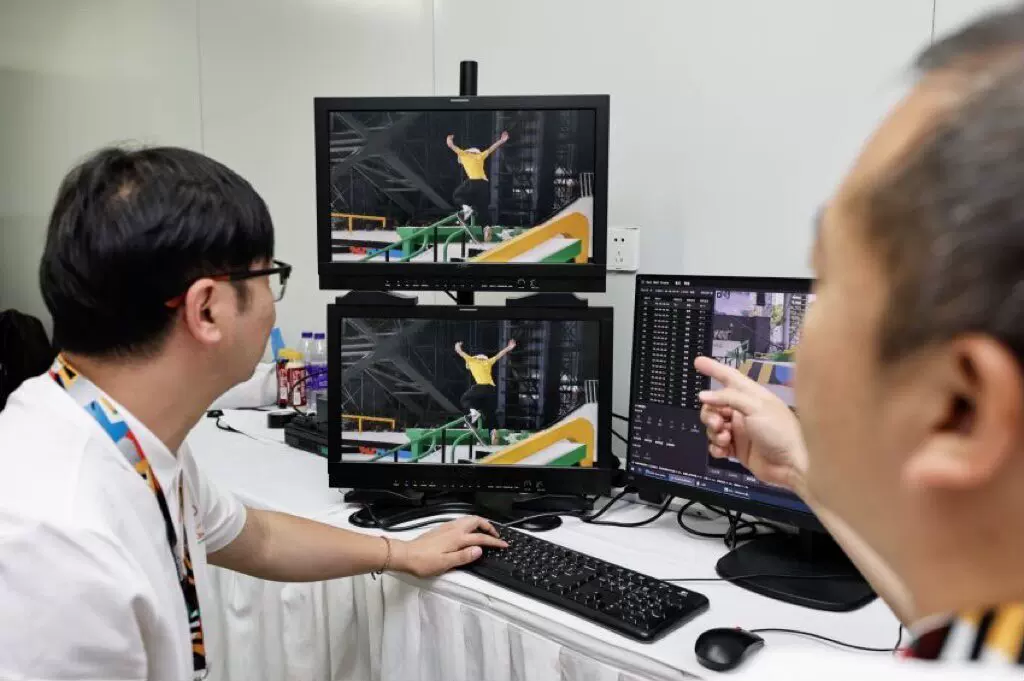
At Paris 2024, OBS Live Cloud became the main method of remote distribution to broadcasters, with 379 video feeds and 100 audio feeds. The work included distribution and content access as well as replay. It is a concrete answer to an abstract question: what can a cloud company actually do? It can move the pictures and help create another way to see them.
The relationship continued into Milano Cortina 2026 with cloud media tools and an Olympic AI Assistant. Such projects make good demonstrations because they bring together different jobs. Storage, networks and AI must cooperate. A clever model without dependable delivery would make a very disappointing television partner.
The bill behind the bet
Customers generally pay for resources and usage, with subscriptions and reserved capacity available for appropriate services. AI adds another meter. Model Studio’s hosted inference pricing distinguishes input tokens from output tokens; rates vary by model, region and context length. A prototype’s modest bill tells you little about a popular application with long conversations.
Alibaba’s own costs are on another scale. In July 2015, the parent announced an additional $1 billion investment in its cloud arm. In February 2025, it committed at least RMB380 billion, then approximately $53 billion, to cloud and AI infrastructure over three years. That is a spending commitment, not completed expenditure or a Series B funding round.
“We are committed to investing for growth and making bold decisions where necessary.”Eddie Wu / November 2023
The investment requires physical infrastructure beneath the software. Qwen’s open releases offer developers a route to experimentation; hosted services offer convenience. Neither abolishes computing costs. In September 2026, Alibaba Cloud reported 107 availability zones across 31 regions and announced further regional expansion. Those planned regions still have to become operating services.
November’s uncomfortable lesson
In 2023, the proposed future was a full cloud spin-off. By November, Alibaba had cancelled it, citing uncertainty from expanded US restrictions on advanced computing-chip exports. Access to hardware had changed the business calculation. Corporate structure was less important than the resources needed to keep building.
That month also supplied a less flattering infrastructure lesson. A November 12 outage lasted more than three hours and disrupted services including Taobao and DingTalk. On November 27, another incident affected database consoles and API access in eight regions. The reported symptom was management access; that does not establish that every underlying database stopped running. The distinction matters when planning recovery.
Borrow the test, not the budget
The useful lesson for builders is to rehearse their busiest minute. Measure traffic, separate application work from stored data, and test recovery while the team can still think clearly. These are recommendations drawn from the cases, not a claim that one provider guarantees them. Elastic capacity needs software that can use it.
Alibaba Cloud is less compelling when its available regions, service compatibility or data requirements do not match the job. Migration and operating skills belong in the cost calculation. Start with a contained workload, set a budget and test the failure paths. The shopper only wants the button to work. Your job is to find out what happens when everyone presses it.