An AI founder can have a working model and still have a remarkably unfinished business. Someone must pay for the compute. Someone must supply usable data. Someone at a prospective customer must agree to try the thing. In Hyderabad, MATH has assembled a programme around that awkward interval between an impressive demonstration and a product somebody needs.
- MATH is T-Hub’s AI and machine-learning Centre of Excellence, supported by India’s Department of Science and Technology.
- Nuage is a paid, year-long virtual incubation programme; founders can participate from outside Hyderabad.
- The offer combines technical resources with mentoring, investor access and potential corporate connections.
The fee is the beginning of the story
Start with the number that rarely survives an incubator’s publicity: ₹118,000. That is Nuage’s published fee including GST. A founder can put it into a budget, compare it with other support and ask what work it will make possible. The bill introduces a welcome seriousness into a conversation usually conducted in the language of limitless potential.
MATH’s wider institutional story began publicly with its March 2024 inauguration by T-Hub and DST. The launch described a mini data centre with GPU capabilities, an AI learning-management system and data infrastructure. Its ambitions included supporting more than 150 startups annually and creating over 500 AI-related jobs by 2025. Those were launch targets. A target is a statement of intention; it deserves a different column from a result.
The organisation describes itself as a nonprofit. Paid incubation sits comfortably within that model: there are services to deliver and resources to maintain. For a founder, the useful question is how the programme changes the cost and difficulty of building. A charitable purpose does not relieve anyone of arithmetic.
Three things a model cannot supply
Nuage was announced in July 2024 as a programme with support tailored to each startup. Launch coverage described onboarding to assess requirements, an implementation phase and periodic reviews. The premise is sensible: two founders working with similar technology may need entirely different help. One has an infrastructure problem. Another has never met the person who controls a customer’s purchasing decision.
The programme’s resource list runs from cloud infrastructure to mentorship, market access and funding readiness. Its earlier public announcements also described a mentor desk and a funding desk. The word “desk” is almost pleasingly bureaucratic. Behind the excitement of AI entrepreneurship sit requests that must reach a person who can act on them.
In December 2024, then-CEO Rahul Paith told Outlook Business that MATH was working closely with 90 AI enterprises. He described distributing more than $650,000 in GPU cloud credits. The distinction he made was explicit:
“We are not giving out cash, but the services we provide represent significant financial value.”Rahul Paith, then CEO · December 2024
That places MATH between several familiar routes to support. A general incubator can offer business advice. A cloud startup scheme can reduce an infrastructure bill. An investor can supply capital. MATH’s proposition combines specialist technical support with the introductions needed to commercialise the work. Its value depends on how well those services connect.
+ data
mentorship
+ introductions
A bus timetable beats a buzzword
Consider the data lake. MATH lists structured and unstructured data, with featured collections including Hyderabad’s General Transit Feed Specification, transport-department datasets and energy consumption data. Featured datasets include Telangana market-yard commodity prices and industrial approvals. These are satisfyingly particular ingredients for a company whose vision is “AI Everywhere.”
A transit feed suggests questions about routes and service. Commodity prices suggest questions about markets. Neither dataset arrives with a business model attached. But each gives a technically capable team something concrete to investigate. The lesson is transferable: begin with information about a problem people already experience, then decide what intelligence would be useful.
MATH also offers AI Career Finder, with separate paths for recruiters and job seekers. For startups, it promises access to specialist talent; for candidates, opportunities and industry connections. Alongside that sit masterclasses for founders, business leaders and SMEs. Their topics include marketing, customer experience and operations; a January 2026 listing addresses finance and cash flow. The audience extends beyond teams training models.
Forty teams, very ordinary problems
The company’s public culture comes into focus at MATHack 2.0. Held in September 2024 alongside Telangana’s Global AI Summit, the hackathon attracted more than 10,000 registrations, according to platform partner TalentFarm.ai. Forty teams reached the final round. Idealabs served as knowledge partner, and HYSEA publicly supported the event.
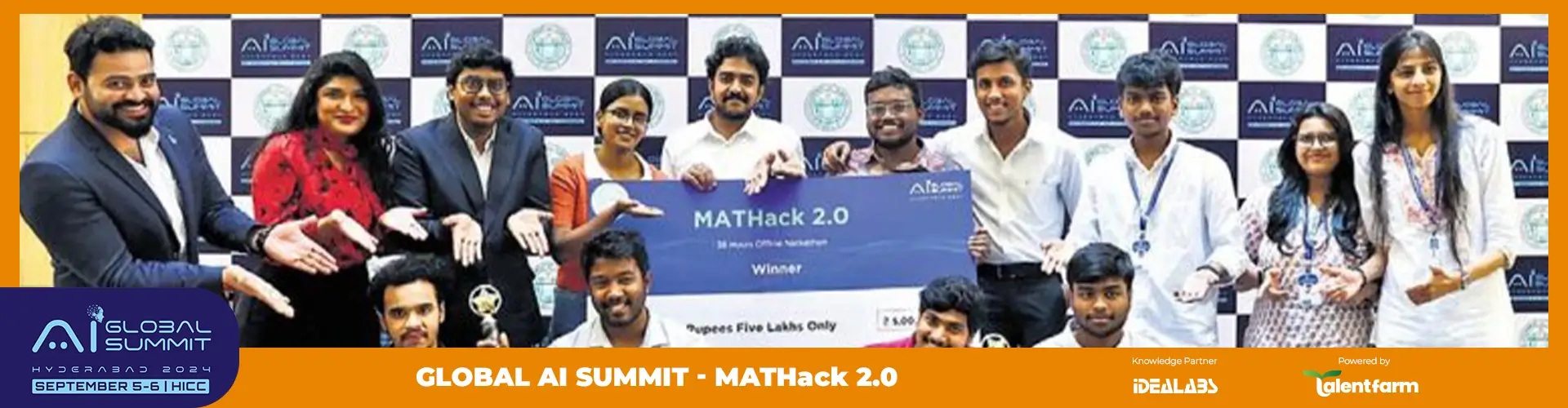
The winners included Flatmates AP, an app for finding rental housing, and Salubrity Health, which combined AI-assisted haircare with professional advice. The first received ₹5 lakh; the runner-up received ₹3 lakh. The subjects are amusingly everyday. Finding somewhere to live and worrying about one’s hair have survived every previous technological revolution. AI founders can reasonably expect them to survive this one.
Events such as Mathademia brought academia, startups and corporates into the same programme. Startup Showcase offered selected businesses visibility at the Global AI Summit, while Pitch Games put founders before an investor jury. These activities create occasions for contact. Whether a meeting turns into a pilot remains a separate piece of work.
Bring a bottleneck, not a wish list
Nuage’s selection criteria ask for technical expertise, scalable solutions and active participation from a CTO or another technical leader. The application proceeds through review and interviews. That suggests a practical way to approach MATH: bring a specific obstacle and a team capable of acting once it is removed.
Before paying, a founder should identify the experiment that needs compute, the customer conversation that needs an introduction and the decision that needs expert advice. Ask about resource eligibility, availability and delivery. Credits only help when they match the workload; introductions only help when a team can follow through.
The same reasoning defines the limits. A team seeking immediate cash, guaranteed customers or someone else to build its product should examine the offer carefully. MATH’s most useful idea is one readers can copy: assemble support around the next test your business must pass. The glamour can wait until the test works.