An aircraft has room for only so much cargo. The containers have different weights. Some arrangements fit; others overlap. Load too little and you waste capacity. Load the wrong combination and the plan becomes impossible. It is an unromantic problem, which makes it a useful place to examine a company founded on one of computing’s most romantic ideas.
- Strangeworks connects businesses to multiple computing methods and specialist expertise.
- Optimization became the practical thread running through its quantum ambitions.
- The useful test is whether a working system improves an actual decision.
The machine is not the problem
Strangeworks launched publicly in 2018, with William Hurley, known as whurley, as founder and chief executive. He had already built businesses acquired by Accenture and Goldman Sachs. This time, the wager was quantum computing: software that would help people reach unfamiliar machines without first becoming experts in every machine’s peculiarities.
The company’s early proposition addressed developers, researchers and technology managers. Someone had to make quantum resources usable, organize access and help teams work together. A cloud platform could serve as the doorway. But a doorway is only useful if there is something on the other side that a customer needs.
According to Strangeworks’ account of its development, pilot projects revealed a recurring pattern: optimization sat at the center of business value. Quantum annealing appeared more immediately applicable than gate-based computing. Quantum-inspired algorithms, running on classical computers, widened the options. The ambition survived; the choice of machinery became more pragmatic.
Let the old computer compete
The cargo experiment makes this approach tangible. In a technical account published on the AWS Quantum Technologies Blog, Strangeworks explored aircraft loading using Amazon Braket Hybrid Jobs and Rigetti’s Ankaa-3 quantum computer. The test cases ran from 26 to 78 variables, each requiring a corresponding qubit in the formulation.
The researchers compared several quantum approaches and included Gurobi, a classical optimization solver. Their modified methods found better solutions than the corresponding standard quantum versions across the tested sizes. Gurobi found the optimal solution. That comparison is the detail to remember when someone tries to sell a quantum result with the classical baseline conveniently absent.
The experiment also exposed a boundary: errors were expected to worsen as problem size increased. A promising result on a defined benchmark deserves examination. A buyer still needs to know whether it beats an existing method on the problem, budget and deadline that actually matter.
Conceptual process, not a performance chart. A newer machine does not receive a head start.
A doorway becomes a workshop
Today, Strangeworks occupies an overlapping market. A developer can go directly to a quantum cloud service. An operations researcher can use a solver directly. An enterprise can hire its own specialists. Strangeworks brings resource access and mathematical expertise together, then helps turn the result into a system that operators can use.
Its Compute catalog includes classical solvers, quantum-inspired technologies, high-performance computing and quantum hardware. Amazon Braket and Microsoft Azure appear alongside providers such as IBM, IonQ and Rigetti. These companies can be partners and alternative routes to the same resources. The distinction rests partly on how much integration and expertise a customer wants.
In 2025, Strangeworks acquired Quantagonia, which had already been a partner. The deal added solver orchestration and AI-assisted decision-making technology, as well as a German operating presence. Quantagonia’s orchestration engine coordinates multiple solvers, rather than asking one algorithm to be good at everything. Its natural-language tools help business specialists formulate planning problems.
Aura, announced in July 2026, carries that direction forward. Strangeworks describes it as the proprietary toolset its specialists use to identify opportunities, formulate models, select computing resources and deploy maintained decision systems. Its public demonstrations include gate scheduling, hospital rostering, logistics routing and energy trading. Those are problems with awkward constraints and consequences outside a browser window.
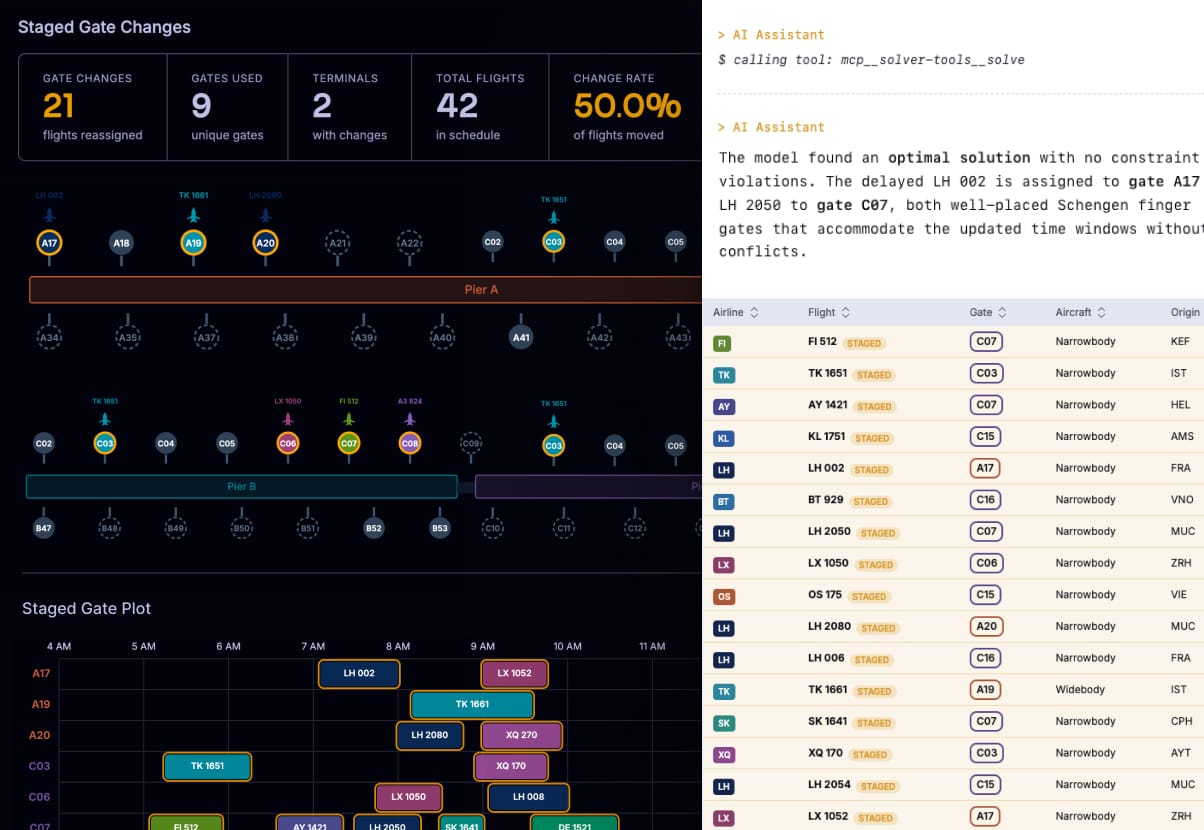
The interface matters because the person who understands a hospital roster may not write optimization software. Yet conversation alone cannot establish that a schedule is feasible. Strangeworks’ model keeps specialists involved in formulation, solver selection and validation. That combination gives the friendly interface something firmer to stand on.
“AI made it easier to generate answers”whurley, introducing Aura, July 2026
The price of finding out
There is a business model beneath the computing philosophy. Strangeworks sells platform access, consumption-based resources and professional services. Its 2024 Business Pro and Enterprise offerings bundled access, hardware credits and services. The current Compute page advertises zero markup on compute. Expertise and delivery therefore deserve attention alongside the machine bill.
One historical price provides scale. The Quantum Quickstart program announced with NC State in November 2023 averaged $35,000 annually, including training and hardware credits. That was the announced price of a particular program at launch. It gives an enterprise buyer a more useful reference than an unspecified promise that quantum exploration is affordable.
Average annual Quantum Quickstart cost at its November 2023 launch, including hardware credits.
For an uncertain project, Launchpad offers a fixed-scope, fixed-budget proof of concept, followed by a feasibility report and a go/no-go recommendation. Larger engagements embed experts with the customer’s team. The arrangement recognizes an ordinary source of disappointment: a successful prototype can still require substantial work before becoming a dependable operational system.
Investors have funded the company’s attempt to bridge that distance. Strangeworks announced a $4 million seed round in 2018 and a $24 million Series A in 2023. Lightspeed led the seed; Hitachi Ventures led the Series A, with IBM and Raytheon Technologies among the participants. Capital bought room to build, not proof that every workload needed quantum.
The ocean does not care about your demo
The recent collaborations make the stakes clearer. In August 2026, Nauticus Robotics and Strangeworks announced plans to explore deployment of undersea fiber-optic sensing networks. Choosing a route involves coverage, sensing density and equipment requirements. Davidson separately announced a planned proof of concept addressing defense mission planning. Both announcements describe work to explore, rather than completed performance gains.
The lesson a reader can borrow is fairly plain: choose one expensive decision, record its constraints, establish what today’s method achieves, then test alternatives. That approach needs trustworthy data and people able to integrate the result. Strangeworks’ most interesting bet is that customers will pay for that discipline. The future may arrive wearing a quantum label. The schedule still has to work on Monday.