The most revealing phrase in Manav Khurana's management vocabulary contains no strategy jargon and fits neatly on a sticky note: “By when?” He likes decisions with one approver and one person responsible. He likes meetings with a goal, an agenda, and as few chairs as possible. He asks teams to connect the work they do to the outcome the business needs. If a project is green, he checks in monthly. Yellow earns weekly attention. Red brings him in every day. There are less complicated ways to run a calendar, but perhaps none as honest about what a calendar is for.
This is the operating system GitLab hired in September 2025, when Khurana became chief product and marketing officer. His remit joins three functions that companies often allow to drift apart: the thing being built, the experience of using it, and the story told about it. Product, design, and marketing now meet at his desk, or more accurately at his screen - GitLab is an all-remote company. The appointment put a business-minded engineer in charge of making one sprawling promise coherent.
The keyboard got faster. The company did not.
Khurana arrived with a problem worthy of that broad job description. Generative AI can make an individual developer dramatically quicker, yet the business around that developer may not move at the same pace. Code still has to be understood, tested, secured, reviewed, deployed, governed, and maintained. When a machine produces more of it, every downstream station receives more work. A typing miracle can become an organizational traffic jam.
His argument is not against coding assistants. It is against mistaking a fast component for a fast system. In his telling, the next useful layer is orchestration: agents that understand the context surrounding code, work across the software lifecycle, and remain inside the enterprise's rules. The question shifts from “How much code did we generate?” to “Did the software arrive safely, reliably, and with less waste?” Volume is an input. Shipping is an outcome.
“I ask a lot of questions so I can learn, and often to connect the dots from inputs to outputs to outcomes.”Manav Khurana, in his public leadership README
That distinction has followed him for a quarter century. Technologies change costume quickly; customers remain stubbornly interested in whether anything works better. Khurana's career reads like a tour of the increasingly invisible machinery beneath modern work: wireless switches, network infrastructure, communications APIs, collaborative design, observability, and now AI-assisted software delivery. Each stop required someone to translate dense engineering into a reason to care.
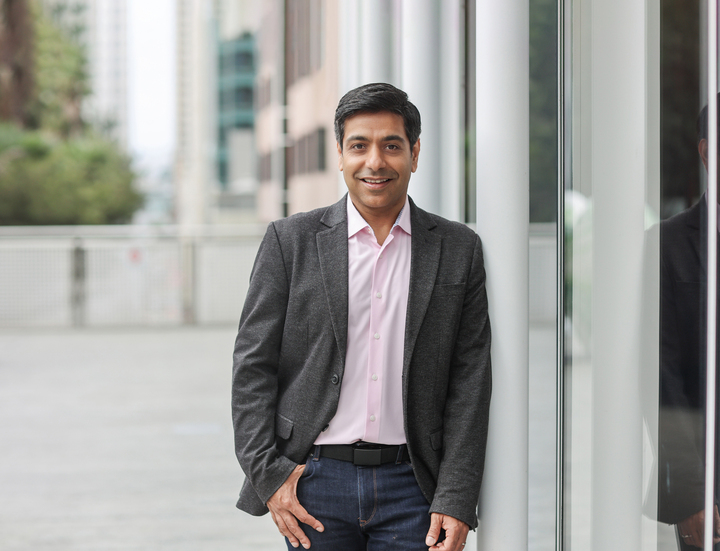
An engineer learns the commercial dialect
Khurana was born and raised in New Delhi. He moved to New York to study electrical and computer engineering at the University of Rochester, graduating in 2000, then headed west. While beginning his career in Silicon Valley, he completed an MBA at Santa Clara University. The pairing became his professional grammar: understand how the system works, then understand why somebody will choose it.
He began in product management for wireless switching at Symbol Technologies, which Motorola acquired, and then joined Meru Networks. At Aruba Networks, he rose through product marketing as workplaces wrestled with a once-novel nuisance: everyone wanted to connect everything wirelessly. The products were controllers, security, and network software. The customer story was freedom from the wired desk without surrendering reliability or control. His public comments from that period already show the habit of turning architecture into workplace consequences.
Twilio moved him from wireless infrastructure to cloud communications. As vice president of product marketing and product growth, he worked where developer adoption and commercial expansion overlap. He wrote product posts, previewed launches for the company's SIGNAL conference, and helped package APIs for builders. It was a useful education in a peculiar truth of developer tools: the buyer may approve the budget, but the person at the keyboard often determines whether a product spreads.
At InVision, where he became chief marketing officer in 2017, the subject changed again. The company sold design collaboration software, but Khurana described its marketing through “three Ps”: people, process, and platform. Designers and their work came before a product pitch. Meetings began with customer comments. Content gave practitioners a stage and a shared professional identity. Marketing, in this version, was less a megaphone pointed at the market than a room the market wanted to enter.
A consumption model and a larger instrument panel
New Relic brought Khurana closer to the data generated by software in motion. He joined in 2019 as senior vice president and product general manager, implemented the company's consumption business model, later served as chief growth officer and observability product GM, and became chief product officer in 2023. Observability asks engineers to see across applications, infrastructure, logs, traces, and errors. It is an instrument panel for systems too complex to inspect by hand.
Usage-based software also makes the relationship between product and business unusually visible. Customers can begin small, experience value, and spend more as usage grows. A weak experience appears in the numbers quickly. So does a useful one. The model rewards the same chain Khurana likes to draw on a whiteboard: activity, adoption, customer result, business result. The marketing claim eventually has to survive the invoice.
“I am a business-minded technical person.”Six words that explain the dual GitLab remit
At GitLab, the instrument panel expands to the whole software factory. His 2026 public appearances have focused on the context and control that AI agents need. An agent may see an editor and terminal but miss the dependencies, ownership, past reviews, vulnerabilities, and organizational policies surrounding the change. GitLab's bet is that its broad view of the lifecycle can supply that missing map while keeping automation auditable.
The executive README with a warning label
Many executives publish polished biographies. Khurana published instructions. His GitLab README explains how he decides, meets, measures, escalates, learns, and replies. Slack gets hourly attention and is usually at inbox zero. Email gets daily attention. He prefers a demo, diagram, data, or design because he is a visual learner. He does not care to be copied on every conversation. Direct contact with someone on his team is welcome.
The document becomes interesting where the polish thins. He writes that his steady questions have sometimes felt intimidating, rhetorical, or like “leading the witness.” He says that is not his intent and names it as something he is trying to improve. Few leadership manuals include the bug report beside the feature list. The admission matters because his system depends on people bringing bad news early. Candor requested from below is credible only when correction is accepted above.
He is similarly unsentimental about recurring one-on-ones. Khurana prefers ad hoc sessions when a real topic appears, preserving daylight in his calendar for a same-day or next-day conversation. He still enjoys the personal part - catching up, small talk, meals, the friendships accumulated while doing difficult work. He simply does not believe human connection improves when scheduled without a reason. The calendar is allowed to breathe; the relationship is expected to do more than wait for Tuesday.
His values mix speed with responsibility. Aggressive but reasonable dates create focus. Misalignments should be raised first with the person involved, not quietly routed around them. Escalation happens together if direct conversation fails. He describes this method as slower, then defends it as necessary for peer trust. Even urgency, it seems, must obey the architecture.
New Delhi still travels with him
The biography beyond work is compact but specific. Khurana met his wife in college; he credits her with keeping him accountable to their shared values. Their son's curiosity inspires him. Family time, community, travel, and tennis anchor life away from the operating plan. He gets on court a couple of times a week and describes the practice without romance: “sweating it out.” Even leisure arrives with a measurable input.
He also provides a tiny lesson in precision about his name. He will respond to every pronunciation, he says, but prefers the original: “Maah-nuhv.” It is a gracious correction rather than a test, and it fits the wider persona - make the desired outcome clear, leave room for the human being to get there.
Khurana's stated ambition at GitLab is large: help build an AI orchestration platform, preserve quality and security across human- and machine-generated code, and contribute to a company measured in multiple billions of dollars of revenue. The more telling aspiration is tucked beside the financial one. He wants colleagues to experience career- and life-changing trajectories from the work. A scorecard, in his hands, is not supposed to shrink people into cells. It is meant to show whether their effort reaches somewhere worth going.
AI will keep making the keyboard faster. Khurana's wager is that the durable advantage belongs to whoever can make everything around it move coherently - agents, controls, customers, teams, and the stubborn chain of consequences between a line of code and a useful result. There will be one owner. There will be a metric. And before the meeting ends, someone will almost certainly ask: by when?