Magnus Kongsli Hillestad learned to code at 35. By then, he had worked in consulting, investment banking and private equity, occupations in which a person can make a respectable living assessing what other people have built. He became interested in doing the building himself. It was a career change with an unusually literal first step: he went upstairs.
In the attic of his home in Oslo, he taught himself programming and experimented with neural networks. The curiosity had begun while he was examining technology trends around an oil services business. An engineer's unsatisfying explanation of how a neural network worked sent him home to investigate. Python, a self-assembled computer and evenings of experimentation followed. Eventually, he left his job.
There is something pleasingly inconvenient about this beginning. The future CEO of a content software company did not start with a content software company in mind. He wanted to understand something that somebody else had failed to explain. The attic came before the business plan.
A finance education, followed by a different sort of homework
Hillestad completed a master's degree in corporate finance at the Norwegian School of Economics in 2005. His career took him through Boston Consulting Group and corporate finance and mergers and acquisitions at Arctic Securities, then to a director's position at EQT Partners. He knew how to study an industry, examine a business and sit on the other side of a financing discussion.
Those are useful qualifications for a founder. They also offer plenty of reasons to remain comfortably employed. Leaving required accepting that his next useful skill might come from being a beginner. At 35, he was learning a craft in an industry that often likes its origin stories to begin in a school computer lab.
A friend introduced him to Even Westvang, Øyvind Rostad and Simen Svale Skogsrud. Their agency had been developing a content platform. Hillestad initially declined the invitation to join: he wanted to make something of his own. Further time with the team changed his mind. The people, their working culture and the potential of the product mattered more than having arrived with the original idea.
Consulting → investment banking → private equity → learning to code → co-founding Sanity.
A change of occupation, with the business experience coming along for the ride.The architect who needed books
The software's origins were wonderfully specific. The agency had been working with OMA, the architecture practice co-founded by Rem Koolhaas. A new website needed somewhere to keep its information. The available tools did not fit what the team wanted to build.
The resulting system treated content as data that could be shaped and reused. Hillestad has described an early version serving as a website backend, a corporate database and a means of printing books. Koolhaas's operation had an in-house print shop. Information could travel from the same system to a screen or, after a PDF conversion, onto paper. The printing press had acquired an unexpectedly modern colleague.
That detail explains the company better than much of the software vocabulary surrounding it. A description of a building should be useful wherever the architect needs it. Tying that description permanently to the layout of a particular web page makes the next use harder. Sanity grew from the practical question of how to keep the information available while changing what people could do with it.
The transition from agency to software business became the founders' shared commitment around Christmas 2017; Hillestad describes 2018 as the point when they shifted into a software company. The distinction matters. A product can exist inside a consultancy for years. Building a company around it requires deciding which work to stop doing.
California was a decision about people
In 2019, Hillestad moved to California with his wife and their two young children. Westvang also relocated, while Skogsrud and Rostad remained in Norway. The arrangement gave Sanity a presence on both sides of the Atlantic. For Hillestad, the point was proximity to people who had already scaled the kind of enterprise software business he hoped to build.
The international ambition preceded the plane tickets. While still in Oslo, the team had a rule against meeting Norwegian customers in person, to prevent convenient local relationships from narrowing its view. American users received attention even when they were small. Hillestad recalled speaking with someone building a website for a local church in Milwaukee. Global thinking could mean a very late conversation about a very particular website.

Moving also meant moving a family. He has spoken about the expense of California and the need to understand relocation as a household decision. By 2024, he described a life that included five weeks of holiday and avoiding weekend work when possible. The ambition was considerable; his preferred calendar still had room for other things.
This makes the skiing photograph more than decorative. The person pursuing an international software business also wanted an ordinary life within reach of the mountains. A founder can have a growth strategy and a pair of skis. Neither needs to be presented as evidence of the other.
He wanted investors who would pick it apart
Hillestad's finance background did not make him immune to needing help. He has described arriving in Silicon Valley without a clear reference point for what a successful approach to sales and marketing should look like. Technical quality alone would not answer those questions.
Heavybit interested him because its people dissected Sanity and said what they thought needed fixing. Getting the investment took more than half a year. The appeal was the criticism itself: it suggested that these were people who understood the business closely enough to be useful when a reassuring answer would have been easier.
“They picked apart my business and told me exactly what they thought I needed to fix.”
Magnus Hillestad, on his first conversations with Heavybit
He later invested in Heavybit himself. That is an unusual footnote to the founder-investor relationship: a former private equity director became a software founder, sought out an investor willing to challenge him, then backed that investor. His experience on both sides of the table seems to have sharpened his interest in what happens after the cheque arrives.
The meeting can wait. So can the fire.
Listen to Hillestad discussing management and the attic experiment acquires a more methodical companion. He talks about communication frameworks, deciding who should make a decision, and establishing the problem before proposing an answer. The founder who changed careers has retained an analyst's appetite for arranging a difficult question into parts.
One Sanity value he discusses is “Let Fires Burn.” The practical test is whether an issue blocks progress or creates a need for clarity. Every problem does not deserve an immediate intervention. He also cautions against treating headcount as evidence of success: hiring someone creates attention around a particular task, whether or not that task deserves so much attention.
His advice about lists is similarly pointed. He argues that their order already implies a priority, even when the author pretends otherwise. Numbering forces a decision into the open. It is a small management habit with a larger implication: ambiguity can survive surprisingly well inside a tidy document.
The combination is distinctive. He wants a business capable of substantial scale, yet talks about restraint in the work itself. Choose the problem. Choose the person responsible. Accept that some perfectly visible flames can remain somebody else's afternoon.
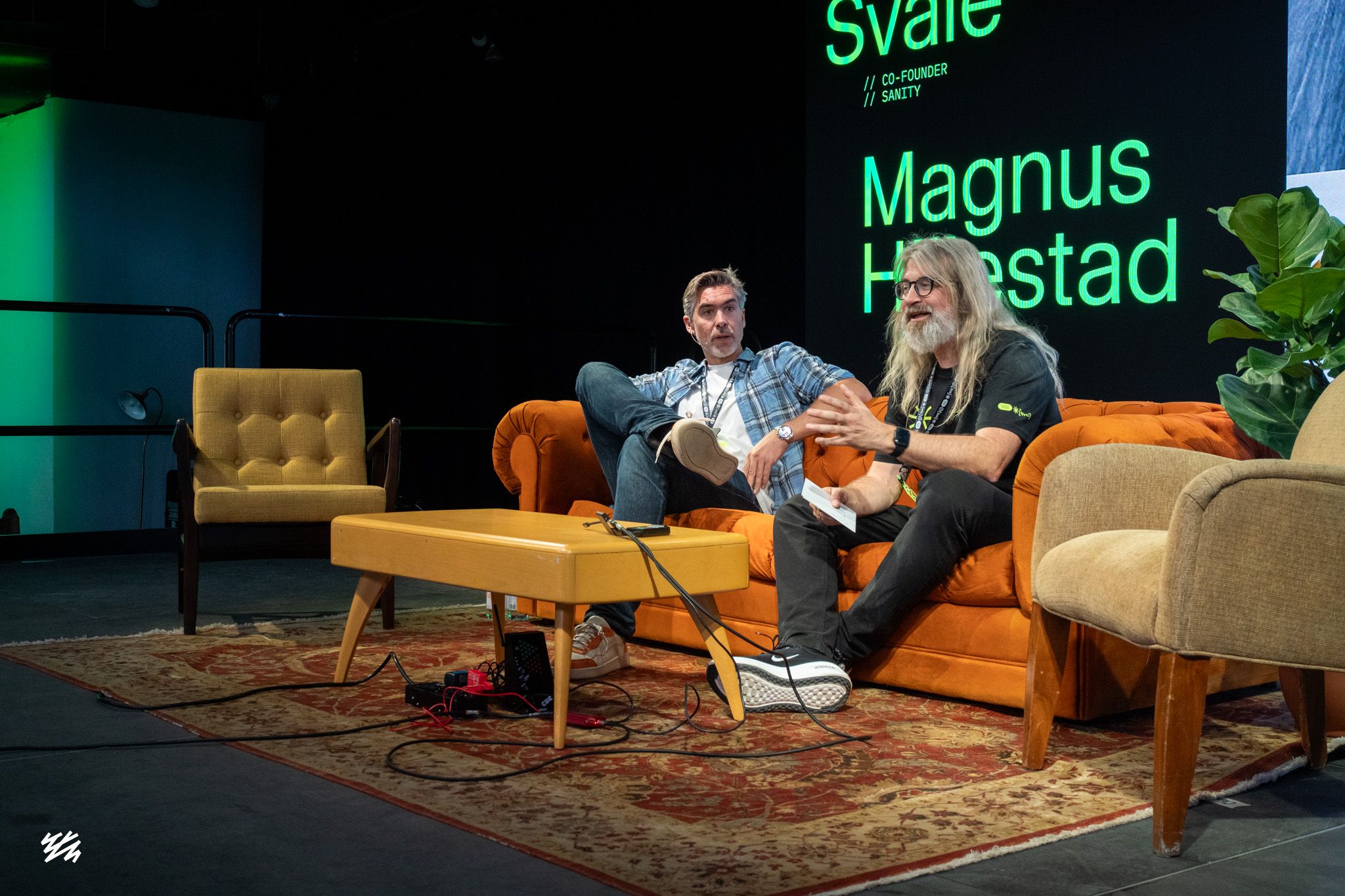
The attic question returns
In May 2025, Sanity announced an $85 million Series C led by Bullhound Capital alongside the launch of its Content Operating System. Hillestad's announcement recalled the founders' first summit at a budget hotel in San Rafael and long walks along the Pacific. Their discussion had concerned the limits of existing content systems and the company they wanted to build.
Financing led by Bullhound Capital, announced alongside Sanity's Content Operating System.
By 2026, his writing had returned explicitly to artificial intelligence, the subject that helped pull him out of finance. His concern was practical: agents need dependable information about a business before they can act on its behalf. Giving software more documents does not automatically resolve contradictions among them. A fast answer to an outdated policy remains an outdated answer.
In October, he separated agent context into five layers: canon, records, process, situation and memory. The categories distinguish what a business approves as true from what has happened, what an agent may do, what is happening now and what has been learned. The underlying issue is responsibility. Someone still has to decide which version of the company's knowledge deserves to be repeated.
At a 2026 conference, he also explored the limits of treating agents as digital employees, drawing on the industrial revolution to examine how new tools change the organization of work. His examples included an AI analysis of Sanity's self-service pipeline and agents that became stuck planning a feature. The technology could be useful and exasperating within the same week. Anyone who has managed a project may recognize the atmosphere.
Hillestad's story has an appealing circularity. He began by refusing to accept a black-box explanation. He is now building a business around making information explicit enough for people and machines to use. The scale has changed. The useful habit remains: when an explanation leaves too much hidden, go and find out how the thing works.