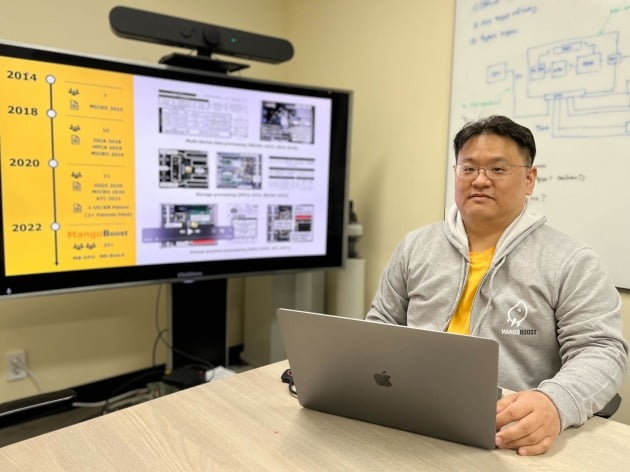
In a photograph from 2022, Jangwoo Kim sits behind an open laptop. Beside him, a screen carries a timeline: 2014, 2018, 2020, 2022. At its end is MangoBoost. The whiteboard behind him is covered with diagrams. A company has arrived in the room, but the room still looks very much like a laboratory.
It is a useful place to begin. Kim’s startup did not begin with a newly discovered enthusiasm for artificial intelligence. It came out of accumulated work on computer systems, and a desire to put that work somewhere people could use it. Academic results had earned attention within his field. He wanted to give them a life beyond the conference hall.
There is an appealing impatience in that decision. Publishing a result settles one kind of question. Selling something built from it opens several more. Will it fit the customer’s equipment? Will the software cooperate? Will it still look clever when somebody has to operate it on a Tuesday afternoon?
The people who came along
When students heard Kim was starting a business, some wanted to join. They came from Seoul National University and POSTECH, the two institutions where he had taught. The professor was proposing a different destination for work they already understood. Their relationship had been formed through research before anyone needed a company badge.
Kim described the founding group with a phrase that carries more weight than a recruitment slogan: “talents that I could trust came together.” Trust, in this case, had a practical use. Building a data processing unit requires people who can work across semiconductor design, computer architecture, and software. The awkward questions tend to live where those disciplines meet.
The circle widened beyond his students. Eriko Nurvitadhi brought experience from Intel. Jun-ki Park, who had worked in semiconductor investment at Samsung Ventures, joined after considering MangoBoost as an investment. Usually an investor asks for a seat at the table. Joining the company is a rather more literal interpretation.
These connections help explain the early company better than its funding alone. Kim was assembling a group that could carry a research idea through the less forgiving work of implementation. A laboratory can demonstrate a possibility. A product team has to account for the customer’s particular machine.
“talents that I could trust came together”
Jangwoo Kim, on MangoBoost’s founding team, 2022
Learning to see the whole machine
Kim’s education crossed several layers of computing. He completed electrical engineering at Cornell in 1997, a computer science master’s there in 2001, and his doctorate at Carnegie Mellon in 2008. Hardware and software were both present before he became a founder.
Industry came next. At Sun Microsystems and Oracle, he worked as a CPU/system architect. Then came POSTECH, followed by Seoul National University in 2017. He became a full professor there in 2019. The progression gave him experience of both building computer systems inside a company and investigating them with students.
That background matters because a data center is a collective undertaking. Processors calculate, storage holds information, networks move it, and software organizes the work. The usefulness of one component depends on what the others can deliver. A wonderfully capable machine can spend part of its day waiting for an answer from its neighbor. Anyone who has worked in an office will recognize the arrangement.
Kim’s business centers on those dependencies. A DPU, short for data processing unit, takes on infrastructure tasks such as networking and storage processing. Moving some of that work away from the CPU can leave more capacity for applications. The attraction is to get more useful work from the equipment involved.
Software coordinates the handoffs. A delay between components can hold up the work.
The subject was already part of his teaching before MangoBoost existed. In October 2020, he was scheduled to give an SNU AI Institute colloquium on next-generation computer systems for AI, streamed through YouTube. The title places the current business in a longer professional conversation. For a professor, explaining an architecture means making its assumptions visible to other people. Commercializing it adds another audience: people who need to decide whether changing their systems is worth the effort, expense, and disruption.
The chip with a software habit
At the company’s beginning, Kim called its DPU “very innovative, but practical.” That last word supplies a useful test for everything else. His launch announcement emphasized complete software support and deployment into existing server infrastructure. The ambition included meeting customers where their machines already were.
The distinction shows up in how he talked about staffing. In an early interview, Kim described systems and software as roughly three quarters of MangoBoost’s technical workforce, with semiconductor design accounting for the other quarter. These were his figures for that early team, rather than a permanent recipe. Still, they show where he believed much of the work belonged.
A chip can arrive in a small package; making it useful can be a much larger assignment. Drivers, services, compatibility, and system behavior surround the physical device. Kim was making a case for treating those surrounding responsibilities as central to the business. His company’s later expansion into software and complete systems follows that original line of thought.
He entered a field where Nvidia, AMD, Intel, and other established technology companies were already active. That puts a particular burden on a startup’s argument. Technical novelty needs to become a reason to choose a product. An infrastructure customer has equipment, applications, and operating habits. The new arrival has to earn its place among them.
When the numbers leave the lab
Money gave the team room to attempt the transition. MangoBoost’s 2023 Series A raised $55 million, led by IMM Investment and Shinhan Venture Investment. The company said it would use the funds to develop its DPU hardware and related products. Research could now be pursued through a business with a larger development budget.
A different kind of reinforcement arrived in May 2024. Carnegie Mellon invested, and professor James Hoe joined as a full-time fellow. Kim had worked closely with Hoe during his doctoral studies. The connection between university and company had become a working relationship again, this time around commercial infrastructure.
The numbers that matter to the technical argument concern what systems can actually do. In MLPerf Training v5.0 in 2025, MangoBoost submitted results using AMD Instinct MI300X GPUs. For the Llama 2-70B-LoRA fine-tuning workload, its single-node configuration took 29.6 minutes. A two-node, 16-GPU configuration took 16.32 minutes; four nodes and 32 GPUs took 10.92 minutes.
More machines. Less elapsed time.
Those results put a concrete example beside the systems thesis. Distributing a task creates work for the connections between machines as well as for the processors themselves. More hardware introduces more coordination. The result depends on how well the whole arrangement handles both.
The figures also deserve their proper boundaries. They describe specific configurations on a defined benchmark. They do not establish that every application gets the same improvement, or that a single component deserves all the credit. For Kim, the useful point is that the company can bring its integration argument to a measured workload.
The customer wants an answer
By 2026, Kim’s pitch had widened. MangoBoost’s offering included BoostX DPUs, LLMBoost software, Alphonso GPU servers, and Kesar storage. The company was bringing together several of the pieces that its original architectural argument had insisted belonged in the same conversation.
On October 12, he introduced Mango Inference, a serverless AI inference platform. Inference is the running of a trained model to produce an answer. For the customer, a service can remove the need to assemble and manage the underlying infrastructure. For the supplier, it creates a continuing obligation to make that infrastructure work.
Kim described a shift from research and development toward business execution. He also outlined plans to build between one and five megawatts of AI infrastructure in Korea across 2026 and 2027, then expand overseas. These were plans, with the work still ahead. He was pursuing Series B funding with a year-end target for completion.
The move brings his founding ambition into a more demanding setting. Demonstrating efficiency in a product is one challenge. Operating a service places the company closer to the customer’s daily experience. Requests keep arriving. Costs accumulate. A system’s virtues have to survive repetition.
Recognition has followed the commercial work. In March 2026, Kim was selected for the National Academy of Engineering of Korea’s inaugural New Frontier Award. The award adds a public marker to a career that now spans academic and industrial settings. It also brings the story back to his reason for starting: he wanted the research to travel. A prize can recognize that passage. The service business supplies a continuing test of how far the underlying ideas can go.
Back to the whiteboard
Kim has kept his academic role alongside the company. That makes the photograph from 2022 feel less like a departure scene than a change of address for an idea. The laptop, the research timeline, and the diagrams belong to a career in which teaching, architecture, and business now overlap.
The personal thread is unusually clear. He wanted his research used. Students and colleagues helped him attempt it. Industry specialists joined. Former academic connections became company connections. Each step increased the number of people, machines, and obligations that had to work together.
Now the founder who began by selling a way to move data is moving closer to selling the finished answer. The question has followed him from the laboratory into the data center: how much useful work can the whole machine do? The next answer will have to satisfy the person paying to run it.