The company quietly rewiring the AI factory.
Walk into a hyperscale data center in 2026 and the noise is not the part that breaks you. It is the heat. Racks of GPUs glow with effort, copper traces between them hot enough to deserve their own zip code. Most of the electricity in the building is not doing math. It is moving numbers from one chip to another. Engineers have a name for this: the interconnect tax.
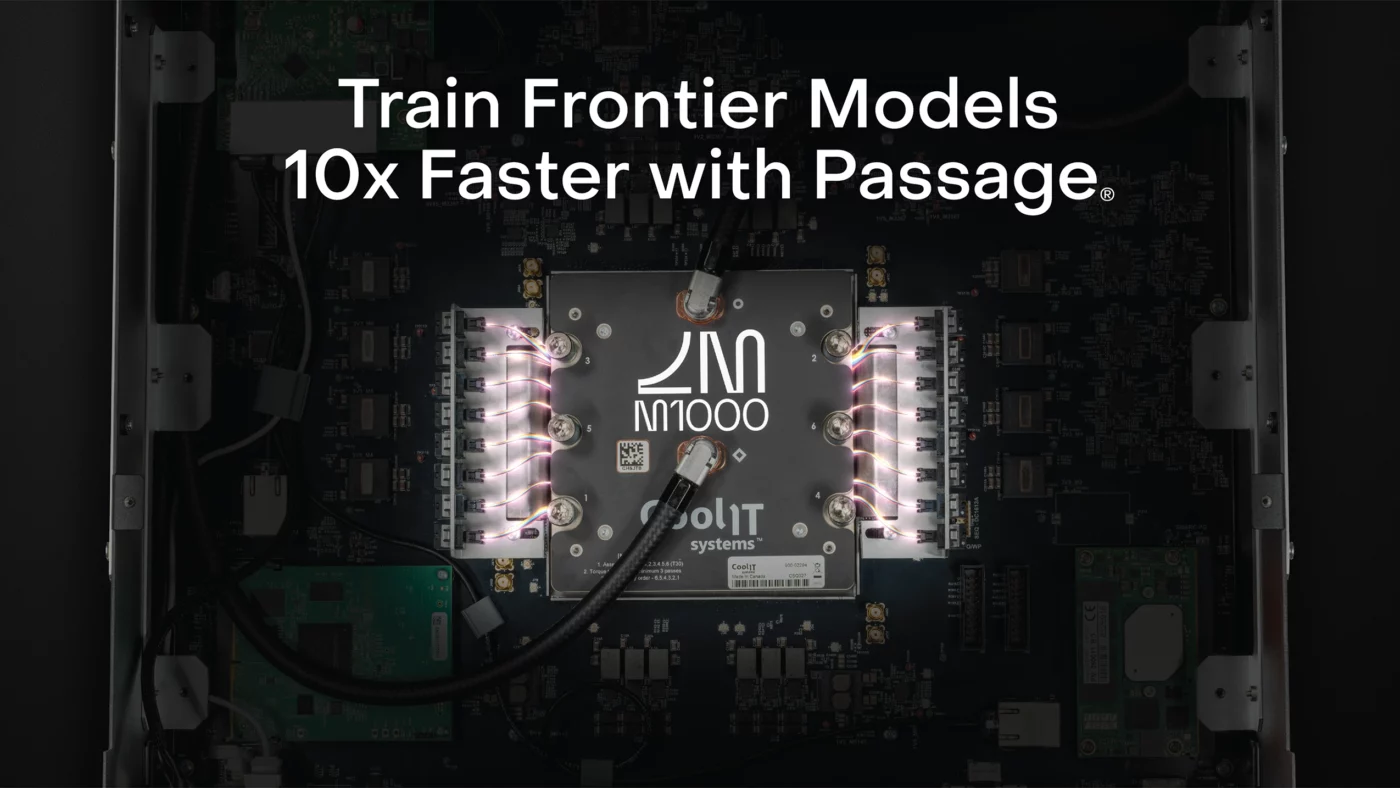
Lightmatter, headquartered on West El Camino in Mountain View, is here to refuse to pay it. The company makes photonic chips - silicon that talks in wavelengths instead of voltages. Its flagship product, Passage, is a wafer-scale optical interconnect that lets thousands of processors gossip at the speed of light. The follow-up, Passage M1000, can shove 114 terabits per second across a single die. That is not a typo and it is not a roadmap. It was announced in 2025.
The interconnect is the computer. Whoever owns that wire owns the next decade of AI.— A thesis you will hear in any Lightmatter pitch, with feeling
Moore's Law kept its promise. The wires didn't.
For thirty years, the chip industry doubled transistor counts on a predictable cadence and most of us learned to expect computing to get faster on schedule. Then somewhere around 2018, the gains stopped feeling generous. Not because silicon stopped scaling - it slowed, but it kept going - but because the wires between chips couldn't keep up. A modern large language model is not one chip thinking hard. It is thousands of chips trying to compare notes fast enough to look like one.
The bottleneck is bandwidth, the energy cost is brutal, and there is a hard physical limit to how fast you can shove electrons down a copper trace. Nick Harris noticed this at MIT, where he was doing his PhD on programmable nanophotonic processors. The lab insight was deceptively simple. Photons do not have a charge. They do not interfere with each other in the same way electrons do. They are also, on the relevant scales, infinitely fast.
If you are still using electricity to move data between chips, you are paying a tax to physics. Lightmatter exists to stop paying it.— Editorializing, but only slightly
Three people, one wafer, a great deal of patience.
In 2017, Harris co-founded Lightmatter with Darius Bunandar, his lab collaborator and now Chief Scientist, and Thomas Graham, who handled the business side. They moved into the kind of dingy Cambridge office that founders love to mythologize later, and they did the thing nobody else was willing to do, which was build a photonics company that intended to ship a real product instead of a paper. This was unfashionable. Photonic computing had been "ten years away" for about thirty years.
Investors paid attention anyway. Spark and Matrix led the seed. Google Ventures came in next. By the time Series B closed in 2021, Hewlett Packard's Pathfinder fund and Lockheed Martin Ventures were on the cap table - which tells you who, exactly, has the most to gain from this working. Lightmatter moved its headquarters to Mountain View in 2023 to be physically closer to the chip and cloud companies it now sells to. It was a small detail. It mattered.
The founders had 87+ patents between them before the first chip ever taped out. The patience is part of the product.— Translated from a slide deck
Milestones, in approximate order
A chip that thinks in wavelengths.
Passage is the headliner. Imagine a silicon wafer that, instead of just doing math, behaves like a programmable optical switchboard. It sits beneath a stack of conventional processors - GPUs, custom AI accelerators, whatever the customer brings - and connects them with light. No SerDes pile-up. No copper bottleneck. Reconfigurable in software.
The newest version, Passage M1000, takes this further with cross-reticle waveguide stitching, multi-wavelength DWDM, and bi-directional optical links. The relevant headline number is 114 Tbps. The relevant subhead is that all of the control circuitry for the photonics lives on the same die, thanks to GlobalFoundries' Fotonix process. Photonics and CMOS, in one piece. That has been the holy grail in this industry for two decades.
Passage
Wafer-scale 3D photonic interconnect for chip-to-chip optical networking.
Passage M1000
3D Photonic Superchip - 114 Tbps optical bandwidth, due summer 2025.
Envise
Photonic AI processor that performs neural-network linear algebra in the optical domain.
Idiom
Compiler and runtime stack that maps standard ML models onto photonic hardware.
Numbers do most of the arguing.
Photonics skeptics have spent a generation rolling their eyes at the field. Lightmatter's defense is mostly arithmetic. The funding story alone is unusual: from an $11M seed to a $4.4B valuation in seven years, with three rounds of insider follow-on along the way. Insiders following on is the second-best signal you can get out of a private market. The best signal is when T. Rowe Price, a public-markets investor, leads a private round - which is what happened in October 2024.
Valuation, in case you missed it
The customer list is, for now, mostly a closed parenthesis. The partners are under NDA, the chip is still in the qualification phase, and commercial shipments are not expected until 2027. But the manufacturing pact with GlobalFoundries is on the record, the SerDes IP partnership with Alphawave Semi is on the record, and the design house behind the brand is Pentagram. (Yes, the brand has its own custom typeface. It is called Inference Sans. Make of that what you will.)
You can either build a faster transistor or you can move the data faster. Lightmatter picked the door fewer people know is there.— Industry analyst, paraphrased
Compute, but for the climate it has to live in.
It is impossible to talk about AI infrastructure in 2026 without talking about electricity. Hyperscalers are negotiating for nuclear power. Data center construction is rate-limited by grid interconnect queues, not by capital. Lightmatter's pitch is not framed primarily in green terms - Harris is a chip guy, not an activist - but the energy implications are not subtle. If you can move a bit between chips using a photon instead of an electron, you save energy and you reduce heat. At hyperscale, both numbers compound.
Harris holds 87+ patents and is an Optica Fellow. The list reads like a photonics syllabus.
Pentagram designed the identity. The "L" and "M" are hidden inside a single monogram - you cannot unsee it.
The company moved from Boston to Mountain View in 2023. Customers were here. Coffee was better.
Photonic computing has been "ten years away" since 1995. Lightmatter is the company betting the third decade is the one that lands.
The interconnect is the computer.
If Lightmatter is right, the data centers built between now and 2030 will look very different from the ones built between 2020 and 2025. Less copper. Less heat. More fiber than any building has ever contained. Models that today are split across thousands of GPUs may run, eventually, on optical fabrics that treat the whole rack as one machine. That is a long way from where the company is today, which is in qualification with a few extremely careful customers. But the trajectory is unusually clear.
Photonics is not magic and it is not finished. Yields on wafer-scale photonic chips are tricky. Laser integration is hard. Thermal stability is a known problem. None of these are mysteries to Lightmatter's engineers. The bet is that the team that has been quietly solving them for nine years is the team that will be holding the patents in 2030.
So: back to the data center. The racks still hum. The GPUs still glow. But somewhere in the middle of one of them - in a partner site, in a part of the building you would not be invited to see - a Lightmatter Passage chip is shuffling data between accelerators with light. The interconnect tax just got cheaper. The math just got bigger. The company that picked the unfashionable door is, very slowly, walking through it.