Elias Almqvist wanted to be an inventor. The job title arrived before the business vocabulary. Years later, when he had learned the word “founder,” the distance between the two occupations seemed small. Both meant making something that did not yet exist, then persuading the world to let it through the door. One title happens to involve more meetings.
His father introduced him to computers when he was about eight. At nine, he had a computer of his own. He grew up in Eklanda, near Gothenburg, and remembers a quiet, middle-class childhood in which his appetite for technology sometimes put him out of step with other children. Programming and building things gave that appetite somewhere to go.
There were lasting friendships, too. His recollection of being an outsider comes with affection for the friends who stayed. It is a useful detail in a founder’s origin story: a person can want to leave a place without wishing to erase everyone in it.
Today he runs Zettascale Computing Corporation. The scale has changed. The original impulse remains easy to recognise: find an interesting problem, learn enough to work on it, and build.
Leaving the syllabus
Almqvist studied computer science and computer engineering at Chalmers University of Technology. His education also included work on aerospace projects; before founding the company, he worked in embedded software. Those are practical strands in a career that is often introduced with the word “dropout.” The word is accurate, but it is a remarkably small suitcase for the things it is expected to carry.
Leaving university tells us where a formal course of study stopped. It says less about what happened to the studying. Almqvist’s technical background crosses software and machines, a useful combination for someone trying to persuade a new kind of processor to do actual work.
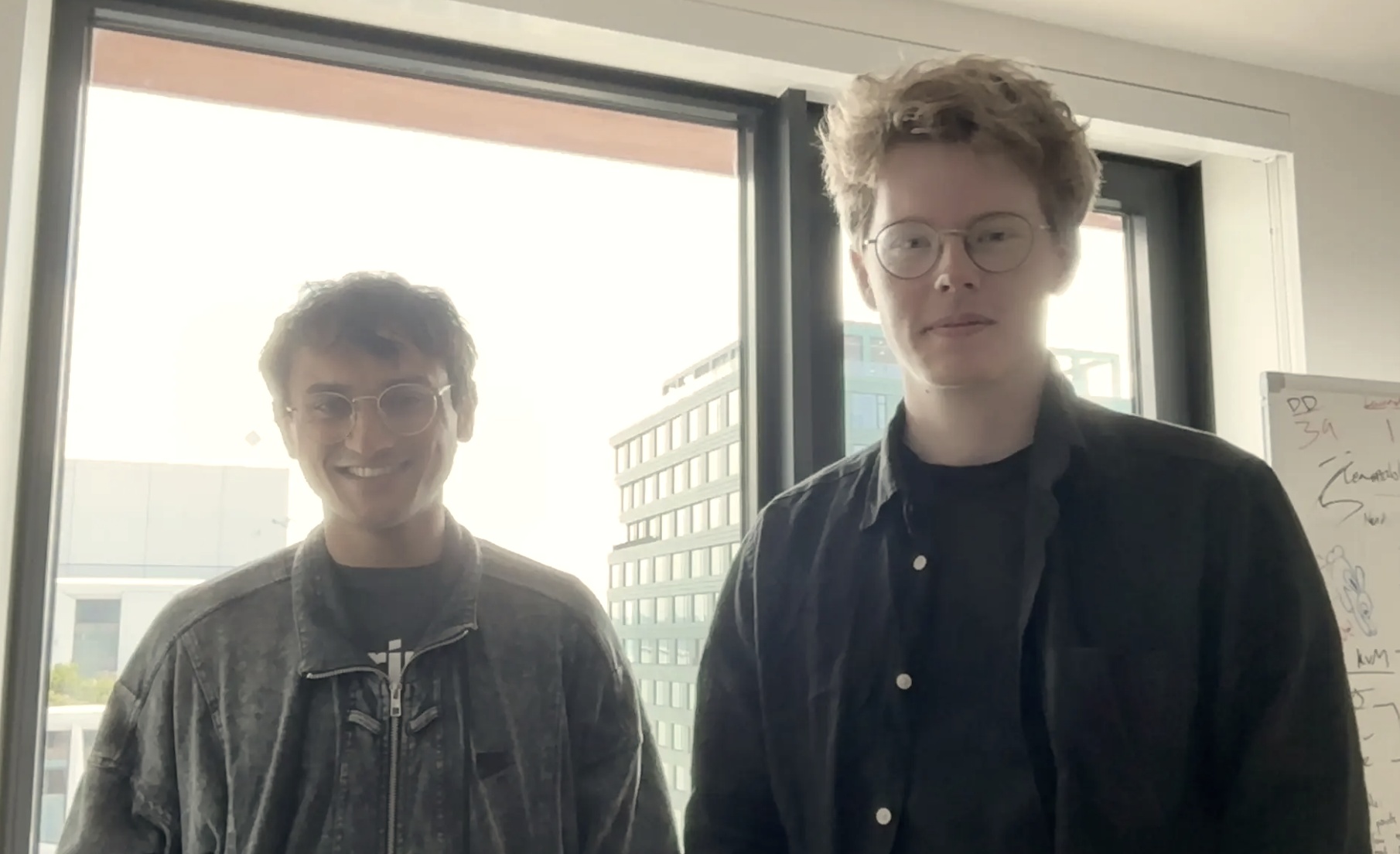
In 2024, he and Prithvi Raj launched Exa Laboratories and joined Y Combinator’s Summer batch. Raj brought an MEng from Cambridge and an interest in scientific machine learning. Their founding proposition was reconfigurable hardware for AI: a processor whose internal dataflow could adapt to different models.
The partnership put two kinds of experience beside the same problem. A model designer wants freedom to experiment. A chip designer must turn that freedom into something that runs. The company’s premise was that these ambitions should be developed together.
An argument with the shape of a chip
The technical question beneath Almqvist’s ambition is deceptively approachable. If AI models change, how much should the machine underneath them be allowed to change? Zettascale calls its approach polymorphic computing. Its XPU is designed to reconfigure dataflow for the model it is executing, rather than require every model to accommodate a single fixed arrangement.
There is a difference between being able to express an idea in software and being able to run it economically. That difference matters to researchers deciding which experiments are worth attempting. A flexible architecture is an invitation to try a wider range of computational shapes. Whether the invitation produces useful results depends on the hardware and the tools around it.
Almqvist has taken that argument into public conversation. In a Deeptech Decoded interview, he challenged assumptions about NVIDIA’s position, the route from language models to more general intelligence, and the capital required to build hardware. These are his positions, rather than settled verdicts on an industry.
The value of the argument is that it can eventually be tested. An architecture must execute a workload. An efficiency claim must survive a measurement. A founder can be articulate for an hour; a machine must keep answering after the interview ends.
The notebook stays open
Away from the company’s product pages, Almqvist maintains wych.dev, a personal site he describes as a digital notebook. He identifies himself there as an autodidactic polymath, a university dropout and a founder. He also says he is originally from Mölndal, Sweden, and is now based in Silicon Valley.
The notebook contains philosophical essays alongside his professional identity. Their titles include “Manipulation of Causalities” and “VERITA DE VERITAS.” He presents the writing as a way to reflect, and cautions readers against treating it as a comprehensive guide to his beliefs. That is a sensible instruction for any notebook, especially one with a search bar.
His public GitHub profile offers another register. Its short description is “i make stuff compute.” The repository collection includes configuration files for his Unix installations, and the code for his personal website is public. The expansive ambition of a company building AI hardware sits alongside the ordinary business of maintaining one’s own computing environment.
These details make the self-taught label more concrete. There is a public place for thinking and a public place for code. Neither is a complete portrait, but together they show how he chooses to present the work: as something to write about, inspect and keep changing.
“i make stuff compute”Elias Almqvist · GitHub bio
A thousandfold change of name
On September 4, 2025, Exa Laboratories announced that it had become Zettascale Computing Corporation. The explanation was unusually mathematical for a rebrand. Internal breakthroughs, the company said, had made exascale an insufficiently ambitious goal. It wanted to make zettascale computing sustainable.
The prefixes carry the joke. Exa denotes 10¹⁸; zetta denotes 10²¹. The new name points to a thousandfold larger order of magnitude. It describes an ambition, rather than a delivered machine operating at that scale. A company name can be a destination without being a receipt.
The announcement also said the company had raised a seed round in September 2024, described as a couple of million dollars. It closed with “Back to building.” The current team page names Y Combinator, Soma Capital and Olive Tree Capital among its backers.
Even the mechanics of the name change have a programmer’s flavour. The announcement includes a new public PGP key and a signed version of the message. Changing a corporate identity is usually a matter for stationery. Here it also meant attending to the machinery that lets a message prove where it came from.
The year the work acquired a workbench
Almqvist’s account of 2025 was a compact list of reported milestones: chip design, a fabrication partnership, prototype Grasshopper cards, an assembly line at headquarters, and initial prototype shipments. He also reported hiring the first two founding engineers and said one had declined an NVIDIA offer to join.
Those statements describe the company’s own progress report. They are useful as a record of what Almqvist chose to emphasise: people, manufacturing, tools and working hardware. The year-end list has the texture of an engineer emptying a pocket full of parts onto the table.
He also made a product teaser. In a comment on the post, Raj credited Almqvist with creating and editing the video himself. It is a small example of the range of tasks that can collect around a young company’s chief executive. Sometimes the person discussing a chip roadmap is also the person making the film about it.
The current team description says Zettascale works in person in San Francisco and intends to remain small. Its advertised values include intellectual honesty, speed and ownership. Such words acquire meaning through everyday decisions: who joins, which experiment runs next, and what earns another week of work.
Grasshopper takes its first hop
On October 7, 2026, Zettascale announced XPU Grasshopper and opened development-kit pre-orders. The name refers to SpaceX’s Grasshopper test rocket. The analogy is about an early machine used to learn, before the larger machine arrives.
The company reports that its FPGA implementation ran the Gemma 3 1B instruction-tuned model at 51 tokens per second on October 2. It describes a development loop in which engineers set the architecture and targets while AI agents proposed, built and tested changes to hardware and software. These are company-reported measurements.
The announcement gives this phase of Almqvist’s story a particular twist. The hardware intended to run AI is being developed with AI participating in the engineering loop. The company treats successful measured changes as the starting point for subsequent work. It is an experimental process with a scoreboard, rather than a claim that machines have taken over the whole job.
The product currently offered is an FPGA prototype development kit, with shipping scheduled for February 2027. Its purpose is experimentation on the architecture ahead of production silicon. That distinction matters: a board on which developers can build is one milestone; a deployed production processor is another.
Scheduled shipping for the Grasshopper FPGA development kit.
What counts as a possibility?
The early Exa launch attracted attention with a claim of up to 27.6 times the H100’s efficiency. That figure came from early simulations. It belongs to a different stage of evidence from the newer FPGA results, and it should be read that way. Ambition is allowed to be large. Its units still need labels.
Grasshopper’s development kit offers an open-source software stack and a limited first edition of 100 numbered boards. The roadmap then points toward cluster access, Gen 1 silicon and Monolith, a proposed computer connecting multiple XPUs into one machine. These remain steps in the company’s plan, each with its own work attached.
For Almqvist, the destination reaches beyond the familiar applications of AI. He frames the company’s purpose around scientific discovery and expanding humanity’s understanding of the universe. It is a large aspiration, but its next expression is quite physical: a board, a software interface, a model running through it.
The boy who wanted to be an inventor now has a company name, a co-founding history, backers, colleagues and a development kit to offer. The interesting part of his story is what those things let him attempt. A computer arrived at nine. Years later, the question has become how to build the computers that leave more room for the next idea.
Keep the notebook open
Profiles, conversations & further reading