In January 2025, Daniel Pearson gave himself permission to be useful in a different way. He had spent eleven years running Bamboo, the growth marketing business he co-founded in 2014. Now its longtime chief operating officer, Aditi, would become CEO. Pearson’s announcement contained several possible futures: advising founders, helping clients, perhaps starting or buying another agency. It also contained something more interesting than a plan. He wanted to get close enough to people’s problems to understand them again.
A founder leaving the daily running of a company can produce an announcement polished until every human fingerprint disappears. Pearson’s was refreshingly practical. There were people he wanted to help and work he enjoyed doing. He called the coming period “explore mode.” By the end of the year, that exploration had a name: Wideframe.
The connection between the two businesses takes a moment to see. Bamboo helped companies grow through advertising. Wideframe helps people work with video. Between them sits an old question in Pearson’s career: when software takes over the fiddly part of a job, what becomes possible for the person doing it?
The ad buyer with a thousand levers
Pearson began as a Facebook ad buyer. In his account of those early days, the work involved thousands of campaigns, divided by audiences and adjusted as results came in. He analyzed combinations, stopped poor performers and moved spending toward better returns. Demand for that expertise encouraged him to build an agency.
By October 2025, he could describe how much of the original work had changed. Targeting, bidding and budgeting had become increasingly automated. The agency’s fee had moved from roughly 15 percent of media spending in 2014 to something nearer 5 percent, he wrote, while its net profit margin remained around 20 percent. Those are Pearson’s figures, describing his business experience rather than a forecast for every agency.
His conclusion was more personal than the familiar argument about machines and employment. He had spent a year learning SQL because deeper questions about campaign data otherwise depended on an analyst’s queue. New tools could remove that wait. The attraction was the chance to ask better questions without first requesting an appointment with the spreadsheet.
“AI took my job and gave me a better one.”Daniel Pearson, October 2025
Six years, and a few forks
In January 2020, approaching Bamboo’s sixth anniversary, Pearson looked back at a business that had gone from zero to managing more than $100 million in annual advertising budget. He described its development as a series of time-sensitive choices. Sometimes the team chose its direction deliberately. Sometimes the passage of time effectively chose for them.
He gave himself neither the omniscience nor the inevitability that founders sometimes acquire in retrospect. More experienced people might have seen the choices more clearly, he suggested. His hope for the next six years was to improve his ability to help determine the direction. There is an appealing lack of theatre in this account. A fork in the road does not become less consequential because you noticed it a little late.
The scale eventually grew much larger. Pearson’s founder biography reports more than $1 billion in growth budget managed for clients including Uber, DoorDash and Dropbox, alongside more than 175 others. That number describes money managed for clients. It is a measure of operating exposure, and should be read that way.
Growth budget managed for clients, as reported in Pearson’s founder biography.
Being responsible for advertising spending offers a particular view of creativity. A video must become an asset someone can use, test and learn from. The clever idea and the unglamorous process share a deadline. An agency operator gets to see both, including the considerable amount of work that happens before anyone can judge the finished thing.
The stamp bill
Pearson’s curiosity has occasionally taken a more literal route. In a 2022 podcast appearance, he recounted sending Warren Buffett more than fifty letters. Buffett eventually replied with a request that Pearson pay for two postage stamps. As encounters with celebrated investors go, it has an unusually modest transaction value.
The same conversation ranged across agency support, internal teams and why Pearson avoided calling his team a family. By then, Bamboo was described as having seventy team members and approaching its eighth anniversary. The topics were the everyday problems of building an organization: how people work together, how a company allocates expertise and how the customer gets value.
The letters make a useful companion to the billion-dollar budget figure. One suggests an operator accustomed to substantial commercial responsibility; the other gives the story a slightly comic scale. A persistent correspondent finally gets a response, and the response concerns postage. Business has a talent for returning grand ambitions to small invoices.
A room where people can ask
Another strand of Pearson’s work began with a few friends helping one another solve growth marketing problems in Slack. In a later account, he described founding the community ten years earlier and seeing it grow to 4,500 people. The starting idea was straightforward: make it easier to get an answer from someone who had encountered the problem before.
When he introduced the Efficient Growth Advisory Board, he named advisors including Seth Berman, Holly Chen, Joshua Kim and Sigal Bareket. He described a networked approach in which advisors could cover one another’s blind spots. The premise was an admission rather than a credential: running growth can be lonely, and nobody knows everything.
His writing about bringing paid media in-house carries a related argument. In 2023, he urged companies to retain access to outside perspectives and make transitions in stages. Bringing one channel inside, or retaining external help for particular functions, could be a sensible arrangement. The question deserved more care than choosing a side and printing it on a badge.
That willingness to mix resources helps explain the route to Wideframe. Pearson had spent years thinking about who should do which piece of work. A software assistant extends that question into a new setting, where people can preserve responsibility for the finished result while changing how they prepare it.
Two friends, one kitchen, a new brief
Wideframe’s founding story includes a photograph of Pearson and Zachary Kim making pasta in Rome between Claude Code sessions. It is a useful antidote to the standard startup origin photograph, in which everybody appears to have been assembled by a recruitment agency. These two have aprons.
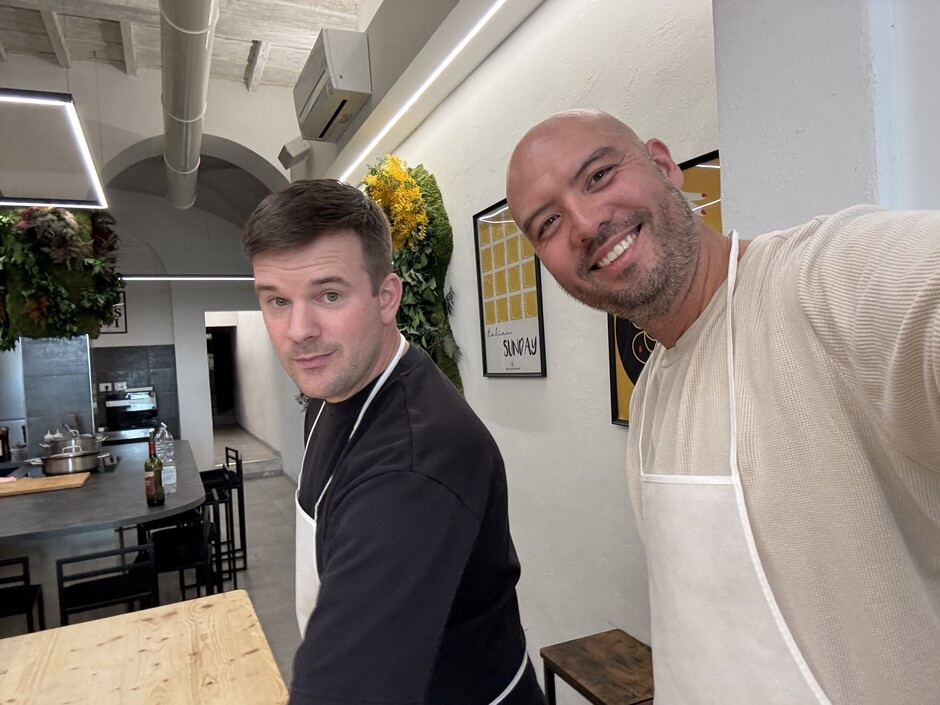
The founders describe themselves as former coworkers and close friends of fifteen years. Their growing interest in coding agents during 2025 eventually became a commitment to apply the technology to video work. The friendship had a professional history, too: Pearson’s public recommendation of Kim recalls working with him at Zaarly and praises both his engineering ability and his willingness to help colleagues.
Long acquaintance gives this partnership a texture that a list of job titles cannot supply. Pearson already knew Kim as someone who could work through technical problems and make himself useful across a company. The new business joined that experience to Pearson’s knowledge of growth marketing and the creative work it requires.
Wideframe was founded in 2025 and joined Y Combinator’s Winter 2026 batch. For Pearson, the move brought him back into the daily work of building a company, this time around a task familiar from the production of video ads: getting footage ready for an editor.
Before the first cut
A folder of footage can contain everything needed to make a video and still be a long way from something an editor can use. Clips need searching, labeling and arranging. Interviews need reviewing. A brief has to become a workable sequence. The romance of editing tends to begin after much of this has happened.
Wideframe’s current pitch is an AI assistant editor that lives on a Mac. Users describe what they need in ordinary language, and the software searches footage and prepares a Premiere Pro project. The company presents the handoff as central to the workflow: the editor receives material ready for further creative decisions in a familiar editing application.
Its launch video follows a shoot through that preparation process, showing the work of linking and organizing footage before the editor finishes the sequence. The emphasis is on giving creative workers more room for the details of their craft. That is a recognizably agency-shaped concern: deadlines can swallow the hours in which a piece of work becomes better.
- LinkBring the footage into reach
- PrepareSearch, organize and assemble
- EditContinue in Premiere Pro
On Product Hunt, Pearson described users ranging from advertising creatives to documentary makers. He also acknowledged the changing model landscape, naming Anthropic and Gemini among the tools the agent uses. For a founder, that creates an ongoing practical obligation: the models may change, but the editor still needs a project that opens and work that makes sense.
The customer gets the leading role
In January 2024, Pearson wrote that he was interested in AI applications that simply worked. He compared them with the mobile era: people cared about getting an Uber, rather than the fact that Uber was an app. The technology mattered because of the experience it made possible.
By October 2025, his analysis of Anthropic’s “Keep thinking” campaign made a similar point about storytelling. He admired the way it put the customer in the leading role and the product in a supporting one. A useful tool helps someone carry out an ambition; its advertising should remember whose ambition it is.
That perspective brings his career into focus. The ad buyer learned to move spending toward results. The agency founder learned to arrange people and resources around client work. The community organizer made it easier to borrow another person’s knowledge. At Wideframe, Pearson is building another form of assistance, this time for the pile of footage waiting before the edit.
The next chapter depends on whether editors find that assistance useful in their own working days. Pearson has spent much of his career near that kind of verdict. A promised saving eventually meets a deadline, a brief and a person who has to deliver. There is plenty of ambition in that encounter. There is also a pleasingly concrete place to begin: help somebody get on with the work.