Manil Lakabi once brought the future of work into his apartment. Manus AI was there, along with builders from OpenAI, LangChain, Replit, Browser Use, and other companies working on agents. He later described the gathering with the enthusiasm of a host who had enjoyed both the demonstration and the company. An industry debating what software might do by itself had, for an evening, assembled in somebody’s home.
It is a useful place to begin with Lakabi. His current ambition concerns how much a single person might accomplish. His working life, meanwhile, has involved teams, a cofounder, research collaborators, and people willing to turn up for a conversation. The future may contain smaller companies. It apparently still needs somewhere to meet.
Today, Lakabi is the CEO and founder of x1, a San Francisco company building an AI tool for native iPhone apps. Before that came generative-AI operations at Scale AI, work on Meta’s FRL team, and Foundry, which he cofounded with Pranav Raja. Across those chapters, an interesting question keeps appearing: what happens when a convincing piece of software has to do a complete job?
An apartment with a view of the future
Lakabi’s account of the Manus gathering included builders from All Hands AI, Fireworks AI, E2B, and Yutori. He thanked Abundant and Monica Xie for helping make it happen. He was impressed by the agent’s demonstrations and anticipated substantial changes in the tasks people would delegate to autonomous software.
The post offers a small, concrete glimpse of him away from a company description. He hosted. He noticed what people were building. He thanked the organizers. He wanted another gathering. Those details give the scene its shape without requiring invented dialogue, an imaginary dinner menu, or a suspiciously cinematic account of the lighting.
His enthusiasm had an earlier expression. As Y Combinator’s Fall 2024 program drew to a close, Lakabi described Foundry’s vision of organizations with fewer humans and many agents. He even entertained the possibility of a company reaching unicorn status with one employee. It was a prediction about what might become possible, and a revealing statement of what interested him.
“a handful of humans, a fleet of AI agents”
Manil Lakabi, reflecting on YC Fall 2024
The apartment gathering and the company ambition sit comfortably together. Both concern people exchanging ideas about what agents can take on. One is social, the other organizational. Reading them together suggests a founder interested in expanding what builders can accomplish, while remaining very much among builders himself.
Before the agents, the data
There is an older, less theatrical chapter on Lakabi’s professional profile: machine-learning projects. In December 2018, he listed a project using news headlines to predict stock-market movement. Another examined used-car characteristics to classify a vehicle’s condition. The tools included Python, statistical analysis, and several classification methods.
These are modest details beside the language of autonomous companies, but they are useful ones. They place practical experiments with data in the record years before x1. A news headline becomes an input. Vehicle attributes become features. A result has to be evaluated. Even in a student-scale project, a model eventually encounters the impolite question of whether its answer is any good.
His professional history includes Meta and Scale AI. At Meta, he worked on the FRL team. At Scale, his work involved generative AI and large-scale language-data projects. That background puts him close to the operational work behind AI systems: the organized effort that helps turn research and models into something other people can use.
His wider career also includes product work at Slash and an earlier founder chapter at Buzzer. A public testimonial for designer Jan at HappyDesign identifies Lakabi as Buzzer’s founder and praises the designer’s attention to the product. It is a small reminder that his entrepreneurial history includes asking another person to help make something better.
An agent has to survive the browser
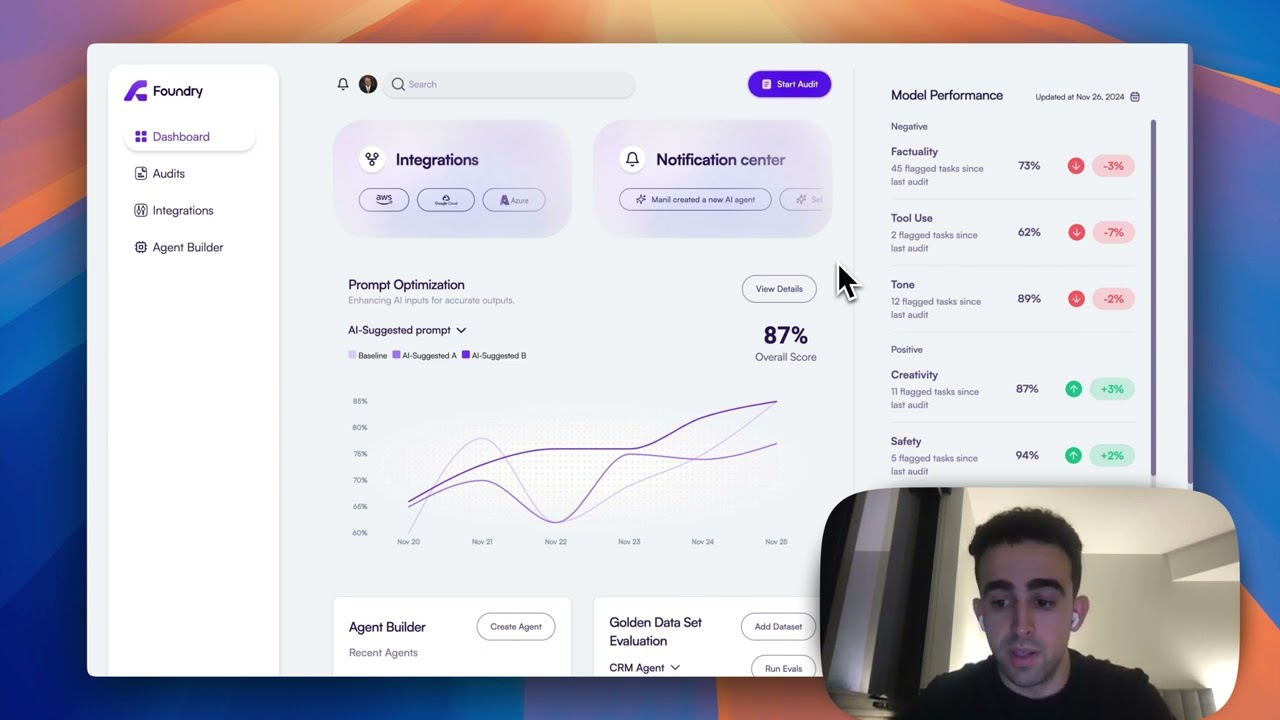
At Foundry, Lakabi worked with Pranav Raja, whose background also included Scale AI. The company offered tools to build, evaluate, and improve agents. Its early pitch addressed an awkward business problem: deploying an agent is easier to celebrate than establishing whether it reliably completes the work assigned to it.
An agent’s response can sound reasonable while a workflow goes wrong. Foundry’s product description covered evaluation of accuracy, relevance, task completion, and code execution. It also described ways to improve existing agents. The practical emphasis was on inspecting performance and doing something about weaknesses, rather than assuming that a successful demonstration settled the matter.
Lakabi’s hiring posts made the infrastructure concerns more concrete. He sought engineers interested in web automation, distributed storage, data pipelines, and simulated web interactions. Another post called for machine-learning work around deterministic simulations, annotation, benchmarks, and reinforcement-learning environments. The browser was becoming a place where agents needed training grounds.
That recruiting language matters because it names the troublesome details. Web pages change. Sessions have state. A test can be disrupted by the environment it uses. For a company trying to evaluate browser agents, controlling those conditions becomes part of the product. The apparently mundane machinery is where repeatable experiments get their footing.
In September 2025, Lakabi appeared among seven authors of SDRBench, a benchmark and reinforcement-learning environment for sales-development workflows. Its tasks crossed applications rather than staying inside a single site. A record encountered in one place had to remain consistent with the work performed elsewhere. Keeping the relationships straight was part of the challenge.
across enterprise workflows
The suite contained 45 small-to-medium-horizon tasks and five longer ones. The numerical split is straightforward; the underlying concern is richer. Work can go wrong because an agent loses track of an entity, misaligns a record, or carries an earlier mistake into a later step. A benchmark makes those demands explicit enough to examine.
There is a useful continuity here, though the products differ. Foundry’s work asks whether an agent can complete connected actions. An app builder faces connected decisions. In both cases, the attractive first result leaves a longer sequence to manage. That connection is a way to read Lakabi’s career, rather than a claim that every chapter followed a predetermined plan.
The app after the applause
x1 brings that concern to people who want to make iPhone apps. The company guides builders through planning, visual design, development, and preparation for publication. Its current Y Combinator profile lists Lakabi as founder and CEO, with David Lieb as the company’s primary partner and Fall 2024 as its batch.
The chronology deserves care. Contemporary material from that batch describes Foundry and agent evaluation. The present company profile describes x1 and app creation. Reading the earlier chapter alongside the current one preserves the actual change in emphasis. A founder’s story becomes more interesting when the work is allowed to develop.
In June 2026, Lakabi published an explanation of x1’s five-stage methodology: Plan, Design, Build, Launch, and Iterate. It describes a sequence for producing native iOS apps in Swift and Xcode. The approach makes room for decisions before development and for continued changes after release. An idea has several stops before it becomes a product.
That sequence has a deliberately ordinary vocabulary. Planning, designing, building, launching, and revising were already recognizable pieces of software work. Putting AI inside them leaves a builder with a familiar set of questions: what should this do, how should it behave, and what needs to happen before someone else can use it?
There is also a teaching element in x1’s description of its work. The tool explains how the pieces fit as features are built. For someone entering software through AI, that matters: an output is easier to judge when the builder understands what has been produced. A company built around an individual needs to make that individual more capable of directing the work. Otherwise, the smaller headcount simply leaves one person with a larger collection of mysteries.
One chair, plenty of decisions
A month earlier, in May 2026, Lakabi wrote about enabling the one-person unicorn. The essay argues that AI changes the relationship between the size of a software product and the number of people needed to build it. His ambition is a system that helps a founder carry an app through development and into a continuing business.
The phrase is provocative. It puts a very large valuation beside a very small headcount. Yet the useful question beneath it is practical: how much can one person coordinate, judge, and maintain? Lakabi’s thesis gives taste, distribution, and product judgment a substantial role. The builder still has decisions to make.
That is where his story remains open. He has worked inside large organizations, cofounded an agent company, contributed to a benchmark, and now leads an app builder. The one-person company is his aspiration. His career so far is full of other people. Perhaps the chair can accommodate a smaller organization. The conversation around it can stay crowded.