Dong-Su Kim’s career contains a useful interruption. After years inside Samsung, with the training of an optical engineer and an introduction to venture investing, he joined a small investment bank. There, the company name could only take him so far. He had to find customers and sell financial services. A person accustomed to examining technology was learning what it took to persuade somebody to pay for something.
That episode gives his later work a different texture. Kim became the founding CEO of LG Technology Ventures in 2018. Today, his work involves startups, industrial companies and the often awkward business of getting them to understand one another. The scientific training remains useful. So does the experience of having a service to sell and a customer who can decline.
In a 2022 interview, he credited firsthand selling with helping him become a successful venture capitalist. The point is refreshingly unglamorous. Venture capital has plenty of vocabulary for opportunity. Kim’s career makes room for the more demanding question: once the invention exists, who will help turn it into a business?
A scientist learns to sell
His education began across borders. His father was a diplomat; childhood included Chile, Ecuador and Panama. He later attended St. Albans in Washington, DC, studied applied physics at Caltech and pursued electrical engineering at Princeton. He returned to Korea and joined Samsung in 1997, working on fiber-optic components. When that market collapsed in 2001, he moved toward technology planning and alliances. Later came Asia Evolution in 2008, then a Samsung Ventures role in Silicon Valley in 2009. The sequence brought the laboratory, the sales call and the investment decision into the same career.
His official career record includes responsibility for Samsung Ventures offices in Menlo Park, Boston, London and Tel Aviv. He led investments in more than thirty companies, covering semiconductors, equipment, materials and storage systems. The breadth matters: an investor moving between those fields must be able to ask technical questions without assuming that technical answers settle the commercial ones.
“For a naturally curious person like me, this is a source of great learning.”
Dong-Su Kim, on reviewing startups
There is an appealingly ordinary detail in his account of life outside the office. He learned golf in South America and kept playing. Its frustrations, he said, were sufficient to displace thoughts of work. A game capable of annoying a venture investor into taking a break has found a rather specific market.
The small material behind a large outcome
One of the companies in Kim’s Samsung-era investment record was Inpria, based in Corvallis, Oregon. Its work concerned photoresists, the materials used to create patterns during semiconductor manufacturing. The subject has fewer obvious charms than a new device on a shop counter. Yet the device depends on processes like these. An improvement in an industrial material can travel a long way before a consumer sees the result.
In February 2014, Inpria announced that it had received $4.7 million of a committed $7.3 million financing from investors including Samsung, Intel Capital and Applied Materials. Kim, then a Samsung investment vice president, publicly endorsed its new approach to lithography materials. The funding was intended to expand the team, accelerate development and advance commercialization. Those are three different jobs, even when a promising technology makes them sound like one.
In September 2021, JSR announced an agreement to acquire Inpria at an agreed enterprise value of $514 million. JSR already held a stake and planned to buy the remaining shares. Inpria had been developing metal-based resists since 2007. The distance between those dates gives the outcome some perspective. A materials business can require years of development and industrial adoption before an acquisition announcement makes the patient work look conveniently inevitable.
Kim’s connection to the company makes the story relevant to his own development. Here was a place where technical understanding could help an investor recognize what an industrial customer might eventually need. The outcome also required people to build a company around the material. Even a very good molecule is unlikely to handle its own commercial negotiations.
The financing announcement and the acquisition agreement mark different stages of that process. The first describes resources to develop and commercialize a product. The second describes an established materials company bringing that product into its own operations. Read together, they offer a concrete example of why corporate investors pay attention to industrial fit. The route from research to adoption crosses several organizations. Someone must understand the technology well enough to explain it, and the business well enough to keep the explanation useful.
A blank sheet in Silicon Valley
When LG recruited Kim, the attraction included the opportunity to create a venture organization from the beginning. He wanted a dedicated fund structure. He drew on people he knew through earlier investments to recruit managing directors and emphasized respect for entrepreneurs. Business development would connect the investment team with corporate business units. The design put relationships inside the organization rather than leaving them to be improvised after each deal.
That choice deserves attention because a corporate venture team works across two operating rhythms. A startup has its own product, capital requirements and decisions. A large industrial group has business units, existing operations and reasons to be careful. Simply bringing them into a room does not give them a shared timetable. Building an organization that can keep the conversation moving is part of the investment work.
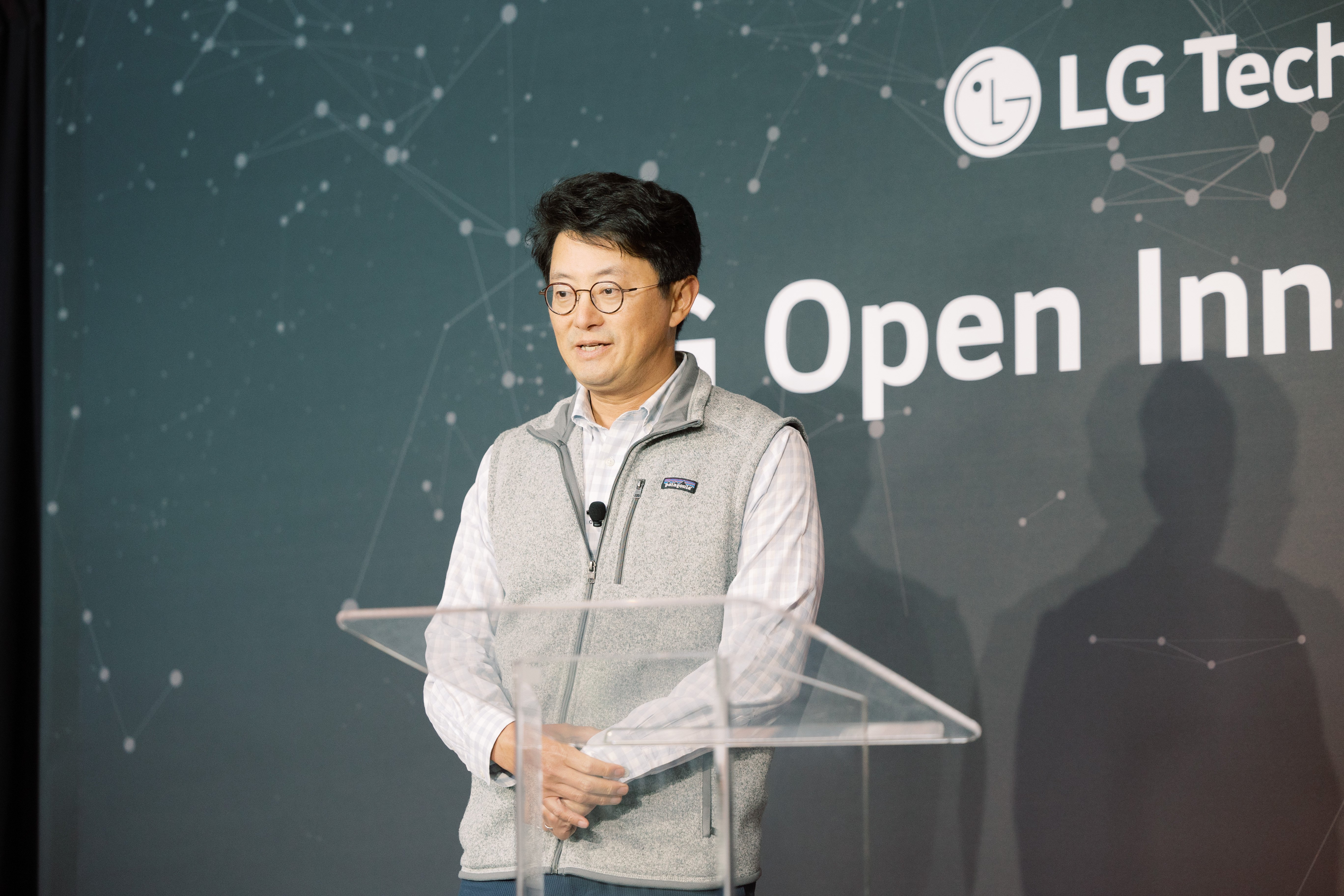
By August 2023, three LG affiliates had committed $192 million to a second fund, following a $480 million first fund. Kim said the organization would continue investing through the industry downturn while promoting connections between portfolio companies and LG businesses. The announcement also covered a separate LG Electronics fund partnership. Keeping the vehicles distinct matters; corporate innovation can involve several organizations with different responsibilities.
The second-fund commitments came from LG Electronics, LG Energy Solution and LG Uplus. Their participation made the venture effort a shared undertaking across operating businesses. For a founder, the useful consequence of such an arrangement depends on what follows: a relevant introduction, a technical discussion, a possible commercial relationship. Capital can begin that work. The fund still needs people who know where to take the conversation.
The company’s current website describes access to LG’s global network alongside its capital. Its portfolio examples include Anthropic, Inworld AI, Figure AI and OTI Lumionics. The last of those works in display materials. A portfolio spanning software and physical technology brings the organization back to the range of questions Kim has encountered since his engineering years.
When a robot becomes a customer
The relationship between industrial capability and a startup becomes especially tangible in robotics. LG Technology Ventures participated in Figure AI’s $675 million Series B round in 2024. A subsequent account described collaboration between Figure AI and LG’s battery division. A robot may be discussed in terms of intelligence, but it also requires power. For a battery business, a developing robotics industry presents potential customers with new requirements.
Kim’s investment interests also include batteries and AI applications. The 2025 account described investments in Anthropic, call-center AI company Cresta and voice-generation company ElevenLabs. It reported a team of twenty-two professionals overseeing fourteen funds at that time. The figures are a dated snapshot of an organization that began with hiring and structural decisions, then acquired the daily obligations of an active portfolio.
In a September 2025 conversation about corporate investing, Kim argued that financial returns and strategic benefits can support one another. He pointed to enterprise AI, the semiconductor infrastructure required by AI and electrification beyond vehicles. He also expressed caution about consumer AI hype and expected consolidation among large language model businesses. His interest in a growing field did not remove the need to distinguish between its opportunities.
That distinction puts execution back into the discussion. A large market can contain companies with very different prospects. An industrial connection may help a startup, but the startup still needs a business that works. Kim’s insistence on financial results keeps that requirement in view. A strategic explanation should be able to survive questions about customers and commercial progress.
The meeting after the meeting
Kim appeared in the 2026 Global Corporate Venturing Powerlist 100. Recognition is one marker of his position in the field. His September 2026 comments are more revealing about how he thinks the work gets done. He described startup potential through a combination of team, technology, market and investors, then returned to a subject running through his career: relationships.
Team02
Technology03
Market04
Investors
In the September 28 interview, he predicted that AI would become so embedded in everyday life that people would cease to notice it. On partnerships, his answer was more immediate. One meeting does not establish a lasting relationship; the follow-up determines what happens next. He suggested further meetings and visits to innovation centers. The calendar, apparently, remains a piece of technology worth understanding.
It is a fitting place to leave this career. Kim has studied devices, sold services, evaluated companies and built an investment organization. Each move added another perspective on the distance between an idea and its use. His present role asks him to work across that distance with founders and established businesses. The interesting moment comes when the introduction is over, the presentation is closed and somebody agrees to continue the work.